Russia slowing down in Kharkiv area after lifting of arms restrictions, says Austin

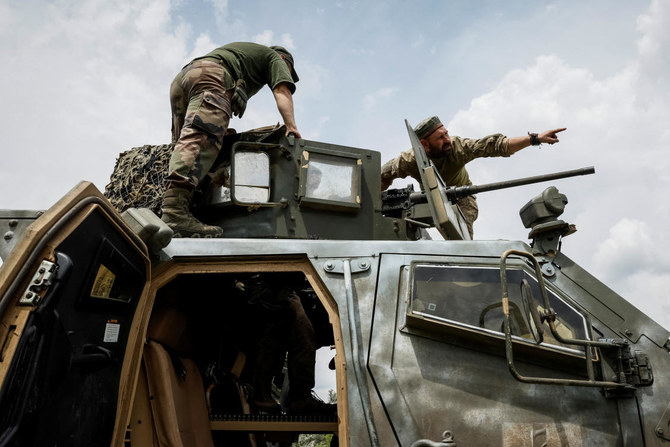
Ukrainian service members of the 33rd Separate Mechanized Brigade teach brother-in-arms to fire a M2 Browning machine gun atop of a Mine Resistant Ambush Protected vehicle Oshkosh M-ATV during a military drill near a frontline in Donetsk on Jun. 12, 2024. (Reuters)
Short Url
Updated 13 June 2024
Follow

Russia slowing down in Kharkiv area after lifting of arms restrictions, says Austin

  • “What I see is a slowing of the Russians’ advance and a stabilizing of that particular piece of the front,” said Austin

BRUSSELS: Russia’s advance in the Kharkiv area is slowing and the frontline is stabilizing after some allies lifted restrictions on Kyiv’s use of donated weapons on Russian territory, US Defense Secretary Lloyd Austin said on Thursday.
“What I see is a slowing of the Russians’ advance and a stabilizing of that particular piece of the front. Now, I think we’ll see incremental gains — and we’ll see puts and takes — going forward,” he told reporters on the sidelines of a NATO defense ministers’ meeting in Brussels.
“But again, a couple of weeks ago, there was concern that we would see a significant breakthrough on the part of the Russians. I don’t think we’ll see that going forward.”


Trump expands travel ban, adding 5 more countries and imposing new limits on others

Updated 6 sec ago
Follow

Trump expands travel ban, adding 5 more countries and imposing new limits on others

  • Nationals from Syria, South Sudan, Burkina Faso, Mali and Niger are banned from visiting the US
  • The White House also fully restricted travel on people with Palestinian-Authority-issued travel documents

WASHINGTON: The Trump administration is expanding its travel ban to include five more countries and impose new limits on others.
This move Tuesday is part of ongoing efforts to tighten US entry standards for travel and immigration. The decision follows the arrest of an Afghan national suspect in the shooting of two National Guard troops over Thanksgiving weekend.
In June, President Donald Trump announced that citizens of 12 countries would be banned from visiting the United States and those from seven others would face restrictions. The decision resurrected a hallmark policy of his first term.
At the time the ban included Afghanistan, Myanmar, Chad, the Republic of Congo, Equatorial Guinea, Eritrea, Haiti, Iran, Libya, Somalia, Sudan and Yemen and heightened restrictions on visitors from Burundi, Cuba, Laos, Sierra Leone, Togo, Turkmenistan and Venezuela.
On Tuesday, the Republican administration announced it was expanding the list of countries whose citizens are banned from entering the US to Burkina Faso, Mali, Niger, South Sudan and Syria. The administration also fully restricted travel on people with Palestinian-Authority-issued travel documents.
An additional 15 countries are also being added to the list of countries facing partial restrictions: Angola, Antigua and Barbuda, Benin, Côte d’Ivoire, Dominica, Gabon, Gambia, Malawi, Mauritania, Nigeria, Senegal, Tanzania, Tonga, Zambia and Zimbabwe.
The Trump administration said in its announcement of the expanded travel ban that many of the countries from which it was restricting travel had “widespread corruption, fraudulent or unreliable civil documents and criminal records” that made it difficult to vet their citizens for travel to the US. It also said some countries had high rates of people overstaying their visas, refused to take back their citizens who the US wished to deport or had a “general lack of stability and government control,” which made vetting difficult.
“The restrictions and limitations imposed by the Proclamation are necessary to prevent the entry of foreign nationals about whom the United States lacks sufficient information to assess the risks they pose, garner cooperation from foreign governments, enforce our immigration laws, and advance other important foreign policy, national security, and counterterrorism objectives,” reads the White House proclamation announcing the changes.
The Afghan man accused of shooting the two National Guard troops near the White House has pleaded not guilty to murder and assault charges.