

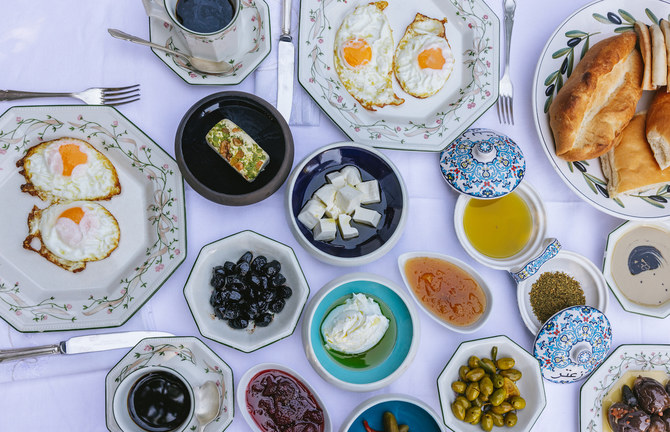

DUBAI: Franco-Palestinian chef Fadi Kattan says the release of his debut cookbook, which pays tribute to Palestinian cuisine, feels “confusing.”
More than eight months have passed since the start of the Israel-Hamas war, and the current catastrophe is something Kattan could never have predicted when he began writing the book two years ago.
However, in the middle of every difficulty lies an opportunity, as they say.

Kattan is based in Bethlehem. (Supplied)
“None of us imagined this horror,” Kattan, who is based in Bethlehem, told Arab News. “On the one hand, I think we need it. People need to see what we are and who we are. We have had enough of this monolithic, dehumanizing image of Palestinians. At the same time, it’s very difficult to be talking about food and celebrating food in this situation.”
The pages of Kattan’s book, “Bethlehem,” reveal a personal portrait through vibrant snapshots of local foods and markets, natural landscapes, Kattan’s family members, and Bethlehem’s culinary community. Designed by Lebanese illustrator Nourie Flayhan, the book cover features warm hues of red and yellow, embellished with a border of patterned embroidery, reportedly native to Bethlehem. It is a love letter to Kattan’s ancient hometown.

Divided into the four seasons of the year, “Bethlehem” features over 60 recipes. (Supplied)
“Bethlehem is called ‘the city’, but in reality it’s a small town,” he said. “It’s a very interesting place. It has a lot of history. The symbolism is very strong because you have (one of) the oldest churches in the world, Church of the Nativity, and opposite it you have the Mosque of Omar. It refers to Omar Ibn Khattab’s pledge to not build mosques in place of churches, but next door. And I think that’s a very strong message of the fact that there’s no coexistence here: We’re all Palestinian. It’s beyond coexistence.”
Despite Bethlehem’s vibrancy, Kattan says his home has been impacted by the Israeli occupation. The settlements and concrete walls give the “feeling that the city is being choked more and more. At the same time, what I see in Bethlehem is the resilience of people and the fact that people are still surviving and are still here, even though a lot of the components of a normal life are not there.”

“Bethlehem” includes recipes such as taboon bread, cauliflower makloubeh and stuffed eggplant. (Supplied)
Tourism in Bethlehem has also taken a hit since last year’s Oct. 7 attacks, he adds.
Divided into the four seasons of the year, “Bethlehem” features over 60 recipes including classics such as taboon bread, cauliflower makloubeh and stuffed eggplant. The chef describes his recipes as accessible, aiming to make Palestinian food as approachable as French or Italian cooking. He also touched upon the contested topic of Israel’s appropriation of Palestinian food and culture. “I don’t always fight it. I think that just telling our story is enough, because our story is the real story,” he said with a smile.
Kattan, who founded the modern Palestinian eatery “Akub” in London, hopes readers will “make a mess” out of his book. “I want them to cook with it and make their copies dirty,” he said. “I want it to be a book in kitchens across the world.”
Chef Fadi Kattan’s cheese-stuffed grape leaves

Chef Fadi Kattan’s cheese-stuffed grape leaves. (Supplied)
Serves 10
Ingredients:
Cheese parcels
20 fresh grape leaves (or substitute leaves stored in brine)
1 tablespoon raisins
Olive oil, for brushing
150 g / 5 1⁄4 ounces Akkawi or Nabulsi cheese (or substitute another fresh brined cheese,
such as halloumi, fresh Syrian cheese, or queso blanco)
2 small tomatoes, thinly sliced
3 tablespoons dried and crumbled zaatar leaves (or substitute oregano)
Dressing:
2 tablespoons extra-virgin olive oil
1 pinch of salt
Leaves of 5 sprigs of fresh mint or fresh zaatar or another green herb of choice
2 drops of water (optional)
Method:
- To make the parcels, if you’re using fresh grape leaves, blanch the whole leaves in a large pot of lightly salted water until they turn a deep green and are soft to the touch, 5 to 7 minutes depending on the thickness of the leaves. Drain well.
- Put the raisins in a bowl filled with enough warm water to cover them, because we need to hydrate them slightly.
- Brush ten little ramekins, 5 to 7 cm / 2 to 3 inches in diameter, with a bit of olive oil. Place two grape leaves in each one, with the top side downwards so that when we flip the ramekin, we’ll end up with the outside of the leaves facing up.
- Cut the cheese into ten equal portions. Drain the raisins.
- Put one piece of cheese, a slice of tomato, a few raisins, and a bit of zaatar leaves on the grape leaves. Fold the leaves to enclose the filling in the ramekins.
- Preheat the oven to 160°C / 325°F. Place the ramekins in a roasting pan and fill the pan with water to the height of the grape leaves in the ramekins.
- Cover the top of the ramekins with a baking sheet; we don’t want the grape leaves to dry out.
- Bake for 20 minutes. Remove the ramekins from the water bath and let cool.
- When you’re ready to serve, flip the ramekins onto plates to see the beautiful stuffed grape leaves.
- To make the dressing, combine the olive oil, salt, and herbs in a blender and process to a homogenous green sauce. Add the water to thin the dressing, if needed.
- Sprinkle it on top of the grape leaves and serve.


