

Pakistan urges UNSC to compel Kabul to sever ties with Pakistani Taliban

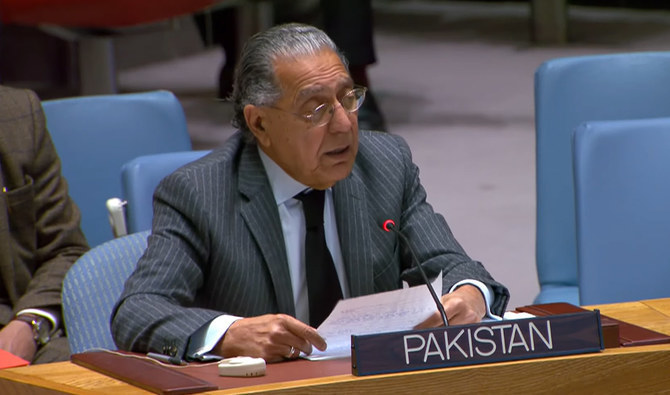
Ambassador Munir Akram, Islamabad’s permanent representative to the United Nations speaks at the UNSC’s United Nations Assistance Mission in Afghanistan (UNAMA) briefing on December 21, 2023, in New York, USA. (Photo courtesy: Pakistan Mission to the United Nations)
Short Url
Updated 22 June 2024
Follow

Pakistan urges UNSC to compel Kabul to sever ties with Pakistani Taliban

  • Pakistan’s Permanent Representative to UN calls on UNSC to prevent TTP from carrying out cross-border attacks 
  • Kabul says rising violence in Pakistan is a domestic issue and it does not allow militants to operate on its territory

ISLAMABAD: Pakistan’s Permanent Representative to the United Nations, Munir Akram, has urged the United Nations Security Council (UNSC) to compel Taliban authorities in Afghanistan to sever ties with the Tehrik-e-Taliban Pakistan (TTP) and prevent cross-border attacks carried out by the group, state media reported on Saturday.

Islamabad blames the surge in attacks on neighboring Afghanistan, saying Pakistani Taliban, or TTP, leaders have taken refuge there and run camps to train militants to launch attacks inside Pakistan. Kabul says rising violence in Pakistan is a domestic issue for Islamabad and it does not allow militants to operate on its territory.

The TTP pledges allegiance to, and gets its name from, the Afghan Taliban, but is not directly a part of the group that now rules Afghanistan. Its stated aim is to impose Islamic religious law in Pakistan, as the Taliban have done in Afghanistan.

“I urge the UNSC to call on the Taliban government to sever its links with the TTP and its associates, prevent them from carrying out cross-border attacks against Pakistan, disarm the TTP terrorists, capture their leadership and hand them over to Pakistan,” the Associated Press of Pakistan (APP) quoted Akram as saying in an address to the 15-member council to which the South Asian state was recently elected as a non-permanent member.

“The impunity which some of these terrorist groups seem to enjoy within Afghanistan poses a dire and direct threat to all of Afghanistan’s neighbors as well as to the international community.”

Akram said the Taliban government did not act “decisively” to halt the TTP’s militant activities despite assurances.

“The highest priority – for the international community, for Afghanistan’s neighbors and for Afghanistan itself – remains the elimination of terrorism within and from Afghanistan,” the envoy added. 

The TTP is responsible for some of the bloodiest attacks in Pakistan, including on churches, schools and the shooting of Malala Yousafzai, who survived the 2012 attack after she was targeted for her campaign against the Taliban’s efforts to deny women education.

Pakistani forces were able to effectively dismantle the TTP and kill most of its top leadership in a string of military operations from 2014 onwards in the tribal areas, driving most of the fighters into neighboring Afghanistan, where Islamabad says they have regrouped.


IMF hails Pakistan privatization drive, calls PIA sale a ‘milestone’

Updated 10 January 2026
Follow

IMF hails Pakistan privatization drive, calls PIA sale a ‘milestone’

  • Fund backs sale of national airline as key step in divesting loss-making state firms
  • IMF has long urged Islamabad to reduce fiscal burden posed by state-owned entities

KARACHI: The International Monetary Fund (IMF) on Saturday welcomed Pakistan’s privatization efforts, describing the sale of the country’s national airline to a private consortium last month as a milestone that could help advance the divestment of loss-making state-owned enterprises (SOEs).

The comments follow the government’s sale of a 75 percent stake in Pakistan International Airlines (PIA) to a consortium led by the Arif Habib Group for Rs 135 billion ($486 million) after several rounds of bidding in a competitive process, marking Islamabad’s second attempt to privatize the carrier after a failed effort a year earlier.

Between the two privatization attempts, PIA resumed flight operations to several international destinations after aviation authorities in the European Union and Britain lifted restrictions nearly five years after the airline was grounded following a deadly Airbus A320 crash in Karachi in 2020 that killed 97 people.

“We welcome the authorities’ privatization efforts and the completion of the PIA privatization process, which was a commitment under the EFF,” Mahir Binici, the IMF’s resident representative in Pakistan, said in response to an Arab News query, referring to the $7 billion Extended Fund Facility.

“This privatization represents a milestone within the authorities’ reform agenda, aimed at decreasing governmental involvement in commercial sectors and attracting investments to promote economic growth in Pakistan,” he added.

The IMF has long urged Islamabad to reduce the fiscal burden posed by loss-making state firms, which have weighed public finances for years and required repeated government bailouts. Beyond PIA, the government has signaled plans to restructure or sell stakes in additional SOEs as part of broader reforms under the IMF program.

Privatization also remains politically sensitive in Pakistan, with critics warning of job losses and concerns over national assets, while supporters argue private sector management could improve efficiency and service delivery in chronically underperforming entities.

Pakistan’s Cabinet Committee on State-Owned Enterprises said on Friday that SOEs recorded a net loss of Rs 122.9 billion ($442 million) in the 2024–25 fiscal year, compared with a net loss of Rs 30.6 billion ($110 million) in the previous year.