

Pakistan urges UNSC to compel Kabul to sever ties with Pakistani Taliban

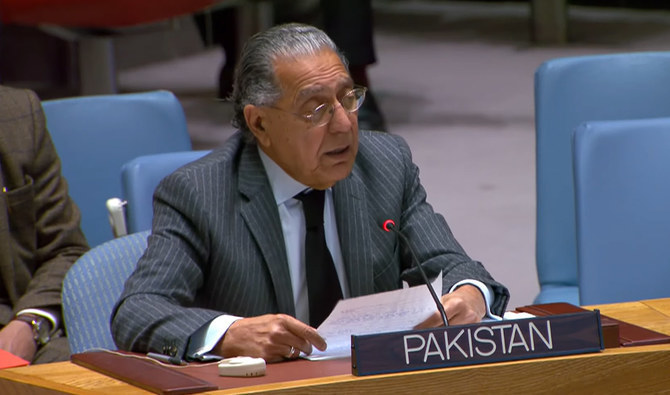
Ambassador Munir Akram, Islamabad’s permanent representative to the United Nations speaks at the UNSC’s United Nations Assistance Mission in Afghanistan (UNAMA) briefing on December 21, 2023, in New York, USA. (Photo courtesy: Pakistan Mission to the United Nations)
Short Url
Updated 22 June 2024
Follow

Pakistan urges UNSC to compel Kabul to sever ties with Pakistani Taliban

  • Pakistan’s Permanent Representative to UN calls on UNSC to prevent TTP from carrying out cross-border attacks 
  • Kabul says rising violence in Pakistan is a domestic issue and it does not allow militants to operate on its territory

ISLAMABAD: Pakistan’s Permanent Representative to the United Nations, Munir Akram, has urged the United Nations Security Council (UNSC) to compel Taliban authorities in Afghanistan to sever ties with the Tehrik-e-Taliban Pakistan (TTP) and prevent cross-border attacks carried out by the group, state media reported on Saturday.

Islamabad blames the surge in attacks on neighboring Afghanistan, saying Pakistani Taliban, or TTP, leaders have taken refuge there and run camps to train militants to launch attacks inside Pakistan. Kabul says rising violence in Pakistan is a domestic issue for Islamabad and it does not allow militants to operate on its territory.

The TTP pledges allegiance to, and gets its name from, the Afghan Taliban, but is not directly a part of the group that now rules Afghanistan. Its stated aim is to impose Islamic religious law in Pakistan, as the Taliban have done in Afghanistan.

“I urge the UNSC to call on the Taliban government to sever its links with the TTP and its associates, prevent them from carrying out cross-border attacks against Pakistan, disarm the TTP terrorists, capture their leadership and hand them over to Pakistan,” the Associated Press of Pakistan (APP) quoted Akram as saying in an address to the 15-member council to which the South Asian state was recently elected as a non-permanent member.

“The impunity which some of these terrorist groups seem to enjoy within Afghanistan poses a dire and direct threat to all of Afghanistan’s neighbors as well as to the international community.”

Akram said the Taliban government did not act “decisively” to halt the TTP’s militant activities despite assurances.

“The highest priority – for the international community, for Afghanistan’s neighbors and for Afghanistan itself – remains the elimination of terrorism within and from Afghanistan,” the envoy added. 

The TTP is responsible for some of the bloodiest attacks in Pakistan, including on churches, schools and the shooting of Malala Yousafzai, who survived the 2012 attack after she was targeted for her campaign against the Taliban’s efforts to deny women education.

Pakistani forces were able to effectively dismantle the TTP and kill most of its top leadership in a string of military operations from 2014 onwards in the tribal areas, driving most of the fighters into neighboring Afghanistan, where Islamabad says they have regrouped.


Pakistani consortium acquires 75 percent stake in PIA in major privatization move

Updated 4 sec ago
Follow

Pakistani consortium acquires 75 percent stake in PIA in major privatization move

  • Around 90 percent of $482 million bid amount will be reinvested into PIA to fund fleet expansion and improve services
  • The airline’s sale is a central pillar of Pakistan’s broader economic reform agenda under a $7 billion IMF bailout 

ISLAMABAD: Pakistan on Tuesday concluded the long-awaited privatization of its loss-making national flag carrier, the Pakistan International Airlines (PIA), with Arif Habib Group emerging as the winning bidder in a process the government says will end decades of state-funded bailouts and help revive the loss-making airline.

The consortium, led by Arif Habib Group, secured a 75 percent stake in PIA for Rs135 billion ($482 million) after several rounds of bidding, valuing the airline at Rs180 billion ($643 million).

The sale marks the South Asian country’s most aggressive attempt in decades to reform the debt-ridden carrier, which has accumulated more than $2.8 billion in financial losses.

Following the announcement of successful bidder, Muhammad Ali, chairman of the Pakistan Privatization Commission, said the biggest advantage fo the sale would be that the government will not have to fund the airline.

“It will have new planes and all Pakistanis, who want to travel around the world directly, which we go through transits via different airports today, all of that will be improved, service quality will be better and overall, there will be an impact on employment and GDP [gross domestic product] growth in the country,” he said.

“[We] had to make it at least Rs120-125 billion [investment]. That is why I am very happy to have Rs135 billion [$482 million] bid, out of which 92 percent will go to the company [PIA]. So, around Rs125 billion [$446 million] investment will be made in the company. So, what our target was for the investment, planes, today there are 18 planes, after 4 years, we are looking at 38-40 planes.”

Ali said they hoped the number of passengers traveling through PIA annually would rise to 7 million from the existing 4 million over the next 4 years.

Once considered among Asia’s leading carriers, PIA struggled with chronic mismanagement, political interference, overstaffing, mounting debt and operational issues that led to a 2020 ban on flights to the European Union, United Kingdom and the United States (US) after a pilot licensing scandal. The EU and the UK lifted the bans, providing fresh momentum to the carrier that still remains barred from flying to the US.

Arif Habib, chairman of Arif Habib Group, said they are committed to restoring the airline’s fortunes through fresh capital, fleet expansion and improved management.

“PIA is our national organization. It has seen good days in the past,” Habib told Arab News. “I hope that this new capital will go into the company and the airline’s problems will be solved.”

He said the airline’s fleet would be expanded significantly.

“In the first phase, there will be 38 aircraft and then it will be expanded to 65 aircraft. Depending upon the demand, we will further increase the number of aircraft,” he said, adding that the group would “give confidence to the existing employees and take full advantage of their expertise.”

The airline currently employs 6,480 staff, according to PIA spokesman Abdullah Hafeez Khan.

Government officials say the structure of the privatization deal was designed to prioritize the airline’s revival rather than immediate fiscal gains for the state.

“I hope that PIA will revive in the future. We’ll go back to the glory days,” Ali said.

Under the agreement, the new management is required to invest up to Rs125 billion [$446 million] in the airline, including the acquisition of new aircraft.

Ali clarified the airline’s name would remain unchanged.

“PIA’s name cannot be changed. It will remain Pakistan International Airlines,” he said.

Under the transaction, the government will retain a 25 percent stake, worth around Rs45 billion ($160 million), in the airline.

Ali, however, said the winning bidder has 90 days to decide if it wants to buy the remaining 25 percent share from the government.

Addressing employee concerns, Ali said no staff member would be laid off for at least one year and that existing pay, perks and compensation structures would remain unchanged during this period. Decisions on longer-term staffing will be made later, he added.

Pakistan had prequalified four investor groups in July, but Fauji Fertilizer Company, part of a military-backed conglomerate, withdrew before ahead of the bidding process.

The airline’s sale is a central pillar of Pakistan’s broader economic reform agenda under a $7 billion bailout agreed last year with the International Monetary Fund (IMF).