

Lebanon’s FM meets with UN, French and US envoys in bid to prevent full-scale war

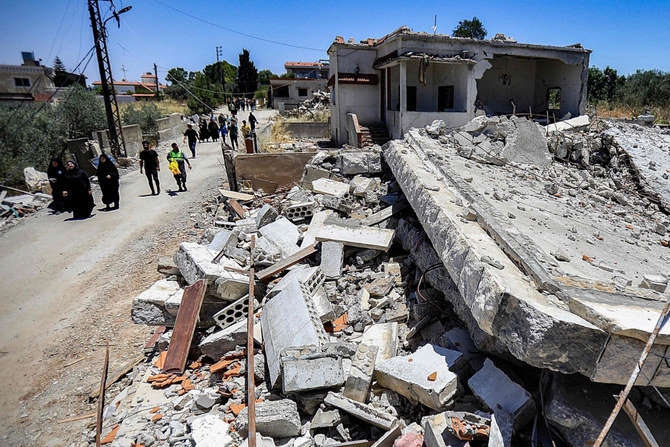
People walk past the rubble of a building that was destroyed by previous Israeli bombardment in the village of Yaroun in south Lebanon near the border with Israel on June 21, 2024. (AFP)
Short Url
Updated 22 June 2024
Follow

Lebanon’s FM meets with UN, French and US envoys in bid to prevent full-scale war

  • Lebanon counts on success of US diplomatic efforts to prevent full-scale war
  • Former ambassador to US tells Arab News: ‘No one has an interest in open war’

BEIRUT: Lebanon’s Foreign Affairs Minister Abdallah Bou Habib met with French Ambassador Herva Magro, the UN Special Coordinator for Lebanon Jeanine Hennis-Plasschaert, and US Ambassador Lisa Johnson on Friday.

The minister reiterated Lebanon’s call for the full implementation of UN Resolution 1701.

Hennis-Plasschaert said there was “no inevitability (to wider conflict with Israel)” during her visit to UN peacekeepers in southern Lebanon.

Also on Friday, it was announced that German Foreign Minister Annalena Baerbock will make shuttle visits to Lebanon, Israel, and the West Bank.

Concerned at the risk of Israel’s war on Gaza spreading across the region, US President Joe Biden sent his special envoy Amos Hochstein to embark on a new round of diplomacy last week. Hochstein called for “urgent” de-escalation during talks with Lebanon and Israel on Tuesday, informing both sides that “the threat of a full-scale war persists and must be avoided.”

It is widely believed in Lebanon that Hochstein convinced Israel to refrain from escalating its military actions against Lebanon for the time being.

In a meeting with visiting Israeli officials including National Security Advisor Tzachi Hanegbi and Strategic Affairs Minister Ron Dermer in Washington on Thursday, US Secretary of State Antony Blinken underscored the importance of “avoiding further escalation in Lebanon and reaching a diplomatic resolution that allows Israeli and Lebanese families to return to their homes,” according to a statement.

According to his spokesperson, Matthew Miller, Blinken also stressed America’s “unwavering commitment to Israel’s security.”

During his talks in Beirut, Hochstein reportedly reassured Lebanese Prime Minister Najib Mikati that Biden’s proposal for a ceasefire in Gaza was being viewed positively, and that Qatar was working to make it happen.

Hochstein also reportedly told Mikati that “things are under control and positive when it comes to the war between Lebanon and Israel.”

Former Lebanese Ambassador to Washington, Riad Tabbarah, described threats of war as a “mere outburst.”

He told Arab News: “Since military operations began on the southern front about nine months ago, the Lebanese have been hearing that war is coming, but it never arrives.

“During diplomatic negotiations, it is common for both sides to face pressure and threats,” he continued. “It appears that there are numerous and diverse negotiations happening behind the scenes, including discussions between the Americans and Iranians, as well as between the Americans and Hezbollah.”

Tabbarah acknowledged the recklessness of Israeli Prime Minister Benjamin Netanyahu and said the Israeli leader “has two options — either war or prison. And there is significant pressure on him, especially from the families of the hostages.”

Tabbarah noted that there are limits to what military action can achieve. “We still recall the time when former Israeli Prime Minister Ariel Sharon crossed those limits in 1982 when he set the Litani Line as his target. However, he went beyond that and reached Beirut. As a result, international powers united to bring him back to the Litani Line.

“No one has an interest in war,” he continued. “Americans, Europeans, and Iranians are working in the opposite direction. The general trend is to avoid escalating to open war.”

Military operations on the Lebanese front decreased significantly on Friday, although the outskirts of Naqoura in the western sector were targeted by Israeli artillery, causing a fire in a house. In the morning, an Israeli military raid targeted the town of Wazzani.

Hezbollah made a series of announcements about their operations, which were “focused on specific targets within the rules of engagement.”

Hezbollah attacked the sites of Ramtha and Samaka in the occupied Lebanese Kfar Shouba Hills, the Zabadin site in the occupied Lebanese Shebaa Farms, and carried out an air attack using drones on the Ras Al-Naqoura naval site, aiming at locations containing Israeli military personnel.

The Lebanese Ministry of Health said that, up to June 19, it has recorded a total of 1,774 casualties, including 432 fatalities, caused by Israeli attacks.


US officials say Gaza stabilization force will not fight Hamas

Updated 8 sec ago
Follow

US officials say Gaza stabilization force will not fight Hamas

  • An American two-star general is under consideration to lead the ISF, but no decision has been made, officials said

NEW YORK: International troops could be deployed in the Gaza Strip as early as next month to form a UN-authorized stabilization force, two US officials said, but it remains unclear how Hamas will be disarmed.
Officials said the International Stabilization Force, or ISF, would not fight Hamas. 
They said many countries have expressed interest in contributing, and US officials are currently working out the size of the ISF, its composition, housing, training, and rules of engagement.

There is a lot of quiet planning that’s going on behind the scenes right now for phase two of the peace deal.

Karoline Leavitt, White House spokesperson

An American two-star general is under consideration to lead the ISF, but no decision has been made, officials said.
Deployment of the force is a key part of the next phase of US President Donald Trump’s Gaza peace plan. 
Under the first phase, a fragile ceasefire in the two-year war began on Oct.10, and Hamas released hostages, and Israel freed detained Palestinians.
“There is a lot of quiet planning that’s going on behind the scenes right now for phase two of the peace deal,” White House spokesperson Karoline Leavitt said. 
“We want to ensure an enduring and lasting peace.”
Indonesia has said it is prepared to deploy up to 20,000 troops to take on health and construction-related tasks in Gaza.
“It is still in the planning and preparation stages,” said Rico Sirait, spokesperson of the Indonesian Defense Ministry. 
“We are now preparing the organizational structure of the forces to be deployed.”

Israel still controls 53 percent of Gaza, while nearly all the 2 million people in the enclave live in the remaining Hamas-held area. The plan — which needs to be finalized by the so-called Board of Peace — is for the ISF to deploy in the area held by Israel, the US officials said.
Then, according to the Trump peace plan, as the ISF establishes control and stability, Israeli troops will gradually withdraw “based on standards, milestones, and timeframes linked to demilitarization.”
A UN Security Council resolution adopted on Nov. 17 authorized a Board of Peace and countries working with it to establish the ISF. 
Trump said on Wednesday that an announcement on which world leaders will serve on the Board of Peace will be made early next year.
The Security Council authorized the ISF to work alongside newly trained and vetted Palestinian police to stabilize security “by ensuring the process of demilitarizing the Gaza Strip, including the destruction and prevention of rebuilding of the military, terror, and offensive infrastructure, as well as the permanent decommissioning of weapons from non-state armed groups.”
However, it remains unclear exactly how that would work.
US Ambassador to the UN Mike Waltz noted on Thursday that the Security Council authorized the ISF to demilitarize Gaza by all means necessary, which means the use of force. 
“Obviously, that’ll be a conversation with each country,” he told Israel’s Channel 12, adding that discussions on rules of engagement were underway.
Hamas has said the issue of disarmament has not been discussed with them formally by the mediators — the US, Egypt, and Qatar — and the group’s stance remains that it will not disarm until a Palestinian state is established.
Israel’s Prime Minister Benjamin Netanyahu said in a speech on Sunday that the second phase would move toward demilitarization and disarmament.
“Now that raises a question: Our friends in America want to try and establish a multinational task force to do the job,” he said. “I told them I welcome it. Are volunteers here? Be my guest,” Netanyahu said.
“We know there are certain tasks that this force can perform ... but some things are beyond their abilities, and perhaps the main thing is beyond their abilities, but we will see about that,” he said.