STUTTGART, Germany: When you lose your phone abroad you hardly expect to get it back, let alone with a smiling selfie on it from the good-natured rival supporters who handed it in to the police.
But that’s exactly what happened to a Scotland fan in Germany who was reunited with his lost phone and discovered a pleasant surprise in the camera roll, the latest entreaty in a blossoming love-in between the two countries.
Thousands of Scottish fans have made the long journey to the Euros, in their kilts and sporrans, and have endeared themselves to their hosts with their infectious enthusiasm and 24-hour carousing.
Where once German city centers would have the sound of an oom-pah band echoing through the streets, now it’s the skirl of bagpipes ringing out along with deafening chants of “No Scotland, no party.”
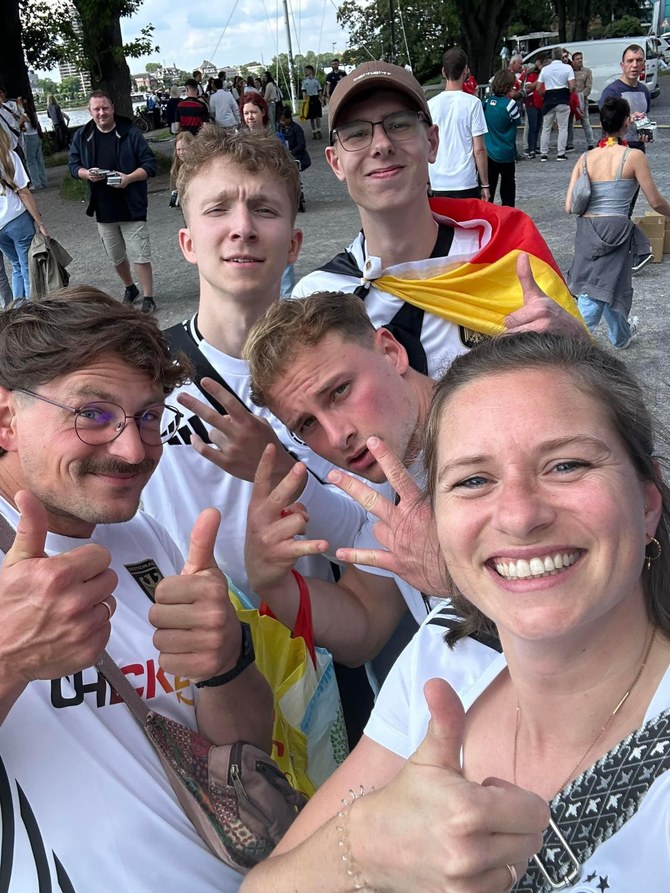
“Kieran left his phone in a portaloo. These Germany fans found it, took a selfie, then handed it into the police. He has his phone back. What a country,” supporters’ body the Tartan Army Group posted on X on Thursday alongside the picture of the five smiling fans.
The two nations may not be famous for their bilateral relations, though there is a connection that dates all the way back to William Wallace’s letters to the Hanseatic League in 1297.
However, there are now calls for a new special relationship to be formed in Europe.
“And we definitely need you guys back in the EU! We’ll always leave a light on for you!,” a German poster wrote underneath the Tartan Army Group post.
“I didn’t know that the Germany-Scotland-Love is what I needed. Please don‘t ever leave, Scots!,” another wrote, adding: “Can we build a direct tunnel? Or a gigantic bridge?“
“There’s something special between Scotland and Germany, I don’t know why, or what it is, but I can feel it,” said another post.
The Scotland fans have not just been confined to cities where the team is playing, with many spread across the country simply happy to soak in the atmosphere — and indeed the beer.
“Dear Scots, these have been a wonderful couple of days with you. I could not be a happier mayor. You are always welcome to Cologne,” Henriette Reker, mayor of Cologne, said on X.
The Tartan Army descends on Stuttgart as Scotland hope to extend their stay in Germany with a win against Hungary on Sunday. No doubt they’ll now have the locals cheering them on, as well.


Lost phone returned with smiling surprise as Scotland-Germany love-in blossoms
https://arab.news/vh9a6
Lost phone returned with smiling surprise as Scotland-Germany love-in blossoms

- “Kieran left his phone in a portaloo. These Germany fans found it, took a selfie, then handed it into the police,” supporters’ body the Tartan Army Group posted on X
- The Scotland fans have not just been confined to cities where the team is playing


In southeast Pakistan, Ramadan brings Hindus and Muslims closer
MITHI: Partab Shivani, a Hindu in Muslim-majority Pakistan, has fasted on and off during Ramadan for years, but this time is different as he practices abstinence for the entire holy month.
Every year, he and his friends in the southeastern city of Mithi arrange iftar, when Muslims break their daily fast, to foster peace and solidarity between the two religions.
“I believe we need to promote interfaith harmony. First, we are humans — religions came later,” Shivani, a 48-year-old social activist, told AFP, adding that he also reads the teachings of the Buddha.
“His message is about peace and ending war. Peace can spread through solidarity and by standing with one another. Distance only widens the gap between people,” he added.
Ninety-six percent of Pakistan’s 240 million people are Muslim. Just two percent are Hindu, most of them living in rural areas of Sindh province where Mithi is located.
In Mithi itself, most of the 60,000 inhabitants are Hindu.
Many of the city’s Hindus also observe Ramadan and iftar has become a social gathering where people from both faiths happily participate.
“This has been a wonderful tradition of ours for a very long time,” said Mir Muhammad Buledi, a 51-year-old Muslim friend who attended Shivani’s iftar gathering.
“It is a beautiful example of harmony between the two communities.”
Like brothers
Discrimination against minorities runs deep in Pakistan.
Following the end of British rule in South Asia in 1947, the subcontinent was partitioned into mainly Hindu India and Muslim-majority Pakistan.
That triggered widespread religious bloodshed in which hundreds of thousands were killed and millions displaced.
According to the Human Rights Commission of Pakistan, freedom of religion or belief is under constant threat, with religiously motivated violence and discrimination increasing yearly.
State authorities, often using religious unrest for political gain, have failed to address the crisis, the independent non-profit says.
But such tensions are absent in Mithi.
“I am a Hindu but I keep all the fasts during this month,” said Sushil Malani, a local politician. “I feel happy standing with my Muslim brothers.
“We celebrate Eid together as well. This tradition in the region is very old.”
Restaurants and tea stalls are closed across Pakistan during Ramadan.
Ramesh Kumar, a 52-year-old Hindu man who sells sweets and savoury items outside a Muslim shrine, keeps his push cart covered and closed until iftar.
“There is no discrimination among us if someone is Muslim or Hindu. I have been seeing this since my childhood that we all live together like brothers,” he said.
Muslim shrine, Hindu caretaker
Locals say Mithi’s peaceful religious coexistence can be traced to its remote location, emerging from the sand dunes of the Tharparkar desert, which borders the modern Indian state of Rajasthan.
Cows — considered sacred in Hinduism — roam freely in Mithi city, as they do in neighboring India.
At two Sufi Muslim shrines in the middle of the city, Hindu families arrange meals, bringing fruit, meals and juices for their Muslim neighbors to break their fasts.
“We respect Muslims,” said Mohan Lal Malhi, a Hindu caretaker of one of the shrines.
Mohan said his parents and elders taught him to respect people regardless of religion or color, and the traditions pass from one generation to the next.
Local residents said both communities consider their social relationships more important than their religious identity.
“You will see a (Sikh) gurdwara, a mosque, and a shrine standing side by side here,” Mohan said. “The atmosphere of this area teaches humanity.”