

World Bank approves $535 million for social protection, livestock development in Pakistan

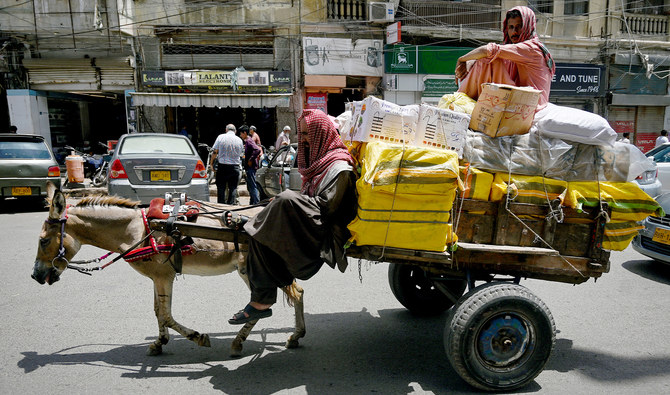
Labourers transport dry fruits on a donkey-cart along a street in Karachi on June 12, 2024. (AFP/File)
Short Url
Updated 21 June 2024
Follow

World Bank approves $535 million for social protection, livestock development in Pakistan

  • The top bank official in Pakistan stresses the importance of building disaster resilience after the 2022 floods
  • The funding is also expected to create growth opportunities in the livestock and aquaculture sectors in Sindh

KARACHI: The World Bank’s Board of Executive Directors has approved $535 million for two projects in Pakistan, a statement said on Friday, adding that the funding would strengthen the social protection system for poor households nationwide while promoting climate-smart and competitive producers in the livestock and aquaculture sectors in Sindh.

The bank’s financing is part of its Crisis Resilient Social Protection (CRISP) and Sindh Livestock and Aquaculture Sectors Transformation (LIVAQUA) programs.

The former project has a wider scope as it seeks to increase resilience of vulnerable households to economic shocks in different parts of the country. However, the latter initiative is only confined to Pakistan southeastern province of Sindh.

“The catastrophic floods that hit Pakistan in 2022 were a tragic reminder of the importance to build resilience to such disasters, including by strengthening both social protection and sectors that support economic growth and recovery,” Najy Benhassine, World Bank

Country Director for Pakistan, was quoted in the statement. “It is also imperative to help the vulnerable absorb climate shocks through innovative climate-smart technology and contingency planning.”

It added that the additional financing of $400 million for CRISP would build on the program’s on-going efforts to equip Pakistan’s social protection system with the policy and delivery system foundations necessary for more effective and rapid responses to future crises.

“Since its inception, the CRISP program has achieved significant results with regular safety net support to more than 9 million families and a demonstrated capability of quickly reaching 2.8 million families during the recent floods,” Amjad Zafar Khan, Task Team Leader for the Project, noted.

“The additional financing would not only assist families in becoming more resilient to climate and economic shocks, but also encourage the use of provincial capacities to take up a larger role in social assistance,” he added.

Meanwhile, the $135 million in LIVAQUA funding is expected to facilitate interventions to promote climate-smart production, value addition and inclusive access to markets.

The statement said this will create growth opportunities in the livestock and aquaculture sectors.

“The project will improve the livelihoods of small and medium livestock and aquaculture producers, increase their resilience to animal health and climate-related shocks, strengthen the overall growth of these two sectors in Sindh, and more broadly improve food and nutrition security and reduce the sectors’ contribution to greenhouse gas emissions,” Myriam Chaudron, Task Team Leader for the project, said.


Pakistani companies likely to raise over $89 million in new stock listings this year

Updated 5 sec ago
Follow

Pakistani companies likely to raise over $89 million in new stock listings this year

  • Farrukh H. Sabzwari says approvals for two listings already granted while 10 more Initial Public Offerings are expected over next 12 months
  • Economists expect KSE-100 index to reach 208,000 points by Dec., reflecting pent-up demand, strategic expansions and broader investor appetite

KARACHI: The Pakistan Stock Exchange (PSX) expects at least a dozen new listings this year, the PSX chief executive officer said on Monday, with the new entrants likely to raise as much as Rs25 billion ($89.3 million) in funding through the equity market.

Pakistan’s benchmark KSE-100 index has rallied to new highs and recorded returns of around 50 percent in Calendar Year (CY) 2025. The market closed at 182,384 points on Monday.

Around 135,000 new investors have also joined the PSX over the last 18 months, according to Pakistani state media.

“Continuing with the momentum, in CY2026, approvals for two Main Board listings have been granted,” PSX CEO Farrukh H. Sabzwari, who has previously served as a local partner of BoA Merrill Lynch and country head of CLSA Emerging Markets in Pakistan, told Arab News.

“PSX is expecting 10 more IPOs (Initial Public Offerings) over next 12 months across various sectors.”

Pakistan’s growing stocks mirror the country’s stabilizing economy which Prime Minister Shehbaz Sharif’s government expects would expand 3.9 percent this fiscal year through June with the help of the International Monetary Fund’s reforms-oriented $7 billion loan program.

The new IPOs would cover food, pharmaceutical, real estate investment trust (REIT), engineering, technology, oil and gas marketing, insurance, auto parts, manufacturing and energy sectors of the economy, according to Sabzwari.

Last year, the PSX listed Zarea Limited, Barkat Frisian Agro Limited, Image REIT, Pak Qatar Family Takaful, Blue-Ex Limited, Nets International Communication Limited and the Pakistan Credit Rating Agency Limited. These listings helped companies raise Rs4.3 billion ($15.4 million) of funding.

In addition, the PSX debt market witnessed seven issuances, valuing Rs10.5 billion ($37.5 million). Pakistan’s finance ministry raises funds through PSX by selling borrowing instruments like Islamic sukuk.

The PSX recorded the highest eight IPOs in a single year in 2021, according to Shankar Talreja, head of research at Topline Securities Ltd. It would be a record if the market lists 12 new entrants this year.

Sana Tawfiq, an economist at Karachi-based brokerage research firm AHL, described the market performance last year as “exceptional.”

“With projected fundraising of up to Rs25 billion ($89.3 million), the upcoming pipeline reflects pent-up demand, strategic expansions, and a broader investor appetite,” she said.

Tawfiq expects the KSE-100 index to reach 208,000 points by Dec. this year.

“As we look toward 2026, Pakistan’s equity market is entering a phase defined by stability, depth, and sustainable growth,” the economist said.

“The market is now transitioning toward a more measured trajectory.”

Key drivers in 2026 would likely include sustained domestic liquidity in equities, strengthening foreign reserves and a contained current account deficit, successful completion of the Pakistan International Airlines (PIA) privatization alongside accelerating progress on privatization and restructuring of power distribution companies (DISCOs), continued efforts to resolve circular debt in both power and gas sectors, and supportive global commodity prices, according to Tawfiq.

In a recent note to its clients, Topline Securities said the current IPO momentum was driven by macroeconomic stability under the IMF program, improving investor confidence and a declining interest rate environment.

Pakistan’s central bank last month cut its interest rate by 50 basis points to 10.5 percent in a surprising move aimed at boosting economic growth in the inflation-hit country.

“Despite ongoing geopolitical and macroeconomic uncertainties, investor sentiment continues to improve,” it said.