

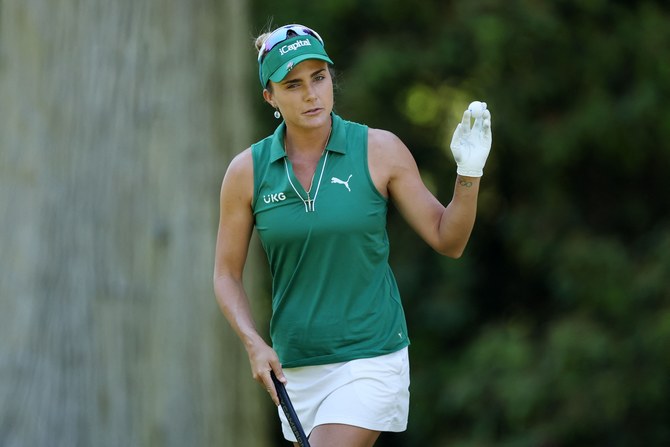

SAMMAMISH: Lexi Thompson knew some form of the question was coming after shooting a 4-under 68 and taking the first-round lead Thursday in the KPMG Women’s PGA Championship.
Would a major title change her plans about retiring from playing full-time on the LPGA Tour?
“I’m just taking it one day at a time. I made my announcement. I’m very content with it,” Thompson said. “Golf is a crazy game, so I’m not going to look too far ahead.”
Thompson made six birdies on her way to a one-shot lead over Nelly Korda and Patty Tavatanakit.
Teeing off in the afternoon as temperatures climbed into the 80s and dried out Sahalee Country Club, Thompson started hot with three straight birdies to open her round and built on last week when she lost in a playoff at the Meijer LPGA Classic.
The 29-year-old Thompson, who recently announced her plans to retire after the season, shot a bogey-free 32 on the front nine, capped with a 6-foot birdie on the par-3 ninth. After a bogey at No. 10, Thompson rebounded with birdies at Nos. 12 and 14 before another bogey at the 16th.
She won the last of her 11 LPGA Tour titles at the ShopRite LPGA Classic in June 2019. The 68 is her lowest round in a major since a 67 in the second round of the Women’s PGA two years ago at Congressional.
“My approach shots felt great,” Thompson said. “They felt really good last week, so just trying to simplify things and get in a rhythm with my swing.”
Korda shot 69 in the morning, and Tavatanakit matched it in the afternoon with a bogey-free round.
The top-ranked Korda missed the cuts in the US Women’s Open and the Meijer LPGA Classic in her last two starts after winning six of seven events, a run that started with a record-tying five straight victories.
Korda started on the back nine and made four birdies on her first five holes. But parts of the morning were a scramble for Korda as the Douglass fir, red cedar and hemlock trees of Sahalee played their role in making it a challenge. A double bogey on the par-4 fourth hole dropped her back to 2 under.
“If you try and be aggressive when you’ve hit it off line, it just bites you in the butt,” Korda said. “Overall, I think I played pretty well. I took my chances where I could and I played safe the majority of the round.”
Korda made a 15-foot putt on the par-3 ninth hole — her final hole — to take the early lead.
There was another group of players at 2 under, including Allizen Corpuz, Celine Boutier, Charley Hull and Leona Maguire. Maguire led this tournament after the third round last year at Baltusrol, but shot 74 on the final day and finished four shots back of the winner, Ruoning Yin.
Playing with Korda, Yin rebounded from a rough start and shot 33 on her second nine to shoot 71.
“Luckily hit it pretty straight today. Hit a lot of fairways and greens. But it does feel like a course where once you’re out of position it’s tough to get back on track,” said Corpuz, who has an outside chance of making the Olympics for the United States with a strong finish this week.
The third major of the year on the LPGA Tour returned to Sahalee, which previously hosted in 2016. And the tree-lined course showed its difficulty.
Lilia Vu, who won last week in her return from a back injury, shot 75. Yuka Saso, the US Open winner three weeks ago, made four consecutive bogeys on the back nine and finished at 2-over 74. Brooke Henderson, who won in 2016, shot 73.
Korda got off to a far better start than her last major, when she shot 80 in the opening round of the US Women’s Open three weeks ago.
Korda’s early run of birdies included three straight between Nos. 13-15 and she and went out in 33. She moved to 4 under after a birdie on the third hole — her 12th of the day — but dropped two shots on the fourth.
“This entire golf course is so demanding,” Korda said. “I had to make some pretty good up-and-downs.”


