


Last week’s consideration of the pressures in professional cricket was followed by some real-time examples in the International Cricket Council Men’s T20 World Cup.
In Kingstown, St Vincent, South Africa scored only 115 against Nepal, who responded positively, cruising to 85 for two midway through the 14th over. Then four wickets fell quickly, leaving eight runs required from the final over, whittled down to two from the final two balls.
Those runs proved to be unattainable, a last ball run out sealing Nepal’s heartbreaking defeat by one run. Both batters, bowler and several fielders were under pressure to make crucial decisions in split seconds.
In St Lucia, Scotland scored a highly creditable 180 for five against Australia, aided by six dropped catches. This target challenged Australia’s batters as they slipped to sixty for three. A victory for Scotland would have elevated the team to the Super 8s stage; as it was, the pressure proved to be too great, as Australia’s extra experience took them to 186 for five with two deliveries remaining. The result meant that England, instead of Scotland, progressed.
In Antigua, a few hours earlier, this had been very much in doubt. There it seemed the rain would not stop in sufficient time prior to the cut-off of 4.46 p.m. local time to allow mopping-up operations to be completed. One may wonder why the cut-off time should be so early in the day.
This relates to the ICC’s playing conditions for T20I men’s cricket, which stipulate that there should be two sessions of 1 hour 25 minutes, separated by a 20-minute interval between innings. Allowances also need to be made for one drink break per innings, umpire and player reviews, and any treatment of injuries. All of this equates to around 3.5 hours. There seems to be no flexibility on this and it would not be practical with matches that start at, say, 8 p.m.
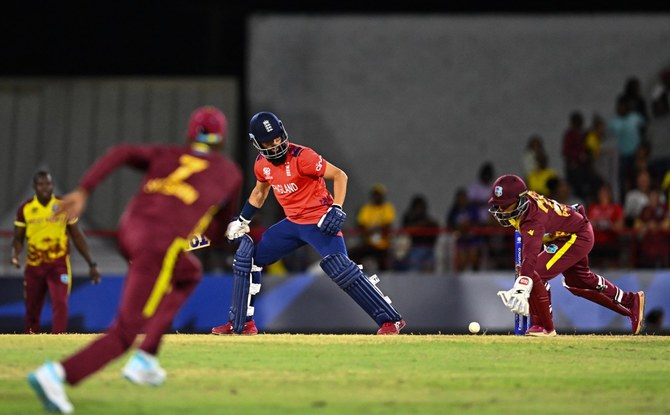
It is also pertinent to ask why a team — any team, let alone defending champions — should be at risk of being knocked out at the group stage by virtue of playing only two of its four group matches, courtesy of adverse weather conditions. England’s captain was pictured looking very mournful in the team area as rain continued to fall. Later, he admitted to it being a stressful day with real fears no play would be possible.
In the event, the match was only 46 minutes from abandonment. Ground staff worked incessantly to clear the outfield of water and the umpires were finally satisfied that play could start in a shortened match of 11 overs per team. This was reduced to 10 overs following a shower during England’s innings, which totaled 122 for five. Namibia fell 41 runs short to soothe England’s anxieties and relieve the pressure on its leadership.
Although only four of the 40 group stage matches were washed out, three of them were in Florida. June is the start of the rainy season in the Caribbean and the Florida peninsula, so it is hardly a surprise the weather has affected matches. The ICC has been criticized for its decision to stage the 2024 T20 World Cup at this time of year in the knowledge of climatic conditions. In its defense, it would no doubt argue that the crowded cricket schedule allows no alternative.
The most favorable conditions for cricket in the Caribbean are between December and April. These months are when five T20 franchise leagues are played. The decision to include the USA as joint hosts in 2024 limits the options. Although Florida is sub-tropical, New York is not. The next T20 World Cups will be hosted by India and Sri Lanka in February 2026, followed by Australia and New Zealand in 2028. In all cases, except for northern India, weather issues should not be of concern. Given the capricious nature of the world’s climate patterns, it seems we are asked to accept that rain will interfere randomly with cricket, as it always has done.
In modern cricket, an established statistical mechanism is now deployed to recalculate scores in rain affected matches, while enhanced pitch and ground covering materials are used and more powerful equipment is available to disperse rainwater. What is needed to make best use of these is sufficient staff on hand. There have been several occasions at this World Cup when that did not appear to be the case.
Another area of discussion has surrounded the absence of reserve days in the group and Super 8 stages, apparently for logistical reasons. Reserve days are available for the semi-finals and final if the team batting second is unable to face ten overs. If the reserve day is invoked in the second semi-final, then the final is scheduled for the next day. This is high risk planning.
What appears to be lower risk planning is the timing of matches. These are weighted heavily in favor of Indian audiences. All matches involving India in the group and Super 8 stages start at 8 p.m. IST. Additionally, this is the scheduled start time for all but seven of the other 47 matches, ensuring that Indians can watch most matches in the evening. In contrast, the local time for viewing Australia’s matches is either 3 a.m. or 10.30 a.m. Furthermore, India’s semi-final venue is pre-planned.
This T20 World Cup is the first to comprise 20 teams. It was bound to create logistical challenges for the ICC. On top of these, the performances of the expanded number of associate members will be scrutinized by those who disagree with their inclusion. In that sense the biggest disappointment for many about the tournament — the sub-standard quality of pitches — may have helped the associate teams.
Many batters in the Full member teams have struggled to adapt to the pitches, creating unexpected opportunities for associates to achieve shock results. Under pressure, they failed to do so on most occasions. Only by playing more regularly against Full members can associates learn to maximize these chances.


