BRIDGETOWN: India batsman Suryakumar Yadav has welcomed the switch from New York to the traditional pitches of Barbados ahead of their opening match in the Super Eight part of the T20 Cricket World Cup against Afghanistan on Thursday.
The Indians, one of the favorites to win the trophy, topped Group A with their three wins over Ireland, Pakistan, USA — their match with Canada in Lauderhill was abandoned — all played on the “spicy” drop-in pitches of the temporary stadium near New York.
The move to Barbados takes the Indians on to the more traditional cricket territory of the West Indies.
“It’s not that we weren’t happy playing there (New York) but we were playing for the first time,” he said at a press conference late on Tuesday.
“So yes, the conditions were different and a little challenging as well.
“But we’ve played here, we know the conditions here, how they react, how they act, so we are very happy to be here. It looks better.”
Suryakumar, the world’s top-ranked batter in the short white-ball format, has never played in Bridgetown in the T20 format but did play two ODIs against West Indies there last year, making 19 and 24.
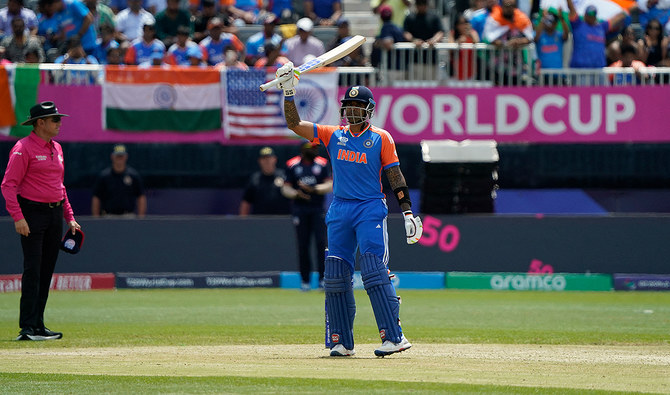
He struggled for runs in those group matches in New York making just two against Ireland and seven against Pakistan before a measured 50 not out from 49 balls — some way short of his average T20I strike rate of 168.06 -guided the Indians to a seven-wicket win over USA.
“I have been the world’s number one batsman for the past two years so you should know how to bat according to different conditions and how you can change your game to what the team needs at that time,” said the 33-year-old.
“If you can play like that, I think it displays good batsmanship. And I try to do that if the wicket is difficult.”
“I knew post-power play that finding boundaries was going to be difficult on that ground with the wind, with the slow outfield.
“So, we had a plan in mind after the power play that we’d just try and hit the gap and run hard.
“It was a little difficult track to bat on, yes, but that day the situation was different. We had to be batting till the end, keeping the wickets in hand.”
Against Afghanistan, and indeed Bangladesh who they face on Saturday, Suryakumar is sure to come up against more of a spin threat but the Mumbai Indians slugger is more than ready.
“That has always been my strong point,” he said. “I mean, if the wicket is slow, the spinner is bowling, or if the wicket is good, that has always been my game.”
“We obviously have plans against Afghanistan. We are completely focused and know our own strong points really well.
“We do think about the opposition. But at the same time, at the end of the day, you should know what your strong points are and back it.”


India’s Suryakumar ‘happy’ to be in Barbados for Afghan test in T20 World Cup
https://arab.news/487z7
India’s Suryakumar ‘happy’ to be in Barbados for Afghan test in T20 World Cup

- The Indians, one of the favorites, topped Group A with their three wins over Ireland, Pakistan and USA
- The move to Barbados takes the Indian team on to the more traditional cricket territory of the West Indies

Russell, Antonelli lead Mercedes in one-two qualifying positions for F1’s Australian GP
- Russell topped all three sessions in F1’s knockout qualifying format, finally casting aside questions of where Mercedes team was in the new-era pecking order
MELBOURNE: Mercedes has revealed its dominant hand during qualifying for Sunday’s Formula 1 Australian Grand Prix.
George Russell earned his ninth-career pole position Saturday ahead of his teammate Kimi Antonelli for the team’s 83rd front-row lockout and its first since the 2024 British Grand Prix.
Russell topped all three sessions in F1’s knockout qualifying format, finally casting aside questions of where Mercedes team was in the new-era pecking order. His pole time, at 1 minute, 18.518 seconds, was almost eight-tenths faster than the nearest non-Mercedes challenger, Red Bull rookie Isack Hadjar, who completed the top three.
“It was a great day, we knew there was a lot of potential in the car, but until we get to this first Saturday of the season, you never know,” Russell said. “But it really came alive this afternoon, especially when the track temperatures cooled, we know we tend to favor those conditions.”
Antonelli was relieved to have made it onto the front row alongside his teammate after a crash in final practice at the exit of turn two meant it was a race in the Mercedes garage to get him out for qualifying.
“It’s been a very stressful day. Unfortunately, I went into the wall (in FP3),” he said. “But the guys (in the garage) were the heroes today to put the car back on track.”
Hadjar was impressive by qualifying third on debut for Red Bull, his highest-ever grid position.
“The only thing I can do is take them at the start, but they’re just too fast at the moment,” Hadjar said of Mercedes. “I want to keep my position and a second podium would be cool.”
Ferrari showed it’s neck-and-neck with McLaren on pace, with just one and a half tenths seconds covering the four drivers just beyond the top-three — with Charles Leclerc qualifying fourth, McLaren’s Oscar Piastri and Lando Norris in fifth and sixth respectively, and Lewis Hamilton in seventh.
Racing Bulls showed they’ve taken a step forward over the winter, with New Zealander Liam Lawson eighth ahead of his highly-rated rookie teammate Arvid Lindblad.
The big surprise of the session came from four-time F1 world champion Max Verstappen, who triggered red flags at Melbourne’s Albert Park after he lost control of his Red Bull car in braking for turn one in the first half of Q1 and ended in the barriers.
The Dutchman, who was unhurt from the crash, though upset that his brakes locked up, will now start from the back of the grid.
F1 heads into a new era this year, with unprecedented changes across the chassis (car) and power unit, which now feature an almost 50:50 output split between the turbo 1.6-liter V6 engine and electrical energy harvested from the brakes, one that requires a new, often counterintuitive driving style from the drivers.