

Israeli forces deepen Rafah invasion, kill 17 in central camps

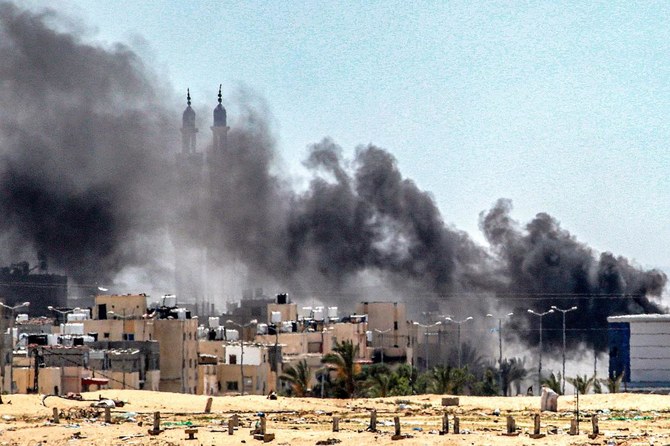
Smoke plumes billow during ongoing battles in the Sultan neighborhood in the northwest of Rafah in the southern Gaza Strip on Jun. 18, 2024 amid the ongoing conflict in the Palestinian territory between Israel and Hamas. (AFP)
Short Url
Updated 18 June 2024
Follow

Israeli forces deepen Rafah invasion, kill 17 in central camps

  • Residents reported heavy bombardments from tanks and planes in several areas of Rafah
  • Israeli tanks were operating inside Tel Al-Sultan, Al-Izba, and Zurub areas in Rafah’s west, as well as Shaboura at the heart of the city

CAIRO: Israeli airstrikes on Tuesday killed at least 17 Palestinians in two of the Gaza Strip’s historic refugee camps and Israeli tanks pushed deeper into the enclave’s southern city of Rafah, residents and medics said.
Residents reported heavy bombardments from tanks and planes in several areas of Rafah, where more than a million people had taken refuge before May. Most of the population has fled northwards since then as Israeli forces invaded the city.
“Rafah is being bombed without any intervention from the world, the occupation (Israel) is acting freely here,” a Rafah resident and father of six told Reuters via a chat app.
Israeli tanks were operating inside Tel Al-Sultan, Al-Izba, and Zurub areas in Rafah’s west, as well as Shaboura at the heart of the city. They also continued to occupy the eastern neighborhoods and outskirts as well as the border with Egypt and the vital Rafah border crossing.
“There are Israeli forces in most areas, there is heavy resistance too and they are making them pay dearly but the occupation is not ethical and they are destroying the city and the refugee camp,” the resident said.
Palestinian health officials said one man was killed in the morning by Israeli fire on the eastern side of Rafah. Medics said they believed many others had been killed in the past days and weeks but rescue teams could not reach them.

Opinion

This section contains relevant reference points, placed in (Opinion field)

The Israeli military said it was continuing “precise, intelligence-based activity” in Rafah, killing many Palestinian gunmen over the past day in close-range combat and seized weapons. The air force struck dozens of targets across the Gaza Strip in the past day, it added.
In the central Gaza Strip, two separate Israeli air strikes on two houses killed 17 Palestinians in Al-Nuseirat and Al-Bureij, two designated refugee camps that are home to families and descendants of people who fled to Gaza in the 1948 war around the creation of Israel, medics said.
“Every more hour of delay, Israel kills more people, we want a ceasefire now,” said Khalil, 45, a teacher from Gaza, now displaced with his family in Deir Al-Balah city in the central Gaza Strip.
“Enough of our blood, I say it to Israel, America, and our leaders too. The war must stop,” he told Reuters via a chat app.
The Israeli military statement did not comment directly on the 17 deaths but said forces continued to operate against militant factions in central Gaza areas.
The commander of an Islamic Jihad sniper cell was killed by an Israeli warplane, and troops also “eliminated” a militant cell, it said.
The armed wings of Hamas and Islamic Jihad said fighters confronted Israeli forces in combat zones with anti-tank rockets and mortar bombs, and have in some areas detonated pre-planted explosive devices against army units.
Israel’s ground and air campaign was triggered when Hamas-led militants stormed into southern Israel on Oct. 7, killing around 1,200 people and seizing more than 250 hostages, according to Israeli tallies.
The offensive has left Gaza in ruins, killing more than 37,400 people, according to its health authorities, and left much of the population homeless and destitute.
Since a week-long truce in November, repeated attempts to arrange a ceasefire have failed, with Hamas insisting on a permanent end to the war and full Israeli withdrawal from Gaza. Netanyahu refuses to end the war before Hamas is eradicated and the hostages are freed.


Editorial: The threat of Yemen’s fragmentation is far reaching

President of Yemen’s Presidential Leadership Council Rashad Mohammed Al-Alimi. (SABA Net)
Updated 25 December 2025
Follow

Editorial: The threat of Yemen’s fragmentation is far reaching

  • The southern issue is a just cause — one that must be addressed in any future political settlement and not reduced to the ambitions of any single individual, including the likes of Aidarous Al-Zubaidi

RIYADH: As Yemen’s political landscape continues to shift at a dizzying pace, it is worth pausing to reflect on the official Saudi position — and the commentary of some of our leading Saudi columnists — regarding the recent unilateral moves by the Southern Transitional Council (STC) in the governorates of Hadramout and Al-Mahrah. These actions, taken without the consent of the Presidential Leadership Council (PLC) or coordination with the Arab Coalition, represent a dangerous gamble with the future of a fragile nation — one that Saudi Arabia, like its Arab neighbors, wishes only peace, stability, and prosperity.
There is no ambiguity in the Kingdom’s stance: it has worked tirelessly to preserve calm in Hadramout and Al-Mahrah, steering both regions away from military escalation and toward peaceful solutions. In a bid to contain the situation, Saudi Arabia, in coordination with its brothers and partners in the United Arab Emirates and the PLC, dispatched a joint team to negotiate with the STC. The goal was clear — facilitate the withdrawal of STC forces and hand over military sites to the National Shield Forces.
Yet despite Riyadh’s call for de-escalation and its appeal to the STC to prioritize national interest and social cohesion, the Council has persisted in its confrontational posture, seemingly indifferent to the grave consequences of its actions.
Observers in Riyadh will note that the Kingdom remains steadfast in its support for the PLC and Yemen’s internationally recognized government. Its commitment to Yemen’s stability is not rhetorical — it is political, economic, and developmental. Saudi Arabia’s vision is to shepherd Yemen from the shadows of conflict into an era of peace, prosperity, and regional integration. This is not merely a function of geography or shared borders; it is a reflection of the Kingdom’s religious, political, and economic responsibilities in the Arab and Islamic world.
From this vantage point, the newspaper firmly believes that the STC’s unilateral actions in Hadramout constitute a blatant violation of Yemen’s transitional framework. They undermine the legitimacy of the recognized government, threaten the fragile peace, and jeopardize the political process. Worse still, they echo the very tactics employed by the Houthi militias — an alarming parallel that should not be ignored.
It is therefore essential to reiterate the Kingdom’s position: the STC must withdraw its forces from Hadramout and Al-Mahrah, restoring the status quo ante. This is not a punitive demand, but a necessary step to safeguard national security and prevent further military flare-ups.
At the same time, Saudi Arabia has consistently affirmed that the southern issue is a just cause — one that must be addressed in any future political settlement. It is enshrined in the outcomes of Yemen’s National Dialogue and must be resolved inclusively, reflecting the aspirations of all southern Yemenis — not reduced to the ambitions of any single individual, including the likes of Aidarous Al-Zubaidi or other STC figures.
Ultimately, we urge the separatists to choose reason over recklessness. Partitioning Yemen will not bring peace — it will sow the seeds of future wars, embolden extremist actors, and pose a threat not only to Yemen’s internal cohesion but to regional and international stability. As Western and American policymakers know all too well: what happens in Yemen never stays in Yemen.