

Under-fire Babar Azam says PCB to take final decision on Pakistan captaincy 

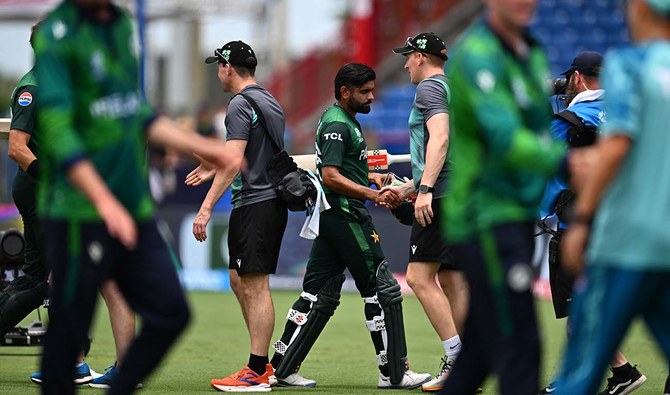
Pakistan's captain Babar Azam shakes hands with other players during the ICC men's Twenty20 World Cup 2024 group A cricket match between Pakistan and Ireland at Central Broward Park & Broward County Stadium in Lauderhill, Florida on June 16, 2024. (AFP/File)
Short Url
Updated 18 June 2024
Follow

Under-fire Babar Azam says PCB to take final decision on Pakistan captaincy 

  • Cricket analysts have called upon Azam to resign following Pakistan’s poor performance at World Cup
  • Pakistan failed to qualify for second round of T20 World Cup after losing to United States, arch-rivals India

ISLAMABAD: Pakistan’s under-fire skipper Babar Azam said this week that it was ultimately up to the Pakistan Cricket Board (PCB) to decide whether he should continue as the national squad’s captain or not, following his team’s dismal performance in the ongoing T20 World Cup. 

Cricket analysts and commentators have called on Azam to step down as skipper after Pakistan failed to qualify for the second round of the T20 World Cup 2024. 

The green shirts crashed out of the World Cup after consecutive losses to minnows United States and arch-rivals India. The United States and India ultimately ended up qualifying for the Super Eight stage of the tournament from Group A, with Pakistan notching victories only against Canada and Ireland. 

Speaking to reporters at a news conference on Monday, Azam said the PCB decided to appoint him captain after pacer Shaheen Shah Afridi’s brief stint as skipper ended this year. 

“When I go back, we will discuss all that has happened here. And if I have to leave the captaincy, I will announce it openly,” he said.

“I will not hide behind anything. Whatever happens will happen in the open. But for now, I have not thought about it. It is eventually PCB’s decision.”

Cricket commentators have blamed Azam for Pakistan’s failure to perform impressively at the mega tournament. Many have questioned his captaincy decisions while most have criticized him for choosing underperforming stars in the playing XI. 

“We win and lose as a team. You are pointing out that [I am] the captain, but I cannot play in every player’s place. There are 11 players, and each of them has a role,” Azam explained.

“That’s why they came here to play the World Cup. I think we have not been able to play well as a team. We have to settle down and accept that we didn’t play well as a team,” he added. 

Azam admitted that though the team performed well in patches, fans were right to be disappointed with them. 

“Everybody is disappointed. We are as disappointed as the fans. It is not one individual’s fault,” he said. 


Pakistan, China to sign multiple MoUs at major agriculture investment conference today

Updated 11 sec ago
Follow

Pakistan, China to sign multiple MoUs at major agriculture investment conference today

  • Hundreds of Chinese and Pakistani firms to attend Islamabad event
  • Conference seen as part of expanding CPEC ties into agriculture, trade

KARACHI: Islamabad and Beijing are set to sign multiple memorandums of understanding (MoUs) to boost agricultural investment and cooperation at a major conference taking place in the capital tomorrow, Monday, with hundreds of Chinese and Pakistani companies expected to participate.

The conference is being billed by Pakistan’s Ministry of National Food Security and Research as a platform for deepening bilateral agricultural ties and supporting broader economic engagement between the two countries.

“Multiple memorandums of understanding will be signed at the Pakistan–China Agricultural Conference,” the Ministry of National Food Security said in a statement. “115 Chinese and 165 Pakistani companies will participate.”

The conference reflects a growing emphasis on expanding Pakistan-China economic cooperation beyond the transport and energy foundations of the flagship China-Pakistan Economic Corridor (CPEC) into agriculture, industry and technology.

Under its first phase launched in 2015, CPEC, a core component of China’s Belt and Road Initiative, focused primarily on transportation infrastructure, energy generation and connectivity projects linking western China to the Arabian Sea via Pakistan. That phase included motorways, power plants and the development of the Gwadar Port in the country's southwest, aimed at helping Pakistan address chronic power shortages and enhance transport connectivity.

In recent years, both governments have formally moved toward a “CPEC 2.0” phase aimed at diversifying the corridor’s impact into areas such as special economic zones, innovation, digital cooperation and agriculture. Second-phase discussions have highlighted Pakistan’s goal of modernizing its agricultural sector, attracting Chinese technology and investment, and boosting export potential, with high-level talks taking place between planning officials and investors in Beijing.

Agri-sector cooperation has also seen practical collaboration, with joint initiatives examining technology transfer, export protocols and value-chain development, including partnerships in livestock, mechanization and horticulture.

Organizers say the Islamabad conference will bring together government policymakers, private sector investors, industry associations and multinational agribusiness firms from both nations. Discussions will center on investment opportunities, technology adoption, export expansion and building linkages with global buyers within the framework of Pakistan-China economic cooperation.