Thaksin granted bail, media reports, as Thai court cases raise risk of political crisis

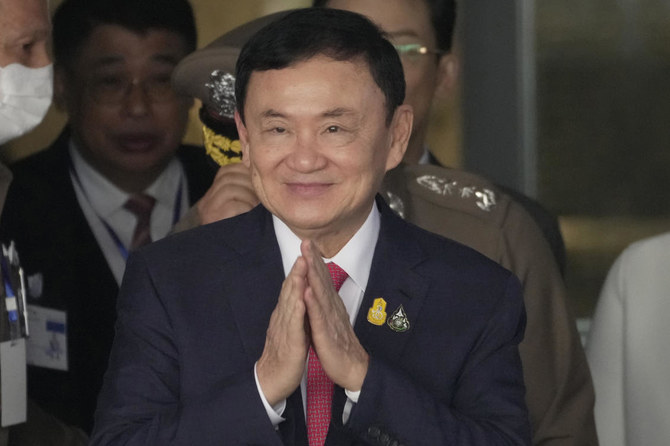
Thailand’s former Prime Minister Thaksin Shinawatra sought bail from a court in Bangkok shortly after the Attorney General formally indicted the 74-year-old billionaire for an offense that carries a maximum jail sentence of up to 15 years. (AP)
Short Url
Updated 18 June 2024
Follow

Thaksin granted bail, media reports, as Thai court cases raise risk of political crisis

  • Thaksin’s is the first of four high-profile cases involving key political players that are before the courts on Tuesday
  • The cases involve some of Thailand’s most powerful politicians, including its current prime minister

BANGKOK: Influential former Thai Prime Minister Thaksin Shinawatra, a powerful backer of the ruling government, was granted bail on Tuesday, local media reported, avoiding pre-trial detention for allegedly insulting the monarchy in a 2015 interview.
Thaksin’s is the first of four high-profile cases involving key political players that are before the courts on Tuesday, in the latest legal wrangling that could see Southeast Asia’s second-largest economy plunged into a new period of uncertainty.
The cases involve some of Thailand’s most powerful politicians, including its current prime minister, and could deepen a decades-old rift between the conservative-royalist establishment and its opponents, such as the populist ruling Pheu Thai party and the opposition Move Forward party.
Thaksin sought bail from a court in Bangkok shortly after the Attorney General formally indicted the 74-year-old billionaire for an offense that carries a maximum jail sentence of up to 15 years for each perceived royal insult.
Public broadcaster ThaiPBS and other local media reported the court had accepted 500,000 baht ($13,600) bail.
Separately, the Constitutional Court will conduct a hearing in a case lodged by a group of senators that could potentially see Prime Minister Srettha Thavisin dismissed from office for breaching the law in appointing a lawyer with a conviction record to his cabinet.
The same court will also hear a case seeking to disband the popular opposition Move Forward Party for their campaign to amend the country’s royal insult law, following a complaint by the Election Commission.
The court is expected to announce the next hearing or verdict date for cases involving Srettha and Move Forward on Tuesday.
The Constitutional Court will also rule whether the ongoing selection process for a new upper house, which started earlier this month and is scheduled to conclude in early July, is lawful.
If the court cancels or delays the process, it would temporarily extend the term of military-appointed senators who have a played crucial role in the formation of the previous government.
POWERFUL COURTS, RATTLED MARKETS
“The political parties and representatives that voters have chosen are being systematically and repeatedly stymied,” Thitinan Pongsudhirak, a political scientist at Bangkok’s Chulalongkorn University, told Reuters.
A single petition can bring down a sitting, elected government or oust a prime minister, he said, outlining the power of the country’s courts.
“There’s a judicial assertiveness that has been damaging to Thailand, subverting popular will and popular mandates.”
Such tensions have previously triggered violent street protests, dissolutions of political parties, airport closures and military coups that have hamstrung the economy.
Thai stock markets have been rattled by the spectre of a political crisis. The main stock index dropped to its lowest level since November 2020 on Monday, but was up more than 1 percent on Tuesday morning.


US Justice Department official eyes cases against Cuba leaders as Trump floats ‘friendly takeover’

Updated 07 March 2026
Follow

US Justice Department official eyes cases against Cuba leaders as Trump floats ‘friendly takeover’

  • “Working group” formed to build cases against people connected to the Cuban government
  • Trump’s has increasingly displayed aggressive stance against Cuba’s communist leadership

MIAMI: The top Justice Department prosecutor in Miami is considering criminal investigations of Cuban government officials, according to people familiar with the matter. The inquiry comes as President Donald Trump has raised the possibility of a “friendly takeover” of the communist-run island.
Jason Reding Quiñones, the US attorney for the Southern District of Florida, has created a “working group” that includes federal prosecutors and officials from the Drug Enforcement Administration and other agencies to try to build cases against people connected to the Cuban government and its Communist Party, according to one of the people. They spoke on the condition of anonymity because they were not authorized to publicly discuss the effort.
It was not immediately clear which Cuban officials the office is targeting or what criminal charges prosecutors may be looking to bring.
The Justice Department said in a statement Friday that “federal prosecutors from across the country work every day to pursue justice, which includes efforts to combat transnational crime.”
The effort is taking place against the backdrop of Trump’s increasingly aggressive stance against Cuba’s communist leadership.
Emboldened by the US capture of Cuba’s close ally, Venezuelan President Nicolás Maduro, Trump last month said his administration was in high-level talks with officials in Havana to pursue “a friendly takeover” of the country. He repeated those claims this week, saying his attention would turn back to Cuba once the war with Iran winds down.
“They want to make a deal so bad,” Trump said of Cuba’s leadership.
While Cuba has faded from Washington’s radar as a major national security threat in recent decades, it remains a priority in the US Attorney’s office in Miami, whose political, economic and cultural life is dominated by Cuban-American exiles.
The FBI field office has a dedicated Cuba group that in 2024 was instrumental in the arrest of former US Ambassador Victor Manuel Rocha on charges of serving as a secret agent of Cuba stretching back to the 1970s.
In recent weeks, several Miami Republicans, in addition to Florida Sen. Rick Scott, have called on the Trump administration to reopen its criminal investigation into the 1996 shootdown of four planes operated by anti-communist exiles.
In a letter to Trump on Feb. 13, lawmakers including Reps. Maria Elvira Salazar and Carlos Gimenez highlighted decades-old news reports indicating that former President Raúl Castro — the head of Cuba’s military at the time — gave the order to shoot down the unarmed Cessna aircraft.
“We believe unequivocally that Raúl Castro is responsible for this heinous crime,” lawmakers wrote. “It is time for him to be brought to justice.”
While no indictment against Castro has been announced, Florida’s attorney general said this week that he would open a state-level investigation into the crime.
The Trump administration has also accused Cuba of not cooperating with American counterterrorism efforts, adding it alongside North Korea and Iran to a select few nations the US considers state sponsors of terrorism.
The designation stems from Cuba’s harboring of US fugitives and its refusal to extradite several Colombian rebel leaders while they were engaged in peace talks with the South American nation.