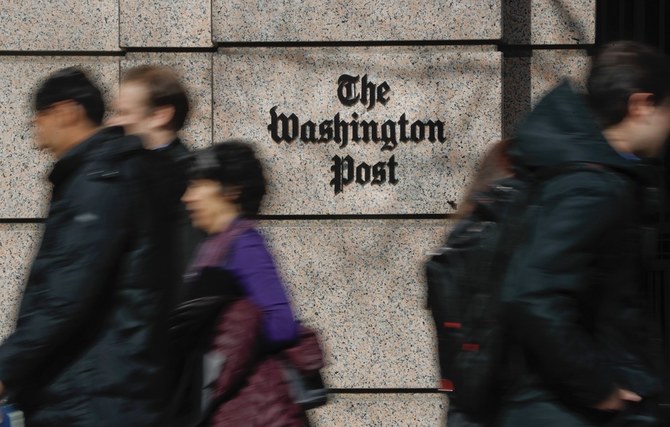
NEW YORK: New leaders of The Washington Post are being haunted by their pasts, with ethical questions raised about their actions as journalists in London that illustrate very different press traditions in the United States and England.
An extraordinary trio of stories over the weekend by The New York Times, NPR and the Post itself outline alleged involvement by Post publisher Will Lewis and Robert Winnett, his choice as a new editor, in wrongdoing involving London publications as much as two decades ago.
The Post said on Monday that it had brought back its former senior managing editor to oversee the newspaper’s coverage of the matter.
Lewis took over as publisher earlier this year, with a mandate to turn around the financially-troubled newspaper. He announced a reorganization earlier this month where the Post’s executive editor, Sally Buzbee, stepped down rather than accept a demotion.
The coverage revealed Lewis’ sensitivity about questions involving his role in a phone hacking scandal that rocked the British press while he was working there. Lewis has maintained that he was brought in by Rupert Murdoch-owned newspapers to cooperate with authorities to clean up after the scandal. Plaintiffs in a civil case have charged him with destroying evidence, which he has denied.
Differences between US and British journalism — some of them big
The public revelation of phone hacking in 2011 led to the closure of Rupert Murdoch’s News of the World tabloid and sparked a public inquiry into press practices that curbed some of the worst excesses.
The British press has long been considered freewheeling in its pursuit of scoops, willing to tolerate behavior frowned upon by its American counterparts. For example, when Lewis and Winnett worked at The Daily Telegraph in 2009, they cooperated on stories about politicians’ extravagant expense-account spending. They paid for data that revealed the spending, a reporting practice that would be considered a substantial ethical breach in the US
The Times reported on Saturday that both Lewis and Winnett worked on stories in the 2000s that appeared to be based on fraudulently obtained phone and business records.
Both the Times and Post reported on a 2002 story article about British politicians who had sought to buy a Mercedes-Benz vehicle described as the “Nazi’s favorite limousine,” based on information obtained by an actor who had faked a German accent to call a manufacturer who gave it to him.
The Post story delved into Winnett’s relationship with John Ford, the actor whose “clandestine efforts” helped uncover stories that included private financial dealings by former Prime Minister Tony Blair. He was allegedly adept in “blagging,” in which a person misrepresents themselves to persuade others to reveal confidential information. That’s illegal under British law unless it can be shown the actions benefit the public.
Headlined “Incoming Post editor tied to self-described ‘thief’ who claimed role in his reporting,” it was among the newspaper’s most popular stories on Monday. Winnett was chosen by Lewis to take over the Post’s main newsroom after the presidential election.
It was an unusually harsh story for a news organization to write about its own leadership. In announcing that Cameron Barr, who left his position last year, would supervise the reporting, the Post said that “the publisher has no involvement or influence on our reporting.” Other editors, including Buzbee’s temporary replacement Matt Murray, will also look over stories produced by the media team.
NPR’s story details several of these issues, along with Winnett’s supervision — when he worked at the Sunday Times in London — of a reporter, Claire Newell, who was hired as a temporary secretary in the UK Cabinet office, giving her access to sensitive documents that made their way back to the newspaper.
Is this an ‘unrecoverable’ situation for Post leadership?
The Post said Lewis declined comment on the stories. Winnett, a deputy editor at the Telegraph in London, did not comment on the three most recent stories, and a message to the newspaper by The Associated Press was not immediately returned on Monday.
Similarly silent: Jeff Bezos, the billionaire owner of the Post, who will ultimately decide whether this is a public relations and internal morale storm that he and the institution can weather.
Not everyone is sure that he can, or should.
“The Washington Post is a great, great, great paper, and its greatness pushes the rest of us in the media world to do a better job,” New York Times columnist Nicholas Kristof wrote on X Monday. “Yet its leadership is now tainted in ways that are unrecoverable; time won’t heal the injury but let it fester.”
Lewis, a former publisher of The Wall Street Journal who is also vice chairman of the board at The Associated Press, has spent the past week trying to assure Post staff members that he understands and will live up to the ethical standards of American journalism.


![]()

The Washington Post’s leaders are taking heat for journalism in Britain that wouldn’t fly in the US
Short Url
https://arab.news/vafv8
The Washington Post’s leaders are taking heat for journalism in Britain that wouldn’t fly in the US
- The coverage revealed Lewis’ sensitivity about questions involving his role in a phone hacking scandal in the UK


Latest updates


Recommended


© 2026 SAUDI RESEARCH & PUBLISHING COMPANY, All Rights Reserved And subject to Terms of Use Agreement.