

Riots erupt in drought-stricken central Algeria over months of water shortages

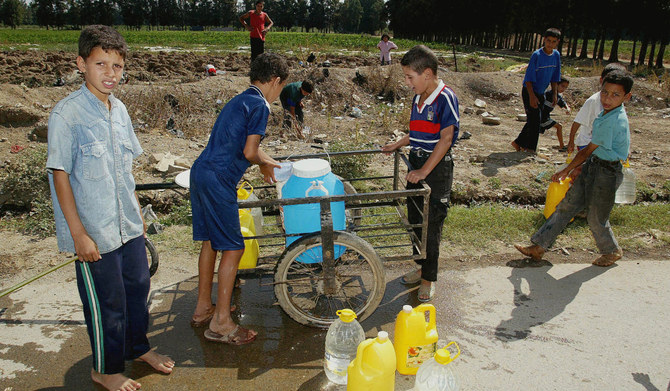
Children fill up cans with water at a drinking fountain in Boufarik, 30kms far from Algiers. (AFP file photo)
Short Url
Updated 11 June 2024
Follow

Riots erupt in drought-stricken central Algeria over months of water shortages

  • The region, located on a semi-arid high desert plateau increasingly plagued by extreme heat, gets its water from three dammed reservoirs that are shrinking as temperatures spike and less rain falls

TIARET, Algeria: Violent riots erupted in a drought-stricken Algerian desert city last weekend after months of water shortages left taps running dry and forced residents to queue to access water for their households.
In Tiaret — a central Algerian city of less than 200,000 located 155 miles (250 kilometers) southwest of Algiers — protesters wearing balaclavas set tires aflame and set up make-shift barricades blocking roads to protest their water being rationed, according to pictures and videos circulating on social media.
The unrest followed demands from President Abdelmajid Tebboune to rectify the suffering. At a council of ministers meeting last week, he implored his cabinet to implement “emergency measures” in Tiaret. Several government ministers were later sent to “ask for an apology from the population” and to promise that access to drinking water would be restored.
The rioting comes as Tebboune is expected to vie for a second term as president of the oil-rich nation — Africa’s largest by area. Northern Africa has been among the world’s worst-hit regions by climate change. A multi-year drought has drained critical reservoirs and reduced the amount of rainfall that has historically replenished them.
The region, located on a semi-arid high desert plateau increasingly plagued by extreme heat, gets its water from three dammed reservoirs that are shrinking as temperatures spike and less rain falls. The reservoirs have become less functional due to a “death of volume” and are reduced to 20 percent of their capacity, agricultural engineer Said Ouarad said.
The region’s groundwater aquifers have for years not been able to recharge due to an absence of rain, he added.
Algeria’s long-term solution would be to pipe water from larger dams further north and south from Tiaret and shift to alternative supplies, including desalination plants that the country has heavily invested in.
But in the meantime, officials are trying to import water from nearby sources. Cosider, the public company responsible for the region’s water infrastructure, hopes to finish new pipelines by July to bring groundwater to Tiaret from wells 20 miles (32 kilometers) away. Until then, the company is trucking large cisterns of water into the city, a company official not authorized to speak on the matter told The Associated Press.
“Tiaret and three surrounding municipalities have suffered from this water shortage for months,” he said. “A calm has returned but the situation remains tense.”
News about the tensions has spread on social media but garnered little news coverage in Algeria, where many papers and television stations rely on advertising revenue from the state. Press freedom in the country has increasingly been curtailed and in recent years journalists have been imprisoned.


Arab and Islamic states reject Israel’s recognition of Somaliland

Updated 28 December 2025
Follow

Arab and Islamic states reject Israel’s recognition of Somaliland

  • Israel formally recognized Somaliland as an “independent and sovereign state” on Friday
  • Saudi Arabia on Friday expressed full support for sovereignty, unity, territorial integrity of Somalia

A group of foreign ministers from Arab and Islamic countries, alongside the Organisation of Islamic Cooperation (OIC), have firmly rejected Israel’s announcement of its recognition of the Somaliland region within Somalia.

In a joint statement issued on Saturday, the ministers condemned Israel’s decision, announced on December 26, warning that the move carries “serious repercussions for peace and security in the Horn of Africa and the Red Sea region” and undermines international peace and security, the Jordan News Agency reported.

The statement described the recognition as an unprecedented and flagrant violation of international law and the charter of the United Nations, which uphold the principles of state sovereignty, unity and territorial integrity, JNA added.

Israel formally recognized Somaliland as an “independent and sovereign state” and signed an agreement to establish diplomatic ties, as the region’s leader hailed its first-ever official recognition.

The ministers reaffirmed their full support for the sovereignty of Somalia, rejecting any measures that would undermine its unity or territorial integrity.

They warned that recognizing the independence of parts of states sets a dangerous precedent and poses a direct threat to international peace and security.

The statement also reiterated categorical opposition to any attempt to link the move with plans to displace the Palestinian people outside their land, stressing that such proposals are rejected “in form and substance.”

Alongside the Jordanian foreign ministry, the joint statement was issued by the foreign ministers of Egypt, Algeria, Comoros, Djibouti, The Gambia, Iran, Iraq, Kuwait, Libya, Maldives, Nigeria, Oman, Pakistan, Palestine, Qatar, Somalia, Sudan, Turkiye and Yemen, as well as the OIC.

Saudi Arabia on Friday expressed full support for the sovereignty, unity, and territorial integrity of Somalia, and expressed its rejection of the declaration of mutual recognition between Israel and Somaliland.