Nigel Farage promises tighter UK borders and tax cuts in election ‘contract’

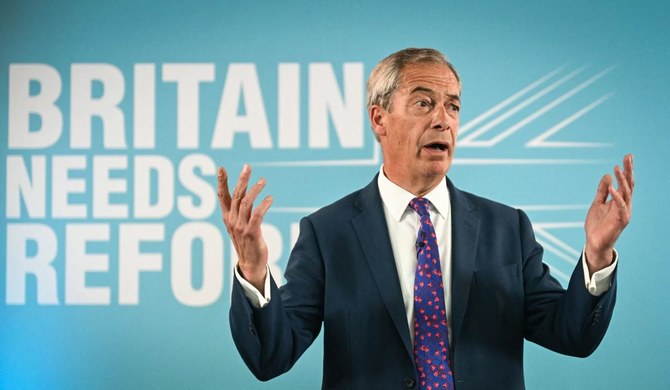
Leader of Reform UK Nigel Farage delivers a speech to launch the hard-right party’s general election manifesto in Merthyr Tydfil, south Wales, on June 17, 2024, in the build-up to the UK general election on July 4. (AFP)
Short Url
Updated 17 June 2024
Follow

Nigel Farage promises tighter UK borders and tax cuts in election ‘contract’

  • Immigration control receives top billing in policy plan
  • Reform seeks to tempt voters away from Sunak’s Conservatives

MERTHYR TYDFIL, Wales: Nigel Farage, whose entry into the election has damaged Prime Minister Rishi Sunak’s faint hopes of victory, set out his policy plans on Monday, describing them as the first step to becoming the dominant party on the right of British politics.
On Monday he said the earlier-than-expected election had come too soon for his Reform UK party but called on supporters of Sunak’s Conservatives to “join the revolt” and pitched Reform as the only ones who could hold to account Labour, whose leader Keir Starmer is forecast to become the next prime minister.
Farage is one of Britain’s most recognizable and divisive politicians and has pressured successive governments into more aggressive stances on cutting immigration. He played a pivotal role in the 2016 vote to leave the European Union.
But his career has been spent campaigning from the sidelines of British politics, having stood unsuccessfully for a seat in parliament seven times and led parties which, despite attracting millions of votes, have failed to weaken the grip of Britain’s two main parties — the Conservatives and Labour.
This time Farage is standing in Clacton-on-Sea, southeast England, where polling shows he could win a place in parliament, but under Britain’s electoral system Reform is only expected to win, at most, a handful of seats across the country.
“We are not pretending that we are going to win this general election,” Farage said at the launch of a 24-page policy document, which he described as a “contract” with voters for the next five years.
But he added: “Our aim and our ambition is to establish a bridgehead in parliament and to become a real opposition to a Labour government.”
Reform chose Merthyr Tydfil for its launch to highlight what it says is Labour misrule in Wales.
Farage’s unexpected entry into the election race — having initially said he would not run and wanted to concentrate on campaigning for Donald Trump in the United States — has split support among Britain’s right-of-center voters.
The Labour Party is around 20 percentage points ahead in opinion polls and forecast to win a large majority. Reform overtook the Conservatives in one poll last week, and Farage has set a target of winning six million votes at the July 4 election.
Other polls put them far behind the governing party.

“JOIN THE REVOLT“
The Reform campaign has so far focused on Farage and his populist appeal.
The 60-year-old received an expensive private education and worked as a commodities trader but has successfully styled himself as a man of the people taking on an out-of-touch political establishment.
Reform’s policies are designed to appeal to the right of center voters who would typically back Sunak’s Conservatives, and they demand change across all the main policy areas.
Immigration, the issue on which Farage has for more than a decade struck a chord with voters, received top billing.
Reform promised to immediately freeze “non-essential” immigration, leave the European Convention on Human Rights, and push migrants arriving by small boats back to France before they land on British shores. They also proposed an extra payroll tax on companies who employ foreign workers.
That tax was one of a raft of measures, including shaving 15 billion pounds off the benefits bill, to raise money that would be spent on tax cuts elsewhere, including raising the income tax threshold to 20,000 pounds, slashing fuel duty by 20 pence per liter and getting rid of value added tax on energy bills.
“This is not a protest document, this is not a protest vote,” Farage said. “We’re unashamedly radical, we want change, this isn’t working.”


US allies, foes alarmed by capture of Venezuela’s Maduro

Updated 4 sec ago
Follow

US allies, foes alarmed by capture of Venezuela’s Maduro

  • Countries such as Russia and China, which had ties with Maduro’s government, were quick to condemn the operation but alarm also shared by France and EU
Paris — FRA
Paris, France, Jan 3, 2026 : The US military operation that led to the seizure of Venezuelan President Nicolas Maduro on Saturday sparked alarm across the international community, with allies and foes of Washington and Caracas expressing disquiet.
US President Donald Trump said Maduro and his wife would be taken to New York to face federal charges after military strikes and an operation which he described as looking like a “television show.”
The Venezuelan government decried what it termed a “extremely serious military aggression” by Washington and declared a state of emergency.
Countries such as Russia and Iran, which had longstanding ties with Maduro’s government, were quick to condemn the operation but their alarm was also shared by Washington’s allies including France and the EU.
Here is a rundown of the main reaction.

- Russia -

Russia demanded the US leadership “reconsider its position and release the legally elected president of the sovereign country and his wife.”

- China -

Beijing said “China is deeply shocked and strongly condemns the US’s blatant use of force against a sovereign state and its action against its president.”

- Iran -

Iran, which Trump bombed last year, said it “strongly condemns the US military attack on Venezuela and a flagrant violation of the country’s national sovereignty and territorial integrity.”

- Mexico -

Mexico, which Trump has also threatened with military force over drug trafficking, strongly condemned the US military action in Venezuela, saying it “seriously jeopardizes regional stability.”

- Colombia -

Colombian President Gustavo Petro — whose country neighbors Venezuela — called the US action an “assault on the sovereignty” of Latin America which would lead to a humanitarian crisis.

- Brazil -

Brazilian President Luiz Inacio Lula da Silva slammed the US attacks as a “serious affront” to Venezuela’s sovereignty.

- Cuba -

Cuba, a strong ally of Venezuela, denounced “state terrorism against the brave Venezuelan people.”

- Spain -

Spain offered to mediate in the crisis to find a way to a peaceful solution, while calling for “de-escalation and restraint.”
- France -

France condemned the US operation, saying it undermined international law and no solution to Venezuela’s crisis can be imposed from the outside.

- EU -

The EU more generally expressed concern at the developments and urged respect for international law, even as it noted that Maduro “lacks legitimacy.”
EU candidate country North Macedonia, along with fellow Balkan nations Albania and Kosovo, backed Washington, however.
“We stand with the United States and the Venezuelan people for freedom and democracy,” North Macedonia FM Timco Mucunski said on X.

- Britain -

British Prime Minister Keir Starmer said all countries should “uphold international law” and added that “the UK was not involved in any way in this operation” as he urged patience in order to “establish the facts.”

- Italy -

In a rare expression of support for the US operation by a major European country, far-right Italian Prime Minister Giorgia Meloni — a Trump ally — argued the US military action in Venezuela was “legitimate” and “defensive.”

- Israel -

Israel also hailed the operation, saying Washington acted as the “leader of the free world.”

- Ukraine -

Ukraine — dependent on US support in its war against invading Russia — did not address the legality of a big country like America using military force against a much smaller one like Venezuela.
Foreign minister Andriy Sybiga instead focused on Maduro’s lack of legitimacy and the Venezuelan government’s repression, while backing “democracy, human rights, and the interests of Venezuelans.”

- South Africa -

South Africa, which Trump accuses of alleged discrimination — and even “genocide” — of minority white Afrikaners, said: “Unlawful, unilateral force of this nature undermines the stability of the international order and the principle of equality among nations.”

- UN -

UN Secretary-General Antonio Guterres was “deeply alarmed” by the US strikes, with his spokesman quoting him as saying it could “constitute a dangerous precedent.”