

Pilgrims perform final rites of Hajj as Muslims celebrate Eid Al-Adha

1 / 2
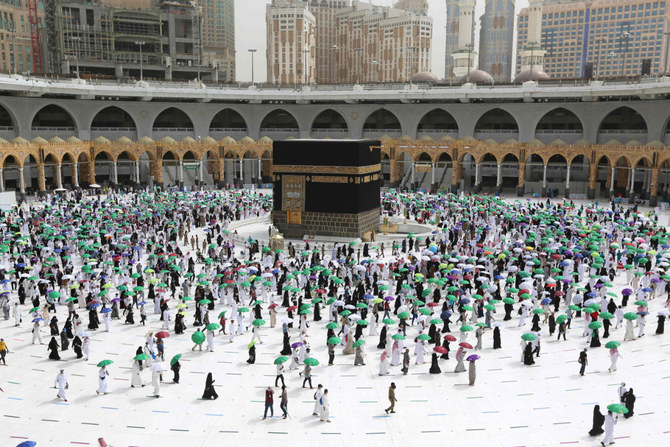
Pilgrims circumambulate the Holy Kaaba at the Grand Mosque in Makkah on Sunday as they perform the final rites of Hajj. (SPA)
2 / 2
Pilgrims circumambulate the Holy Kaaba at the Grand Mosque in Makkah on Sunday as they perform the final rites of Hajj. (SPA)
Short Url
Updated 17 June 2024
Follow

Pilgrims perform final rites of Hajj as Muslims celebrate Eid Al-Adha

  • Long day started with masses of pilgrims embarking on a symbolic stoning of the devil in Muzdalifah under the soaring summer heat

MINA: More than 850,000 pilgrims had performed Tawaf Al-Ifadah by Sunday night in Makkah, the ritual marking the final days of the Hajj and the start of the Eid Al-Adha celebrations for Muslims around the world.

The long day started with masses of pilgrims embarking on a symbolic stoning of the devil in Muzdalifah under the soaring summer heat. The stoning is among the final rites of the Hajj, which is one of the Five Pillars of Islam.

It came a day after more than 1.8 million pilgrims congregated at a sacred hill, known as Mount Arafat, outside the holy city of Makkah, which Muslim pilgrims visit to perform the annual five-day rituals of Hajj. The Tawaf Al-Ifadah is performed by Hajj pilgrims after the returning from Mina.

In a press conference on Sunday night, Col. Talal bin Abdulmohsen Al-Shalhoub, spokesperson of the Saudi Ministry of Interior, said that all pilgrims safely returned to their tents in Mina after departing from Muzdalifah.

He emphasized that security forces are continuing their operations to ensure the security and safety of the Guests of Allah throughout their stay in Mina, including their rituals at the Jamarat Bridge and within the Grand Mosque.“These services encompass crowd control and management on all routes connecting their accommodations in tents, the bridge, and the Grand Mosque, as well as during their tawaf. I urge all guests to adhere strictly to the instructions governing their ritual performances,” he stated.
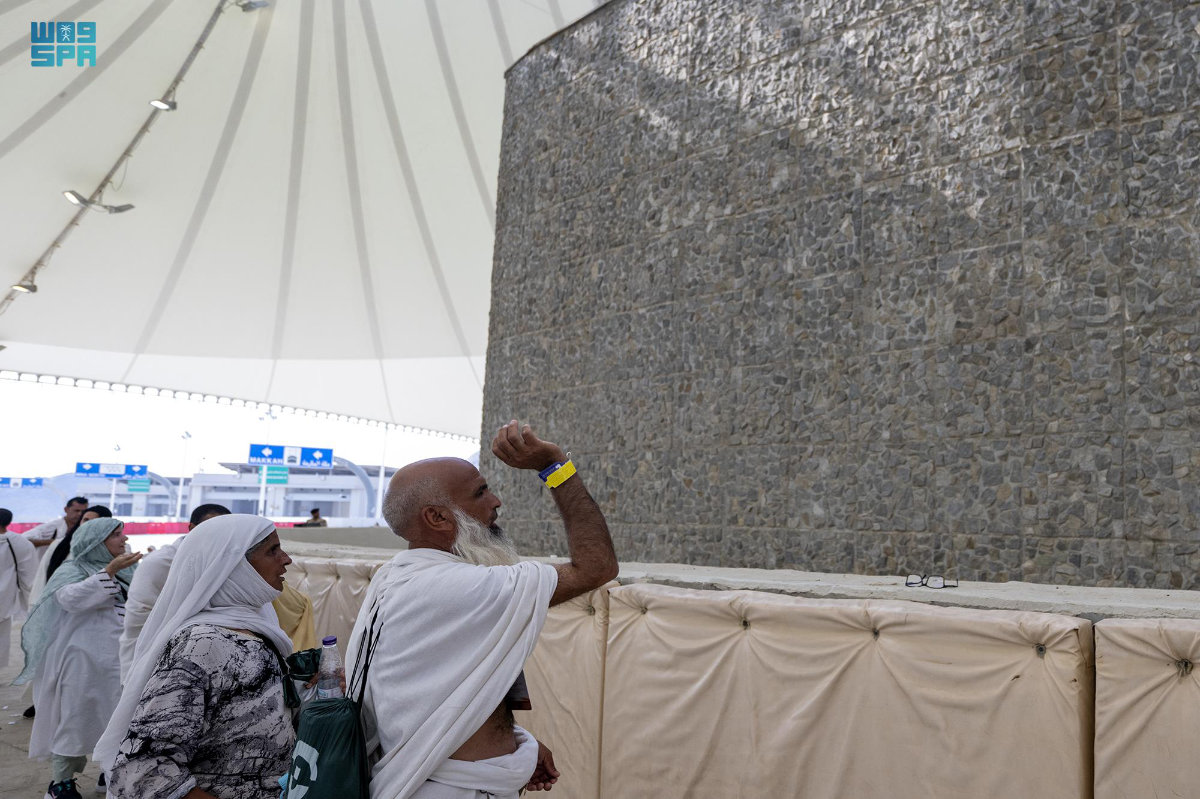


Pilgrims cast stones at pillars in the symbolic stoning of the devil, one of the last rites of Hajj, at the Jamarat in Mina, near the holy city of Makkah, on June 16, 2024. (SPA)

The spokesperson also advised pilgrims not to carry personal belongings when heading to the Jamarat Bridge or the Holy Mosque.

“Furthermore, I urge those intending to leave Mina on the second day of Tashreeq to follow the specified guidelines,” he added.

The days of Tashreeq are the three days that follow the 10th of Dhu al-Hijjah, Eid al-Adha, and are known for the ritual of stoning the three pillars in Mina, symbolizing the rejection of temptation and evil.

However, it is permissible for pilgrims to leave Makkah before sunset on the 12th day of Dhul Hijjah.Al-Shalhoub further reported that the 911 center in the Makkah region had received a total of 78,872 calls on the 10th of Thul Hijjah, covering security reports and service inquiries, all of which were promptly addressed.

He highlighted the close monitoring by Saudi leadership of all security sectors, noting continuous enhancements in their performance each year.“Our security personnel serve as exemplary role models in fulfilling their duties and facilitating the Hajj journey for pilgrims,” he concluded.

For his part, Ayedh Al-Ghuwainem, deputy minister of Hajj and Umrah for Hajj affairs said that the organizational plans and efforts were implemented in harmony with all the participating Hajj agencies.

“The stoning process occurred safely and tranquilly within just ten hours, achieving a compliance rate of 95 percent with the instructions,” he said.

He further added that the plans were designed to accommodate the diverse jurisprudential preferences of pilgrims using modern technology and preplanned schedules for grouping the pilgrims.Al-Ghuwainem stated that more than 800,000 pilgrims had arrived in Mina before dawn on Sunday, and by 8 a.m., all pilgrims had reached Mina.

On their arrival at the Jamarat Bridge, some 70 percent of the pilgrims used the first and fourth floors, while the rest of them went through the second and third floors, according to the deputy minister.

“Moreover, more than 850,000 worshippers have so far performed the Ifadah tawaf since midnight using shuttle bus services from and to the Grand Mosque,” he said.

The deputy minister added that the challenge they faced along with the concerned authorities was that most of the pilgrims preferred to go on foot, despite all the awareness campaigns and the availability of all means of transportation. He also urged the pilgrims to follow the instructions.


Threat to Kingdom’s security is ‘red line’ that will be ‘addressed and neutralized,’ Saudi envoy says

Updated 14 January 2026
Follow

Threat to Kingdom’s security is ‘red line’ that will be ‘addressed and neutralized,’ Saudi envoy says

  • Abdulaziz Alwasil tells UN Security Council the situation in southern Yemen is ‘a just cause with social and historic dimensions’ that can only be resolved through dialogue
  • Recent military activity in the south was unilateral, resulting in an escalation that harms the interests of Yemeni people and undermines efforts to address issues in the south, he said

NEW YORK CITY: Any attempt to threaten Saudi Arabia’s national security is a “red line” and will be met with decisive action, the Kingdom’s ambassador to the UN told the Security Council on Wednesday.

Speaking during a meeting of the council to discuss Yemen, Abdulaziz Alwasil said the situation in the south of the country is “a just cause with social and historic dimensions” that can only be resolved through dialogue.

“We stress that any attempt to threaten our national security is a red line, and we will not hesitate to take the necessary actions and steps to address it and neutralize it,” he added.

Alwasil reaffirmed Saudi Arabia’s support for Yemeni President Rashad Al-Alimi, the Presidential Leadership Council, and the Yemeni government in their efforts to achieve security, stability, development and peace while preserving national unity.

He said military activity by Southern Transitional Council forces in Hadramout and Al-Mahra on Dec. 2, 2025, was unilateral, did not have the approval of the Presidential Leadership Council, and was not carried out in coordination with the Coalition to Restore Legitimacy in Yemen.

It had resulted in an unjustified escalation that harmed the interests of the Yemeni people, undermined efforts to address the issues in the south, and ran counter to the coalition’s objectives, Alwasil added.

The Kingdom, working with its coalition partners, the Presidential Leadership Council and the Yemeni government, had moved to contain the situation by dispatching a military force to coordinate arrangements with the Southern Transitional Council in Aden, he said.

The aim was to ensure the return of the southern council’s forces to their previous positions outside of Hadramout and Al-Mahra, and the handover of camps to legitimate government forces and local authorities in line with agreed procedures, Alwasil added.

He expressed regret over the military operations that took place in Hadramout and Al-Mahra, close to Saudi Arabia’s southern border, which he said posed a direct threat to the Kingdom’s national security, as well as the security of Yemen and regional stability. Such steps were extremely dangerous, he added, and contradicted the principles on which the Coalition to Restore Legitimacy in Yemen had been founded.

Alwasil welcomed a prisoner and detainee exchange agreement signed in Muscat on Dec. 23, which he described as an important humanitarian measure to alleviate suffering and build confidence.

He praised Oman for hosting and sponsoring the consultations and supporting negotiations, and commended the efforts of UN’s special envoy for Yemen, Hans Grundberg, the International Committee of the Red Cross and all others that has played a part.

Regarding the political efforts to resolve the crisis, Alwasil said Saudi Arabia welcomed President Al-Alimi’s call for an inclusive conference in Riyadh to bring together all stakeholders to discuss just solutions to the situation in southern Yemen.

Preparations for the conference have begun, he added, in cooperation with the Yemeni government and southern representatives, reflecting the close ties between the two countries and their shared interests in stabilizing Yemen.

He urged all southern stakeholders to participate actively and constructively in the talks, to help find comprehensive and just solutions that meet the legitimate aspirations of the people of southern Yemen.

Alwasil called on all Yemeni forces and stakeholders to cooperate and intensify their efforts to reach a lasting political settlement that would ensure security and stability.

He described the southern issue as “a just cause with social and historic dimensions,” adding that “the only way to address it is through dialogue that leads to a comprehensive political solution” based on nationally and internationally agreed terms of reference.