Police arrest five in southern Pakistan for chopping off camel’s leg

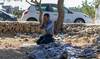
The combination of photos shows the camel whose leg was cut off by a landlord in Sanghar district’s Mund Jamrao village in Sindh, Pakistan on June 15, 2024. (Photo courtesy: @MeghUpdates/X)
Short Url
Updated 16 June 2024
Follow

Police arrest five in southern Pakistan for chopping off camel’s leg

  • Local media widely reported landlord chopped off camel’s leg after it trespassed into his field
  • NGO for injured and stray animals rescues camel, provides it treatment in Karachi 

ISLAMABAD: Police in Pakistan’s southern Sindh province this week arrested five persons for their involvement in chopping off a camel’s leg, the state-run Associated Press of Pakistan (APP) reported.

Local media reports said a landlord in Sanghar district’s Mund Jamrao village allegedly had a camel’s leg chopped off on Friday after the animal trespassed into his field for fodder.

The owner of the camel, a poor peasant named Soomar Behan, was contacted by police after the episode went viral on social media. However, Behan refused to file charges against the landlord following which police took action.

Sindh Information Minister Sharjeel Inam Memon confirmed that a case had been registered against the accused for amputating the camel on the state’s behalf, describing it as a “humanely unacceptable” act.

“He said that the Sindh Chief Minister Syed Murad Ali Shah had taken notice of the incident,” APP said on Saturday. “Sharjeel said that the five accused had been arrested.”

Sanghar lawmaker Shazia Ata Marri wrote on social media platform X police took action as soon as she learned about the “horrible and painful” incident.

“While the police is still doing its work, proper medical treatment is being provided to the poor animal,” she wrote on X.

Section 429 of the Pakistan Penal Code (PPC) states that anyone who kills, poisons, maims, or renders useless any animal of the value of ten rupees or upwards, shall be punished with imprisonment of either a term of up to two years or be fined for the offense, or both.

CDRS Benji Project Karachi Shelter, a local non-profit organization working for stray and injured animals in Pakistan, provided treatment to the injured camel at a shelter in Karachi on Saturday night. 

“Cammie the camel is settling into her new home,” the NGO posted on Facebook with a video showing the camel feeding, a white bandage wrapped around her leg. 

“She is in pain, and it was traumatizing for her to be carried into the shelter. But she is eating now and taking in everything around her with those beautiful, intelligent eyes.”

The NGO said its staff had cleaned the camel’s wound to make sure it was not infected. 


Pakistan, global crypto exchange discuss modernizing digital payments, creating job prospects 

Updated 05 December 2025
Follow

Pakistan, global crypto exchange discuss modernizing digital payments, creating job prospects 

  • Pakistani officials, Binance team discuss coordination between Islamabad, local banks and global exchanges
  • Pakistan has attempted to tap into growing crypto market to curb illicit transactions, improve oversight

ISLAMABAD: Pakistan’s finance officials and the team of a global cryptocurrency exchange on Friday held discussions aimed at modernizing the country’s digital payments system and building local talent pipelines to meet rising demand for blockchain and Web3 skills, the finance ministry said.

The development took place during a high-level meeting between Finance Minister Muhammad Aurangzeb, Pakistan Virtual Assets Regulatory Authority (PVARA) Chairman Bilal bin Saqib, domestic bank presidents and a Binance team led by Global CEO Richard Teng. The meeting was held to advance work on Pakistan’s National Digital Asset Framework, a regulatory setup to govern Pakistan’s digital assets.

Pakistan has been moving to regulate its fast-growing crypto and digital assets market by bringing virtual asset service providers (VASPs) under a formal licensing regime. Officials say the push is aimed at curbing illicit transactions, improving oversight, and encouraging innovation in blockchain-based financial services.

“Participants reviewed opportunities to modernize Pakistan’s digital payments landscape, noting that blockchain-based systems could significantly reduce costs from the country’s $38 billion annual remittance flows,” the finance ministry said in a statement. 

“Discussions also emphasized building local talent pipelines to meet rising global demand for blockchain and Web3 skills, creating high-value employment prospects for Pakistani youth.”

Blockchain is a type of digital database that is shared, transparent and tamper-resistant. Instead of being stored on one computer, the data is kept on a distributed network of computers, making it very hard to alter or hack.

Web3 refers to the next generation of the Internet built using blockchain, focusing on giving users more control over their data, identity and digital assets rather than big tech companies controlling it.

Participants of the meeting also discussed sovereign debt tokenization, which is the process of converting a country’s debt such as government bonds, into digital tokens on a blockchain, the ministry said. 

Aurangzeb called for close coordination between the government, domestic banks and global exchanges to modernize Pakistan’s payment landscape.

Participants of the meeting also discussed considering a “time-bound amnesty” to encourage users to move assets onto regulated platforms, stressing the need for stronger verifications and a risk-mitigation system.

Pakistan has attempted in recent months to tap into the country’s growing crypto market, crack down on money laundering and terror financing, and promote responsible innovation — a move analysts say could bring an estimated $25 billion in virtual assets into the tax net.

In September, Islamabad invited international crypto exchanges and other VASPs to apply for licenses to operate in the country, a step aimed at formalizing and regulating its fast-growing digital market.