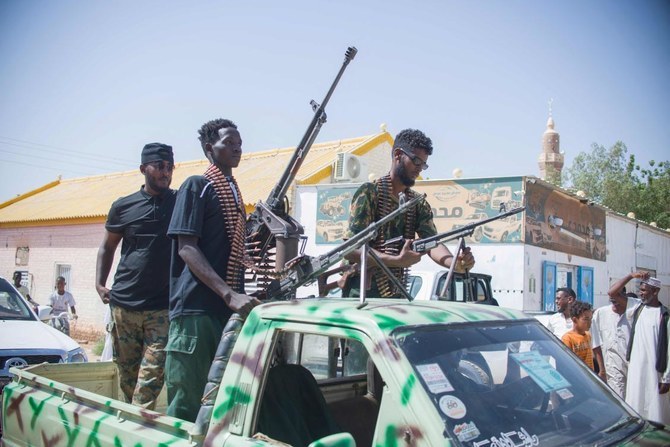
UNITED NATIONS: Sudanese paramilitary forces are using the Central African Republic as a “supply chain,” including for recruitment of fighters, according to a report published Friday by UN experts, who are concerned about a “spillover effect.”
Sudan descended into war in April 2023 when the generals in charge of the army and the paramilitary Rapid Support Forces (RSF) took up arms against each other in a fight for control, rejecting a plan to integrate.
“The spillover effect of the conflict in the Sudan has significantly affected the situation in the Central African Republic,” said the expert committee, formed by the UN Security Council to monitor sanctions on Central Africa.
They highlighted in particular the humanitarian situation, as the country sees an influx of millions of Sudanese refugees, as well as incursions by the two warring Sudanese parties — plus air raids by the Sudanese army in and around the Umm Dafog border post, where the RSF is present.
This “continues to constitute a security threat to civilians and an impediment to humanitarian activities in the area,” the experts said.
They insist the paramilitaries are also using the Am Dafok area in the Central African Republic on the border “as a key logistical hub.”
Because the RSF can “move between the two countries easily through a long-standing network” they have been able to recruit “from among armed groups in the Central African Republic.”
“Opposition armed groups from the Central African Republic have been reported to have actively recruited for, and sent members of their own groups to fight in, the Sudan under RSF,” the experts said.
They noted in particular fighters in Sudan since as early as August 2023 from the Central African rebel group Popular Front for the Rebirth of Central Africa (FPRC).
The experts said they are aware that this armed group and others “are still able to cross between the Sudan and the Central African Republic at will and use Sudanese territory to launch attacks.”
The experts thus called on Central African authorities to “counteract the surge in arms trafficking from neighboring countries, particularly given the current conflict situation in the Sudan.”
They also asked the leaders to combat “the infiltration of foreign fighters into the Central African Republic, which poses a significant long-term threat to the region.”

UN experts say Sudan paramilitaries recruiting in Central Africa
https://arab.news/cdhpt
UN experts say Sudan paramilitaries recruiting in Central Africa
- “The spillover effect of the conflict in the Sudan has significantly affected the situation in the Central African Republic,” said the expert committee
- This “continues to constitute a security threat to civilians and an impediment to humanitarian activities in the area“
More than 80 countries condemn new Israeli rules in West Bank, invoke the ‘New York Declaration’
- Surrounded by nations’ representatives, Palestinian envoy Riyad Mansour reads statement at UN HQ denouncing the measures as ‘contrary to Israel’s obligations under international law’
- Critics say the steps — including expansion of Israeli settlements, legalization of outposts, direct land purchases by settlers, removal of oversight — amount to de facto annexation
NEW YORK CITY: More than 80 countries and several international organizations on Tuesday condemned what they described as unilateral decisions and measures taken by Israeli authorities with the aim of expanding their “unlawful” presence in the occupied West Bank.
Surrounded by more than 80 representatives of the nations and groups, Riyad Mansour, the permanent observer of the State of Palestine to the UN, read a joint statement in which they said: “Such decisions are contrary to Israel’s obligations under international law and must be immediately reversed.”
Israel this month approved significant new measures that tighten its control of the occupied West Bank, focusing in particular on accelerating the process of registering land in a part of the territory known as Area C as “state property.”
The new steps, which critics say amount to de facto annexation, include the legalization of outposts, expansion of Israeli settlements, authorization for direct land purchases by settlers, and the removal of oversight on such transactions.
In their statement, the countries and organizations stressed their “strong opposition to any form of annexation.”
They continued: “We reiterate our rejection of all measures aimed at altering the demographic composition, character and status of the Palestinian territory occupied since 1967, including East Jerusalem.
“Such measures violate international law, undermine the ongoing efforts for peace and stability in the region, run counter to the comprehensive plan, and jeopardize the prospect of reaching a peace agreement ending the conflict.”
They reaffirmed their determination “to take concrete measures in accordance with international law, and in line with the relevant UN resolutions and the July 19 advisory opinion of the International Court of Justice, to help realize the right of the Palestinian people to self-determination, and to counter the illegal settlement policy in the occupied Palestinian territory, including East Jerusalem, and policies and threats of forcible displacement.”
This stance is reflected, they said, in the 2025 New York Declaration, a UN-endorsed initiative proposed, following a conference in July 2025, by France and Saudi Arabia with the aim of reviving efforts to achieve a two-state solution to the conflict between Israel and Palestine.
“We reiterate that a just and lasting peace on the basis of the relevant UN resolutions, the Madrid terms of reference, including the principle of land for peace, and the Arab Peace Initiative, ending the Israeli occupation that began in 1967 and implementing the two-state solution — where two democratic states, an independent and sovereign Palestine and Israel, live side by side in peace and security within their secure and recognized borders on the basis of the 1967 lines, including with regard to Jerusalem — remains the only path to ensure security and stability in the region,” they added.


