HOUSTON: A federal judge on Friday ordered the liquidation of conspiracy theorist Alex Jones′ personal assets but dismissed his company’s separate bankruptcy case, leaving the immediate future of his Infowars media platform uncertain as he owes $1.5 billion for his false claims that the Sandy Hook Elementary School shooting was a hoax.
Judge Christopher Lopez approved converting Jones’ proposed personal bankruptcy reorganization to a liquidation. But Lopez threw out the case of his company, Austin, Texas-based Free Speech Systems, after failed attempts by Jones to reach an agreement with Sandy Hook families on his proposals to reorganize and keep operating the company while paying them millions of dollars.
It wasn’t immediately clear what will happen in the coming weeks to Free Speech Systems, Infowars’ parent company, which Jones built into a multimillion-dollar moneymaker over the past 25 years by selling dietary supplements and other products. But both Jones and lawyers for the Sandy Hook families said they expect Infowars to cease operating at some point because of the huge debt.
A trustee appointed Friday in Jones’ personal bankruptcy case to oversee the liquidation now has control over his assets, including Infowars, according to lawyers for Sandy Hook families.
Dismissal of Free Speech Systems’ case means the families can now move immediately to collect on the $1.5 billion in state courts in Texas and Connecticut where they won defamation lawsuits against Jones and the company. It’s possible Infowars will continue operating during the collection efforts, which could include selling off the company’s assets.
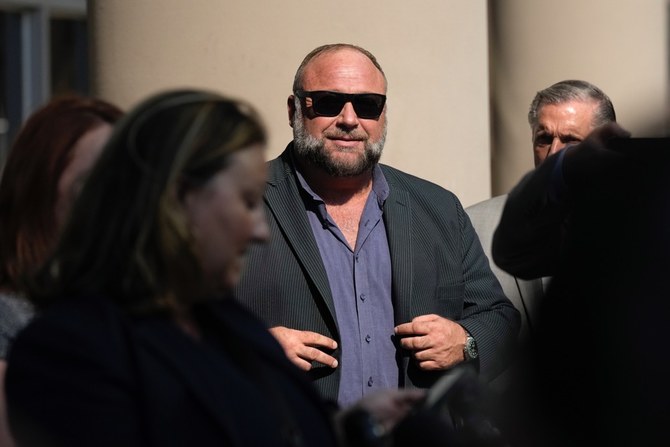
Jones, who smiled as the judge dismissed the company’s case, called in to Infowars after the court hearing and predicted more battles in the state courts. “The bizarre political attempts to hijack the operation have failed,” he said, and added that he would find another way to broadcast his shows if he loses Infowars.
Outside the courthouse, he railed about the families not accepting his reorganization proposals and alleged that they were being used by political groups in a conspiracy to silence him. He said he would try to maximize revenues at Infowars to make money for creditors and then wind down the business in a way that takes care of its 44 employees.
“This is about taking me off the air,” Jones said. “Understand that what you’ve seen in the corporate media about me, or what I said about Sandy Hook or any of this, has no bearing on reality.”
Chris Mattei, a lawyer for the Sandy Hook families, called Infowars “soon-to-be defunct” as his clients move to collect on the debt in state courts. He said the families will also pursue Jones’ future earnings.
“Today is a good day,” Mattei said in a text message after the hearing. “Alex Jones has lost ownership of Infowars, the corrupt business he has used for years to attack the Connecticut families and so many others. ... Alex Jones is neither a martyr nor a victim. He is the perpetrator of the worst defamation in American history.”
Lopez had been asked to either convert Free Speech Systems’ bankruptcy reorganization to a liquidation or dismiss the case. He said his sole focus was what would be best for the company and its creditors. He also said Free Speech Systems’ case appeared to be one of the longest running of its kind in the country, and it was approaching a deadline to resolve it.
“I was never asked today to make a decision to shut down a show or not. That was never going to happen today one way or another,” Lopez said. “This case is one of the more difficult cases I’ve had. When you look at it, I think creditors are better served in pursuing their state court rights.”
Many of Jones’ personal assets will be sold off, but his primary home in the Austin area and some other belongings are exempt from bankruptcy liquidation. He already has moved to sell his Texas ranch worth about $2.8 million, a gun collection and other assets to pay debts.
In the lead-up to Friday’s hearing, Jones had been telling his web viewers and radio listeners that Free Speech Systems was on the verge of being shut down because of the bankruptcy. He urged them to download videos from his online archive to preserve them and pointed them to a new website of his father’s company if they want to continue buying the dietary supplements he sells on his show.
Jones has about $9 million in personal assets, according to the most recent financial filings in court. Free Speech Systems has about $6 million in cash on hand and about $1.2 million worth of inventory, according to J. Patrick Magill, the chief restructuring officer appointed by the court to run the company during the bankruptcy.
During Friday’s hearing, lawyers for the Sandy Hook families repeated claims that Jones illegally diverted millions of dollars both before and during the bankruptcies, and questioned his sending his audience to his father’s website. The families have a pending lawsuit in Texas accusing Jones of illegally diverting money, which he denies, and said they will continue efforts to claw it back.
Jones and Free Speech Systems filed for bankruptcy protection in 2022, when relatives of many victims of the 2012 school shooting that killed 20 first graders and six educators in Newtown, Connecticut, won lawsuit judgments of more than $1.4 billion in Connecticut and $49 million in Texas.
The relatives said they were traumatized by Jones’ comments and his followers’ actions. They have testified about being harassed and threatened by Jones’ believers, some of whom confronted the grieving families in person saying the shooting never happened and their children never existed. One parent said someone threatened to dig up his dead son’s grave.
Jones is appealing the judgments in the state courts.
The families in the Connecticut lawsuit, including relatives of eight dead children and adults, had asked that Free Speech Systems’ bankruptcy case also be converted to a liquidation. But the parents in the Texas suit — whose child, 6-year-old Jesse Lewis, died — wanted the company’s case dismissed, saying it would speed up collection of Jones’ debt to them.
Lawyers for the company filed documents indicating it supported liquidation, but attorneys for Jones’ personal bankruptcy case wanted the judge to dismiss the company’s case.


![]()

Alex Jones’ personal assets to be sold to pay $1.5B Sandy Hook debt. Company bankruptcy is dismissed
Short Url
https://arab.news/grpc2
Alex Jones’ personal assets to be sold to pay $1.5B Sandy Hook debt. Company bankruptcy is dismissed


Latest updates


© 2026 SAUDI RESEARCH & PUBLISHING COMPANY, All Rights Reserved And subject to Terms of Use Agreement.