

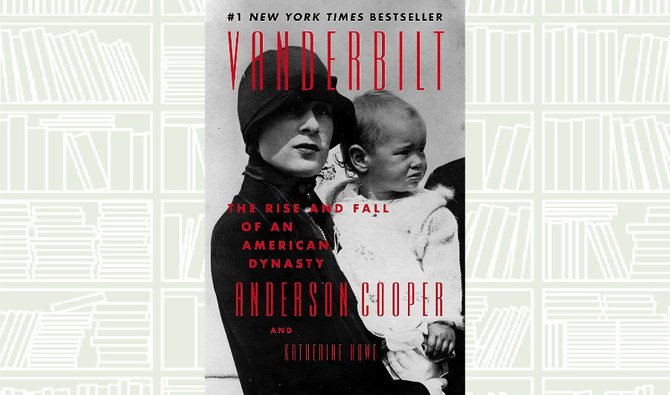
Book Review: ‘Vanderbilt’ by Anderson Cooper

Short Url
Updated 13 June 2024
Follow

Book Review: ‘Vanderbilt’ by Anderson Cooper

Written during the pandemic in 2021, “Vanderbilt: The Rise and Fall of an American Dynasty” looks at the Vanderbilt family, one of the most famous in US history, written by one of its own.

It was penned by journalist Anderson Cooper, formerly of CNN, and while many of us rifled through old archives while on lockdown in our own homes, Cooper attempted to piece together fragments of his own history — and US history.

The book begins with young Cornelius “the Commodore” Vanderbilt at the beginning of the 19th century. Through grit, and a pathological desire to acquire money at all costs, he was able to build two giant empires, one in shipping and another in railroads, that would make him the richest man in America. His staggering fortune was fought over by his heirs until well after his death in 1877.

His great-great-great-grandson is Cooper and this personal yet exhaustive book covers a vast amount of real estate — both in stories and locations — as historian Katherine Howe, his co-writer, and Cooper explore the story of the legendary family and its influence.

Cooper and Howe breathe life into the former’s ancestors who built the family’s vast empire, basked in the Commodore’s wealth and became synonymous with American capitalism and high society.

Moving from old Manhattan to the lavish Fifth Avenue, from the ornate summer palaces to the courts of Europe and modern-day New York, Cooper and Howe recount the triumphs and tragedies of this American dynasty. 

The vignettes are often fascinating and give context to tales often recounted, like that of Alva Belmont, who was married to a Vanderbilt before pivoting to a world of activism. In her heyday she hosted one of the most lavish gala balls of all time, held in 1883, which inspired many a TV series and fanciful gossip following her rivalry with the infamous Caroline Schermerhorn Astor.

The story looks at the melancholic life of Alva’s daughter, Consuelo, and at her eventual happy ending.

Cooper and Howe delve into corners of stories that are more or less unknown. I was particularly fascinated by the story of his relative who lived in a museum for years, before being eventually kicked out.

The stories link and go back and forth on the timeline, perhaps making it slightly confusing for the lay reader.

It does really require the reader to have some prior knowledge of the Vanderbilt family, with its many scandals and nuances.

The authors also go into detail about the lives, and deaths, of the many Vanderbilt men.

The last part of the book spends time exploring the late Gloria Vanderbilt, Cooper’s mother. These passages are the most emotional in the book.

Cooper, who is now a father, explains how writing the book helped to provide a historical context which his son can read about in later life to understand the story behind the stories, and tall tales, written about their family.


Book Review: ‘Keep the Memories, Lose the Stuff’

Updated 01 January 2026
Follow

Book Review: ‘Keep the Memories, Lose the Stuff’

If you are someone who adopts a new year, new me mindset every Dec. 31, then Matt Paxton’s 2022 book “Keep the Memories, Lose the Stuff: Declutter, Downsize, and Move Forward with Your Life,” written with Jordan Michael Smith, is worth picking up.

In the process of reading it, I found myself filling four bags with items to donate.

Paxton’s approach is notably different from Marie Kondo’s once-ubiquitous Japanese tidying method, which asks readers to pile all their possessions into one part of the room, hold each item up and ask whether it sparks joy.

While Kondo’s philosophy sounds appealing on paper — thanking objects and dedicating an entire weekend to the process — it is not realistic for everyday life. Paxton’s method feels more practical and gentler.

Paxton knows the emotional terrain of clutter well. For more than 20 years he has helped people declutter and downsize. He was a featured cleaner on the reality show “Hoarders” and later hosted the Emmy-nominated “Legacy List with Matt Paxton” on PBS.

Through this work, Paxton gained insight into why people hold on to things and what makes letting go difficult even of what seemingly looks useless.

What works especially well is how personal the book feels from the outset.

He opens by explaining his anxiety-inducing decision to move to a different US state with his three children, and all of their stuff, to live with his new wife and all of her stuff.

Together, they would be raising seven children — very Brady Bunch style — but with slightly more practical life considerations.

He also talks about how he got into this line of work. When he was in his 20s, his father died and he had to help clear out his belongings. He found that process to be cathartic and special. And he was good at it.

Soon after, short on cash, he accepted a job from someone in his small, close-knit community to help organize her home — likely hired out of pity more than anything else.

That slow process of sifting through items and learning the stories behind each one — directly from the owner of those objects — sparked plenty of joy. He was hooked.

Throughout the book, Paxton makes the case for consistency. His advice is manageable. He encourages readers to dedicate just 10 minutes a day to decluttering to form a habit. We all can spare that.

Paxton also stresses the importance of communication.

Talk to your loved ones about what you want done with your belongings when you are no longer around, and just as importantly, listen to what they want done with theirs, he urges. He offers practical guidance on having these conversations with parents, partners and children.

One critique of this book is that Paxton dedicates a large portion to physical photographs. While this is relevant for many older readers, it may feel less urgent going forward, particularly for Gen Z and younger, whose clutter is more likely to be solely digital.

Ultimately, “Keep the Memories, Lose the Stuff” is less about getting rid of things than about making space; by speaking about objects, sharing their stories and allowing them — and each of us — to move on.