

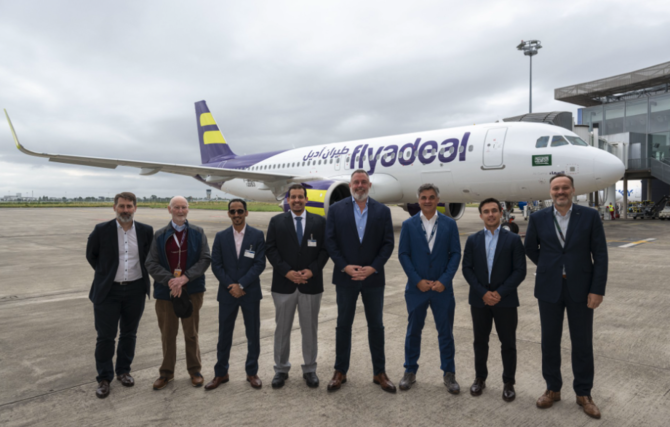
Flyadeal receives first fully-owned aircraft in landmark moment 

Flyadeal CEO Steven Greenway, along with colleagues Ahmed Bakadam, director of maintenance and engineering, and Ali Al-Zahrani, senior manager technical fleet, gathered in France for the official exchange. Supplied
Short Url
Updated 13 June 2024
Follow

Flyadeal receives first fully-owned aircraft in landmark moment 

RIYADH: Saudi Arabia’s low-cost airline flyadeal has taken delivery of its first-ever wholly-owned aircraft in a “milestone” moment, according to the CEO.

The airline received the Airbus A320neo, named Al Sama after an Arabic constellation star in Toulouse, Airbus’ main assembly site.

This acquisition is also the company’s first new aircraft in 2024 and marks the beginning of a delivery plan that includes adding four vessels this year and eight A320neos in 2025.

The newly acquired aircraft will join the airline’s expanding domestic and international route network, serving nearly 30 destinations across Saudi Arabia, the Middle East, Europe, and North Africa.

Flyadeal CEO Steven Greenway, along with colleagues Ahmed Bakadam, director of maintenance and engineering, and Ali Al-Zahrani, senior manager technical fleet, gathered in France for the official exchange. 

“The addition of aircraft number 33 represents a symbolic double milestone for flyadeal, bringing in our first fully owned aircraft and inducting the first new aircraft into the fleet this year. Until now all flyadeal aircraft are leased,” Greenway said.

He added: “With a plan targeting around 50 aircraft by the end of 2025 that will double to 100 by 2030, we are on course for a dynamic delivery schedule over the next few years. An incredible growth path that is being accelerated by the shear demand for inbound and outbound travel catering to a diverse profile of travellers.”

Greenway expressed satisfaction with their partnership with Airbus and highlighted the aircraft’s comfort and eco-friendliness, emphasizing their commitment to providing passengers with a positive flying experience. 

As part of future fleet requirements, flyadeal placed its largest ever order last month for a further 51 Airbus A320 family aircraft comprising 12 A320neos and 39 larger A321neos. 

Sporting a spacious cabin of 186 seats in a three–three configuration that features seating of the highest standards and specifications for a low-cost airline and larger than normal overhead bins, the A320neo is the backbone of flyadeal’s fleet, which is among the youngest in the industry averaging just over two years old. 


Saudi-French cooperation to localize veterinary vaccine manufacturing

Updated 16 sec ago
Follow

Saudi-French cooperation to localize veterinary vaccine manufacturing

RIYADH: In the presence of sector leaders, the National Livestock and Fisheries Development Program signed a memorandum of understanding with French company Ceva under the patronage of Minister of Environment, Water and Agriculture Abdulrahman bin Abdulmohsen Al-Fadhli, who also chairs the program’s board.

The agreement aims to localize vaccine manufacturing, transfer technology and technical expertise, and expand the industrial and commercial production of veterinary vaccines across the Kingdom.

According to the MoU, the two parties will work to achieve high efficiency in mass production scale-up and establish a clear path for sustainable commercial operation that meets the needs of the local and national market, as well as strengthen the biosecurity and food security system.

The MoU also includes the development and modernization of messenger RNA vaccine technologies, along with joint research and development of a Middle East Respiratory Syndrome vaccine for camels. This involves designing, evaluating, and developing vaccines specifically tailored to combat the virus.

The agreement also covers the development of a rabies vaccine and related solutions, as well as supporting national efforts to control the disease through vaccine provision, capacity building, and the implementation of integrated prevention strategies.

The collaboration between the program and Ceva aims to meet the needs of the poultry vaccine market in the Kingdom, currently estimated at around SR750 million ($199 million).

The company will work to cover approximately 30 percent of this market with an initial investment of around SR250 million.

With continued government support for poultry projects and increased production in the sector, the market is expected to grow at a rate exceeding 10 percent annually, reaching approximately SR1.25 billion by 2030.

The addition of the world’s leading poultry vaccine manufacturer to Biotech Park highlights the program’s key role in developing new industries within the livestock and fisheries sector.

It also highlights the program’s commitment to building international partnerships with global companies, organizations, research centers, and universities to support advanced biotechnology industries and attract high-quality investments. It also seeks to create new economic sectors based on biotechnology, enhance veterinary health security, and support the sustainable economic development of the livestock sector, as well as empower national and emerging companies and provide advanced research and industrial infrastructure.

This will solidify the Kingdom’s position as a global hub for biotechnology industries and the development of national capabilities.

Ceva is the first international partner to join Biotech Park, the future veterinary biotechnology city launched by the program in Dhurma Governorate. The city is the world’s first specialized and fully integrated hub for veterinary biotechnology, serving as a benchmark for sector development and a platform supporting markets across the Kingdom, the Gulf, the Middle East, Africa and beyond.

The signing of Ceva is a significant step, given its position as the world’s leading manufacturer of poultry vaccines and medicines, and one of the most prominent international companies in the field of biotechnology.

The MoU aims to localize the veterinary vaccine industry, ensuring its compatibility with the strains of poultry diseases prevalent in Saudi Arabia. This includes the transfer of technology and technical expertise from Ceva, along with the implementation of specialized training programs to guarantee that manufacturing facilities comply with international Good Manufacturing Practice standards.