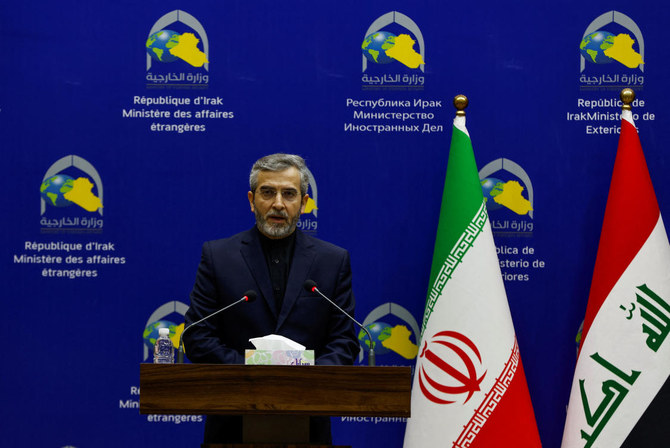
BAGHDAD: Iraq’s foreign minister on Thursday, receiving his Iranian counterpart in Baghdad, warned of the dangers of conflict expanding in southern Lebanon and its repercussions across the Middle East.
Near-daily cross-border fire between Lebanese-based militants and Israeli forces have occurred since Palestinian group Hamas attacked southern Israel on October 7, triggering the ongoing aggression in the Gaza Strip.
The exchanges between Israel and Lebanon’s powerful Iran-backed Hezbollah group, an ally of Hamas, have intensified in recent weeks, sparking fears of wider war.
“If southern Lebanon is attacked, it will affect the entire region,” Iraq’s top diplomat Fuad Hussein said at a press conference with Iran’s acting Foreign Minister Ali Bagheri, who also voiced opposition to a regional escalation.
“The expansion of the war is a danger, not only for Lebanon but for the entire region,” Hussein said, repeating his call for a permanent ceasefire in Gaza.
The Iranian minister similarly called for “putting an end as quickly as possible, and without preconditions,” to “war crimes” and “genocide” in the Gaza Strip.
He said Israel, in response to their “failure” in Gaza, “may seek to commit further wrongs and broaden the scope of their aggression,” but Iran would not allow anyone “to harm stability and regional security, even if only a little.”
Experts have said they believe risk of a wider war is limited.
Hezbollah, a major ally of Tehran’s, launched a barrage of rockets at northern Israel on Wednesday and promised to intensify its attacks after the killing of a top military commander the day before in an Israeli strike.
The Israeli military said more than 150 projectiles were fired from Lebanon into Israel in successive barrages, without any reported casualties, adding that they responded with strikes against several targets in southern Lebanon.


![]()

Iraq warns of ‘danger’ in Lebanon conflict expanding
Short Url
https://arab.news/n3vzs
Iraq warns of ‘danger’ in Lebanon conflict expanding
- The exchanges between Israel and Lebanon’s powerful Iran-backed Hezbollah group, an ally of Hamas, have intensified in recent weeks, sparking fears of wider war


Latest updates


© 2026 SAUDI RESEARCH & PUBLISHING COMPANY, All Rights Reserved And subject to Terms of Use Agreement.