


ISLAMABAD: Pakistan will work with Arab states and other Muslim countries to seek the implementation of two United Nations Security Council (UNSC) resolutions for a ceasefire in Gaza, Islamabad’s top diplomat at the United Nations said on Wednesday, a week after Pakistan was elected as a non-permanent member of the Council.
Pakistan will replace Japan, which currently occupies the Asian seat, on January 1, 2025, to begin a two-year term after being elected to the top UN body for the eighth time with 182 votes in the 193-member General Assembly.
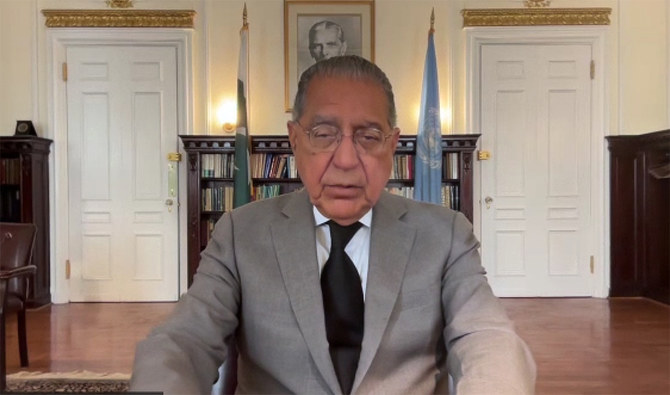
“We are trying to do together with our Arab and Muslim brothers, to get an implementation of the Security Council’s decisions on a ceasefire, on providing humanitarian access for the besieged people, the Palestinians, and Gaza, and to promote reconstruction and finally of course to promote the vision of a two-state solution which everybody agrees is the only course through which a durable peace can be established in the holy land,” Pakistan’s Permanent Representative to the United Nations, Ambassador Munir Akram, told Arab News in a Zoom interview from New York.
On Monday, the UNSC backed a proposal outlined by US President Joe Biden for a ceasefire between Israel and Hamas in the Gaza strip and urged the Palestinian group to accept the deal aimed at ending the eight-month-long war.
Akram said the United States proposal called for the implementation of a ceasefire plan, which was negotiated by Egypt, Qatar, and the US.
“Now the question is whether this resolution will be implemented and again, the question of implementing resolutions when it comes there, the United Nations has limited capability for enforcement,” he said, adding that the UN had no military means to implement its decisions and sanctions required passage by the UNSC, which was difficult due to the power of veto.
The world had witnessed many instances where actions had been blocked in the Security Council because of the use of the veto, Akram said.
“This is where we have to explore what is possible and what is doable to get to the objectives that we all want, which is ceasefire in Gaza, humanitarian help, reconstruction, and a two-state solution.”
As a non-permanent member of the UNSC, the ambassador said Pakistan would promote an international order based on the UN Charter, emphasizing self-determination, sovereignty, territorial integrity, non-interference, and prohibiting the use or threat of force.
“We will seek for the implementation of the UN resolutions on Kashmir and other conflicts and will also be seeking to strengthen UN peacekeeping capabilities to make UN peacekeeping more effective,” Akram said.
When asked about his country’s expectations from Indian Prime Minister Narendra Modi who has been sworn in for a third term, Akram said Pakistan “looked forward” to the possibility of dialogue to address all outstanding issues, including the principal issue of Kashmir.
The Muslim-majority Himalayan region of Kashmir has been a flashpoint between Pakistan and India since their independence from British rule in 1947. Both countries rule part of the Himalayan territory but claim it in full and have fought two wars over the disputed region.
“Pakistani government is open to a constructive dialogue with India,” Akram said. “We hope this will be a dialogue without preconditions and that we would be able to promote more normal relations and a relationship based on the principle of sovereignty and equality of states.”


