

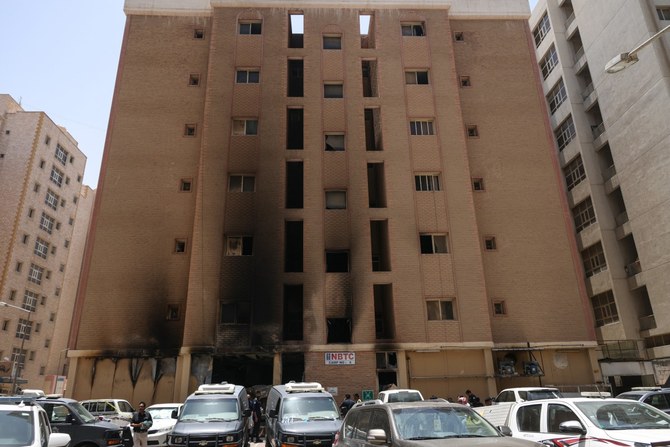

KUWAIT: Most of the victims in a deadly blaze that engulfed a block housing immigrant workers were from India, Kuwait’s foreign minister said on Thursday, raising the death toll to 50.
Kuwait’s Emir Sheikh Meshaal Al-Ahmad Al-Jaber Al-Sabah ordered financial compensation for the families of the victims, who will be repatriated to India in military aircraft, according to an official statement.
Three Filipinos were among the dead, Philippines officials said, after the fire sent black smoke billowing through the six-story building south of Kuwait City.
At least 43 more were injured in the fire in Mangaf, south of Kuwait City, which broke out around dawn on Wednesday at the ground level of the block housing nearly 200 workers.
“One of the injured died” overnight, Foreign Minister Abdullah Al-Yahya told reporters, after 49 people were declared dead on Wednesday.
“The majority of the dead are Indians,” he added. “There are other nationalities but I don’t remember exactly.”
Indian Prime Minister Narendra Modi said the country is “doing everything possible to assist those affected by this gruesome fire tragedy,” in a post on X late on Wednesday.
Next of kin will receive payments of 200,000 rupees ($2,400), Modi’s office announced.
In Manila, the Department of Migrant Workers said three Filipinos died from smoke inhalation, with two more in critical condition while six escaped unharmed.
“We are in touch with the families of all the affected (workers), including the families of those two in critical condition and the families of the three fatalities,” Migrant Workers Secretary Hans Leo J. Cacdac said in a statement.
Kuwaiti officials have detained the building’s owner over potential negligence and have warned that any blocks that flout safety rules will be closed.
Since the fire broke out, Kuwaiti officials have carried out intensive inspections to demolish violating properties.
Stories of the victims
From a father-of-two who planned to leave his job to a 29-year-old due to visit his family in August, two dozen Indians from the southern state of Kerala died, leaving their families bereft.
Among the Keralite victims was Muralidharan Nair, who had been working in Kuwait for 32 years, including 10 as a senior supervisor in the company that owned the housing facility where the fire broke out.
“He came on leave in December for two months with a plan to end his career in Kuwait. The company called him back,” his brother, Vinu V Nair, told Reuters, adding that the family identified the 61-year-old from a list published by India’s embassy. His two roommates also died in the blaze.
For decades, a disproportionately large share of Indian workers in the Gulf have been drawn from Kerala, a densely packed state along southern India’s Arabian Sea coast.
News of the disaster spread quickly in Kerala. The family of Saju Varghese, 56, found out about the fire from television and social media, and confirmed his death from friends and relatives in Kuwait.
Working in the Gulf nation for the last 21 years, Varghese planned to visit Kerala later this month to arrange his daughter’s higher education.
“The family is in a state of shock,” their neighbor, George Samuel, said.
Another victim, Stephin Abraham Sabu, 29, was an engineer in Kuwait since 2019 and called home almost daily.
He had visited his hometown Kottayam “two or three times” since he left, and had booked air tickets to return in August for the housewarming of his family’s new home and to help them buy a new car, his friends said.
Sabu’s father has a small shop in Kottayam while his mother is a housewife. His brother, Febin, also works in Kuwait but lived separately.
With agencies


