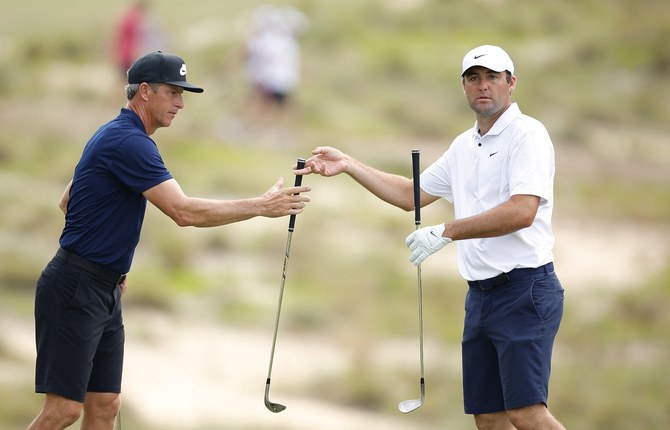

PINEHURST, N.C.: Pebble Beach has the Pacific Ocean. Oakmont is the brute with its church pew bunkers. Pinehurst No. 2 has the cereal bowls turned upside down.
The greens at Pinehurst No. 2 are the signature of this Donald Ross course that hosts the 124th US Open starting on Thursday. They go by any variety of names — upside-down cereal bowls, inverted saucers, turtlebacks or domes.
Whatever they’re called, they are universally regarded as daunting, particularly for a US Open already known as the toughest test in golf.
“You hit it on the green, the hole is not done,” defending champion Wyndham Clark said.
He played when he arrived on Monday and was amazed and how firm and fast they already were, calling them “borderline” in terms of fairness. And this was still three days out from the opening tee shot on Thursday.
Perhaps that’s why in three previous US Opens at Pinehurst No. 2, a total of four players finished the championship under par. One was Payne Stewart, thanks to that famous 15-foot par putt on the final hole to beat Phil Mickelson in 1999 at 1-under par.
Martin Kaymer took advantage of the rain-softened conditions and brilliant golf to win in 2014 at 9 under, with Rickie Fowler and Erik Compton eight shots behind and the only other players in red numbers for the week.
“I’d say in general, I think the best players play aggressively off the tee and conservatively into the greens. I think this course is basically that strategy — just on steroids,” Viktor Hovland said. “I think having a shorter club in is very important. But then into the greens you’ve got to play very, very conservatively. I think just hitting the greens itself is of high value.”
There have been plenty of illustrations of that.
Jordan Spieth was practicing to the right of the par-3 ninth green on Wednesday afternoon, aiming toward a coaster the size of a golf hole on the left side. He pitched it hard, well past the hole to the top of a small ridge so that it would roll back toward his target. And it did just that, but it was a foot too far to the left and before long had run all the way off the green.
“This is one you putt,” Spieth told Sam Burns. Instead of walking over to his bag for a putter, Spieth used the left-handed putter of alternate Josh Radcliff and gave it a whack.
It can be hard to keep track of golf balls, especially when a practice group has four players, with balls rolling all over the place, some of them winding up off the green.
Such is the nature of Pinehurst No. 2. And while the course is more than a decade removed from its restoration project that returned sandy areas with native plans instead of thick rough, it’s the greens that give the course its character.
And then it’s up to the USGA to make conditions so demanding that only the most highly skilled players can handle them. Such is the essence of the US Open.
John Bodenhamer, the chief championships officer at the USGA who is in charge of setting up the course, said 2014 data showed 70 percent of the players hit the fairway, but only 56 percent of them hit the green.
“It is all about these magnificent upside-down cereal bowl putting greens,” Bodenhamer said. “They are difficult to hit, and we need to get the right firm and fast conditions around them.”
And when players miss the greens — from the fairways, sometimes from putts that roll off the crowned edges — there are options.
“I was joking with my caddie, ‘We should probably get our putter checked.’ I’ve never swung so hard on my putter for nine holes, just trying to get up and down the mounds,” PGA champion Xander Schauffele said. “There’s certain spots where you feel like you have to hit it really hard. You hit it too hard, you putt it off the other side of the green.
“Leaving yourself in a really good position is A-1,” he said. “But even when you do leave yourself in a good position, the hole is not over yet. It’s sort of half the battle.”
Clark won last year at Los Angeles Country Club with a score of 10-under 270. That week also started with Schauffele and Rickie Fowler setting a US Open record of 62 in the opening round some 10 minutes apart.
No one expects that kind of scoring this week. Bryson DeChambeau, who studied physics at SMU, cited Boo Weekley, who barely studied at all during his brief time at Abraham Baldwin Agriculture College.
“Pinehurst is no joke. This is a ball-striker’s paradise,” DeChambeau said. “You have to hit it in the middle of the greens. And this is a Boo Weekley quote, but the center of the green never moves. So I’ll try to focus on that this week.”
There is more trouble than just the greens. The sandy areas — “sandscapes” is what they are called in these parts — have wiregrass bushes the size of basketballs speckled across the terrain. Hit in there and hope — it could be a clean lie, it could be trouble.
“It’s a walk up that fairway of a bit of anxiety, because they don’t know what they’re going to get,” Bodenhamer said. “The randomness ... it’s not just 5-inch, green, lush rough. It can be something gnarly, wiregrass, or it can be a perfect sandy lie. I think you’re going to see some players walk to their golf ball and be unhappy, and others are going to be thrilled.
“We think that is pretty cool, and we think that is exactly what Donald Ross intended.”