VIENNA/PARIS: Iran is responding to last week’s UN nuclear watchdog board resolution against it by expanding its uranium-enrichment capacity at two underground sites, but the escalation is not as big as many had feared, diplomats said on Wednesday.
Iran bristles at such resolutions by the International Atomic Energy Agency’s 35-nation Board of Governors, and it reacted to the previous one 18 months earlier by enriching to up to 60 percent purity, close to weapons grade, at a second site and announcing a large expansion of its enrichment program.
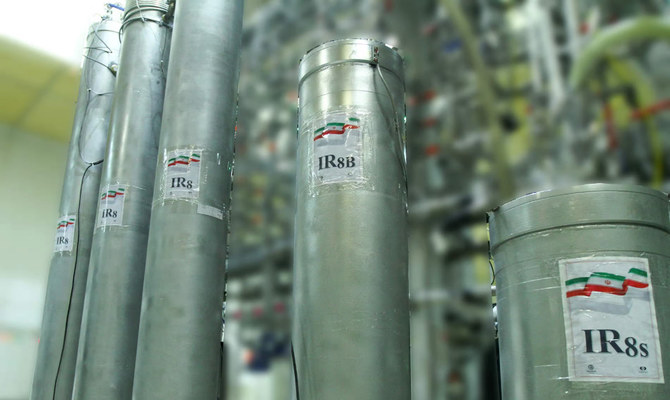
This time it plans to install more cascades, or clusters, of centrifuges, the machines that enrich uranium, at both its underground enrichment sites, five diplomats said. IAEA inspectors observing Iran’s progress plan to issue a report to member states on Thursday, three of the diplomats said.
“It’s not as much as I would expect,” one Vienna-based diplomat said, referring to the scale of Iran’s escalation.
“Why? I don’t know. Maybe they’re waiting for the new government,” they said, referring to the death in a helicopter crash last month of Iranian President Ebrahim Raisi and Foreign Minister Hossein Amirabdollahian, and the presidential election due to be held on June 28.
The IAEA Board passed a resolution a week ago calling on Iran to step up cooperation with the IAEA and reverse its recent barring of inspectors despite earlier US concerns Tehran would respond with atomic escalation. Only Russia and China opposed.
Diplomats did not go into specifics on the number or type of centrifuges being added or what level they would enrich to, though one diplomat said they would not be used to quickly expand Iran’s production of uranium enriched to up to 60 percent, close to the 90 percent of weapons grade.
The diplomats said they would wait to see what the IAEA said Iran had actually done but they were aware of Iran’s plans.
The move is “at the lower end of expectations and something we’re pretty sure they were going to do anyway,” one diplomat said, meaning it would have happened even without the resolution.
Iran did not fully follow through on its November 2022 announcement after the previous resolution. While it installed all the centrifuges it said it would at its underground enrichment plant at Natanz, 12 cascades of one advanced model, the IR-2m, are not yet in operation.
Iran is only enriching to up to 60 percent at an above-ground pilot plant at Natanz and its Fordow site, which is dug into a mountain. In November 2022 it started enriching to up to 60 percent at Fordow but it has yet to install all the additional cascades it said it would.


Iran expanding enrichment capacity after IAEA resolution, diplomats say
https://arab.news/8wzy5
Iran expanding enrichment capacity after IAEA resolution, diplomats say

- Iran is only enriching to up to 60 percent at an above-ground pilot plant at Natanz and its Fordow site, which is dug into a mountain


Syria Kurds chief says ‘all efforts’ being made to salvage deal with Damascus
- Abdi said the Syrian Democratic Forces (SDF), the Kurds’ de facto army, remained committed to the deal
- The two sides were working toward “mutual understanding” on military integration and counter-terrorism
DAMASCUS: Syrian Kurdish leader Mazloum Abdi said Thursday that “all efforts” were being made to prevent the collapse of talks on an agreement with Damascus to integrate his forces into the central government.
The remarks came days after Aleppo saw deadly clashes between the two sides before their respective leaders ordered a ceasefire.
In March, Abdi signed a deal with Syrian President Ahmed Al-Sharaa to merge the Kurds’ semi-autonomous administration into the government by year’s end, but differences have held up its implementation.
Abdi said the Syrian Democratic Forces (SDF), the Kurds’ de facto army, remained committed to the deal, adding in a statement that the two sides were working toward “mutual understanding” on military integration and counter-terrorism, and pledging further meetings with Damascus.
Downplaying the year-end deadline, he said the deal “did not specify a time limit for its ending or for the return to military solutions.”
He added that “all efforts are being made to prevent the collapse of this process” and that he considered failure unlikely.
Abdi also repeated the SDF’s demand for decentralization, which has been rejected by Syria’s Islamist authorities, who took power after ousting longtime ruler Bashar Assad last year.
Turkiye, an important ally of Syria’s new leaders, sees the presence of Kurdish forces on its border as a security threat.
In Damascus this week, Turkish Foreign Minister Hakan Fidan stressed the importance of the Kurds’ integration, having warned the week before that patience with the SDF “is running out.”
The SDF control large swathes of the country’s oil-rich north and northeast, and with the support of a US-led international coalition, were integral to the territorial defeat of the Daesh group in Syria in 2019.
Syria last month joined the anti-IS coalition and has announced operations against the jihadist group in recent days.


