

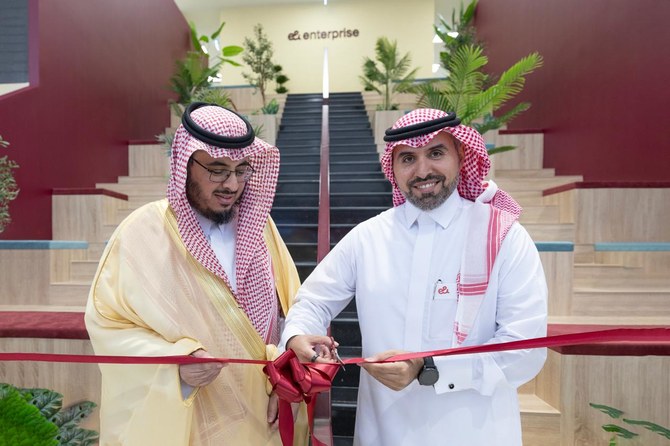
e& enterprise launches customer service center in Riyadh

Short Url
Updated 12 June 2024
Follow

e& enterprise launches customer service center in Riyadh

e& enterprise has announced the launch of a new Contact and Customer Experience Center in Riyadh. Aligned with Saudi Arabia’s Vision 2030, the new facility is designed to take customer experiences to new heights while significantly contributing to the local economy by creating more than 1,500 new jobs at various levels.

The launch took place during a ceremony held by the company on Sunday, in the presence of Deputy Governor of the Communications, Space and Technology Commission Raed Al-Fayez and Deputy Minister Assistant of Future Jobs and Capabilities Safa Alrashed. E& enterprise’s CEO Tariq Alangari welcomed the dignitaries and media representatives to the event.

The new center is a byproduct of e& enterprise’s commitment to advancing the Kingdom’s digital transformation. Equipped with the latest communication technologies, NOC control and high-readiness data centers, the facility meets the Kingdom’s stringent cybersecurity requirements. It adheres to the highest standards of quality, security, and business continuity, ensuring unparalleled customer service.

Tareq Alangari, CEO of e& enterprise, said: “We are thrilled to announce the launch of the new Contact and Customer Experience Center in our continuous efforts to support the digital transformation journey of the Kingdom’s government and private entities, providing them with completely new digital experiences. At e& enterprise KSA, we’re committed to Saudization and the professional development of local talents, contributing to achieving the digital ambitions and goals of the Kingdom’s Vision 2030.”

e& enterprise’s Contact and Customer Experience Center in Riyadh will be staffed by experts in customer experience and contact center management with technical and practical certificates specialized in quality management, customer, and beneficiary experience. The new facility will also focus on creating a suitable environment for national competencies and promoting investment in the business outsourcing, call centers, and control sector. 

e& enterprise began its operations in Saudi Arabia in 2020 and has since expanded by acquiring several regional and local companies. e& enterprise KSA serves customers in five different sectors: cybersecurity, the Internet of Things, cloud computing, customer experience and call centers, and financial technology.

HelpAG, the cybersecurity arm of e& enterprise, localizes cyber control services for companies and governments through specialized strategic consulting. In cloud computing, e& enterprise acquired the majority stake in Bespin Global, providing digital transformation solutions with expertise in eight countries, including Korea and Japan.

In fintech, Beehive, the first licensed P2P lending platform in the MENA region acquired by e& enterprise in 2023, connects SMEs with investors using innovative technologies and offers Shariah-compliant options. Meanwhile, in IoT, e& enterprise provides advanced IoT services for smart cities, sustainability platforms, and industrial automation. As for customer experience, the company’s engageX platform enhances customer journeys with AI and CPaaS services, supported by skilled contact center personnel.

e& enterprise is a subsidiary of the e& group, which is present in more than 32 countries through various business pillars in communications and information technology. They empower institutions and individuals in the government and private sectors to achieve digital transformation through the latest technology solutions. Committed to driving the Kingdom’s digital revolution, e& enterprise plays a vital role in advancing the goals of Saudi Vision 2030.


Cisco drives Kingdom’s secure expansion into AI-driven, cloud-first future

Updated 21 December 2025
Follow

Cisco drives Kingdom’s secure expansion into AI-driven, cloud-first future

With local infrastructure investment, AI-ready data centers and diverse strategic partnerships, Cisco is supporting the Kingdom’s secure expansion into an AI-driven, cloud-first future. 

Fady Younes, managing director for cybersecurity at Cisco for the Middle East, Africa, Türkiye, Romania and CIS, said that Saudi Arabia is adopting AI at a pace faster than the global average, according to Cisco’s Cybersecurity Readiness Index and AI Readiness Index. Still, while this rapid uptake is driving efficiency and innovation, it also introduces new AI-related risks that organizations must address early, he said. This underscores the critical importance of embedding security into every digital and AI initiative from the outset to ensure safe and sustainable growth.

A key pillar of Cisco’s strategy in Saudi Arabia, according to Younes, is local infrastructure investment. Cisco has established fully operational data centers in the Kingdom to deliver cloud-based security services and the Webex collaboration platform, with plans to launch a dedicated Meraki cloud region. Localizing these services, he said, supports national data-sovereignty requirements, strengthens regulatory compliance, and reduces latency, enabling faster AI-driven threat detection and response.

Younes also pointed to Cisco’s partnership with AMD and HUMAIN, a PIF company. This joint venture, set to launch in 2026, will combine advanced data centers with Cisco and AMD technologies to provide efficient, cost-effective infrastructure and develop up to 1 GW of AI capacity by 2030. He described the initiative as a strong example of how global technology expertise and local ambition can align to support the Kingdom’s long-term AI goals.

Discussing the growing demand for AI-ready data centers, Younes highlighted Cisco’s role in modernizing traditional environments into unified, high-performance platforms. This includes Secure AI Factory architectures with scalable AI PODs and embedded security, private and hybrid cloud models that preserve data sovereignty, GPU-optimized compute powered by low-latency Silicon One networking, and unified management through platforms such as Intersight and Nexus Dashboard. All these capabilities, combined with strategic partnerships with companies like NVIDIA, give Saudi organizations the resilience and scalability needed to run large-scale AI workloads with confidence.

On the cybersecurity front, Younes explained that AI now sits at the core of how threats are detected and contained. By applying AI across the security stack, Cisco can identify patterns that human analysts would miss, correlate signals across networks, endpoints, and cloud environments, and automate large parts of responses at speed. This approach is fundamental in the Middle East, where rapid digitization has expanded attack surfaces and introduced risks like shadow AI and fragmented security tools.

Platforms such as Cisco’s AI Defense, he said, are designed to protect AI models and applications themselves, while also strengthening overall detection and response. Identity has also become the primary target in modern attacks, so Cisco’s AI-driven tools protect user identities, authentication flows, and access behaviors across hybrid environments. Combined with capabilities like Hybrid Mesh Firewall and Universal Zero Trust Network Access, these technologies are delivered through the Cisco Security Cloud, enabling Middle East organizations to respond faster, simplify operations, and stay ahead of increasingly AI-driven threats.

Beyond technology, Younes stressed that building a skilled local workforce is essential to sustaining Saudi Arabia’s digital momentum. Cisco works closely with universities, government entities, and telecom partners to develop talent equipped for AI-enabled, cloud-centric networks. To date, more than 480,000 learners in Saudi Arabia have been trained through the Cisco Networking Academy, with women accounting for 36 percent of participants. Cisco has also committed to providing free digital upskilling for 500,000 learners in the Kingdom over the next five years across AI, cybersecurity, data science, and programming.

He added that Cisco is placing growing emphasis on AI-security literacy, helping learners and professionals understand emerging risks such as data exposure, shadow AI, and identity-based attacks. To further advance AI research and development, Cisco and King Abdullah University of Science and Technology announced the launch of a new AI Institute, focusing on applied research in areas ranging from AI-native communication systems and advanced edge infrastructure for Industry 5.0 to AI-driven solutions for critical sectors such as water, energy, food, and healthcare.

Looking ahead, Younes believes that the most significant security priorities for Saudi organizations over the next five years will shift toward protecting far more dynamic, distributed, and automated environments. One of the biggest needs will revolve around securing AI systems themselves, not just the data they use, but the models, applications, and pipelines that drive new digital services. As cyberattackers increasingly use AI to scale their operations, organizations will also need defenses that operate at machine speed and can automatically correlate signals across networks, users, and cloud workloads.

Fragmented security architectures will be another challenge as companies modernize and move deeper into hybrid and multicloud environments. Cisco’s integrated approach, bringing networking and security together through the Cisco Security Cloud, is designed to address this challenge, Younes said. By simplifying complex hybrid and multicloud environments and supporting zero-trust security across AI workloads, Cisco aims to help Saudi organizations innovate securely and confidently as they embrace AI at scale.

Finally, there is the long-term workforce element. As networks become more cloud-centric, Saudi organizations will need talent that understands both AI and cybersecurity. Cisco’s partnerships across the Kingdom, from enterprise collaborations to skills programs, are designed to help build that capability so organizations can innovate confidently at scale.