

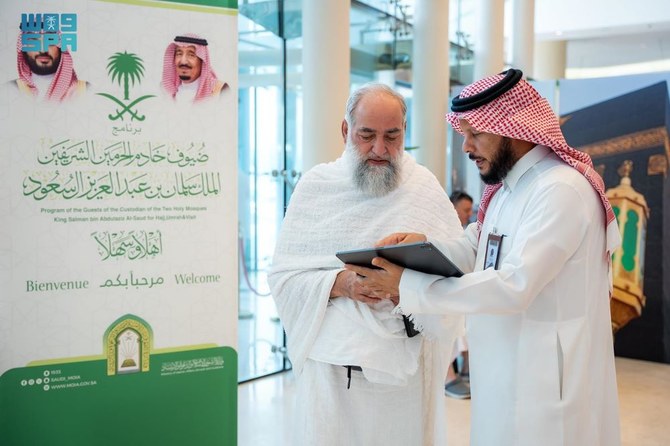
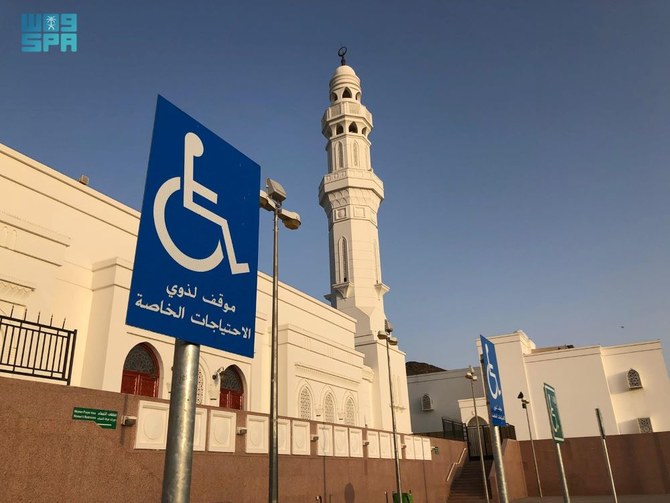

MAKKAH: Government agencies in the Kingdom play a vital role in providing humanitarian services to ensure the safety and comfort of pilgrims during the Hajj rituals, with special care provided to the elderly and disabled people.
Hospitals and health centers are available in Makkah, Madinah and the holy sites, offering first aid and emergency medical care. Awareness and educational campaigns about public health and preventive measures are also being conducted.
Security services undertake crowd management and traffic control to ensure the safety of pilgrims. They also provide search and rescue services and deploy teams to maintain order and safety at the holy sites.
Visitor Umm Ayman Reda said she was delighted with the available services from the moment she arrived at King Abdulaziz International Airport. She said she used the Haramain High Speed Railway to get to her hotel and it “did not make her feel old” as she did not have to walk long distances.
She said the Hajj agency told her about an integrated program for the elderly and people with special needs, which ensures they can perform their rituals with ease and comfort. This was “a significant humanitarian effort provided by the Kingdom to serve Hajj pilgrims from all over the world,” she said.
Saad Jameel Al-Qurashi, who owns of a local Hajj agency, said the Kingdom’s leaders were dedicated to ensuring the comfort of pilgrims at every stage of the Hajj journey.
He said the pilgrimage sites in Arafat and Muzdalifah were fully equipped with services to assist the elderly and people with special needs so they could perform their rituals in comfort.
“All Hajj workers are dedicated to serving the pilgrims … it is an honor that Saudis proudly uphold at all levels,” he said.
He also complimented the transport and communication services and said visitors were provided with drinking water, free meals and guides to help them perform their Hajj rituals correctly.
Brochures and information leaflets in multiple languages are being distributed and information centers have also been established.
Modern technology is used to track the movement of pilgrims and ensure their safety. Mobile applications help visitors navigate and access necessary information, while quick relief services are available for emergency situations.
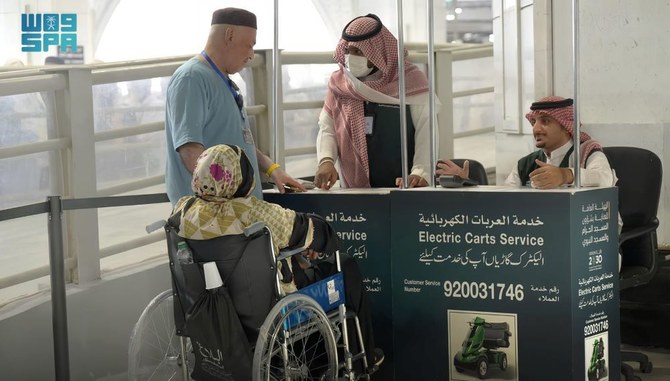
The General Authority for the Care of the Two Holy Mosques told Arab News it had implemented comprehensive measures to care for people with disabilities at the Grand Mosque, including within the prayer rooms. These are cleaned and sterilized before and after each prayer and Zamzam water is available.
Smart golf carts are also available at the Grand Mosque — located in the eastern courtyards — for people with mobility issues and electric scooters can be reserved through the Tanaqol application for performing rituals. These can be accessed at several points, including the Marwah entrance at Gate 25, the Bab Darul Arqam entrance at Gate 16 and the Shubaika Stairways entrance at Gate 66. Wheelchairs are available at both the entrance to the eastern square at Bab as-Salam (Gate 19) and the entrance to the western square at Bab e Ajyad.
Volunteers are on hand to push the wheelchairs at both the entrance to Bab e Ajyad on the ground floor — serving pilgrims and those on the ground floor — and Bab e Safa on the second floor, serving pilgrims in the Masaa area.
The main and interior doors at the Grand Mosque are equipped with Braille guide signs to assist visually impaired people. During circumambulation, the elderly and people with disabilities are provided with umbrellas to protect them from the heat of the sun.


