Pakistan, Muslim World League to host global conference on girls’ education in September

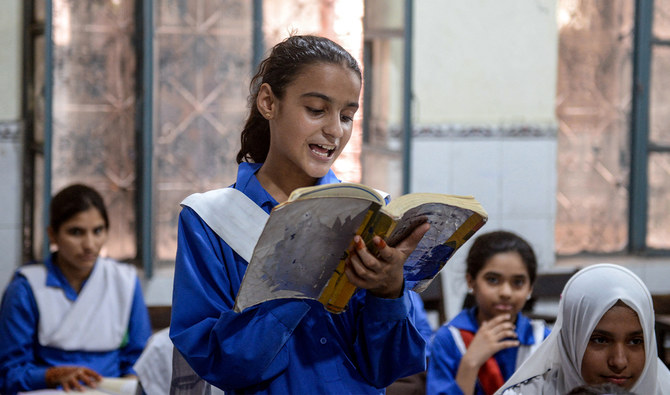
Students attend a class in Lahore, Pakistan, on May 24, 2024. (AFP/File)
Short Url
Updated 12 June 2024
Follow

Pakistan, Muslim World League to host global conference on girls’ education in September

  • Eminent scholars, education ministers from Islamic countries to attend three-day event
  • Event to explore solutions to various barriers to education millions of girls face daily 

ISLAMABAD: Pakistan’s government will join hands with the Muslim World League to host a “landmark” global conference on girls’ education in September, state-run media reported on Wednesday, to ensure girls have better access to education and other facilities. 

According to the Malala Fund, 12 million girls are out of school in Pakistan and only 13 percent of girls advance to grade IX. The international non-governmental organization says social norms such as gender stereotypes and preference for educating boys continue to prevent girls from accessing education. 

State broadcaster Radio Pakistan said the primary objective of the three-day conference is to “explore and formulate” effective strategies to enable institutional responses and ensure better resource allocation for promoting girls’ education on a global scale.

“This event aims to bring together a diverse group of international and national dignitaries, including education ministers from numerous Islamic countries, to address and find solutions to different challenges faced by girls in the education sector,” Radio Pakistan said. 

It said eminent scholars, education experts, policymakers and various other stakeholders are expected to attend the conference. They will share their expertise, experiences, and best practices in the field of girls’ education. 

“The event will serve as a crucial platform for sharing experiences, discussing the multifaceted challenges faced by girls in accessing education, and exploring innovative solutions to overcome these barriers,” Radio Pakistan explained. 

It said PM Sharif has constituted a dedicated committee to organize the event in a “befitting and efficient manner.” 

The state-run media said the committee is headed by Secretary of Education Mohyuddin Wani and includes lawmaker Nausheen Iftikhar, representatives from the foreign office, the federal directorate of education and the Capital Development Authority (CDA). 

“This event marks a significant step toward the global promotion of girls’ education, demonstrating Pakistan’s commitment to being at the forefront of this vital initiative,” Radio Pakistan said. 

“By hosting such a crucial conference, Pakistan aims to contribute substantially to the global dialogue on education and help forge a path toward a more inclusive and equitable educational landscape for girls worldwide.”


Sindh assembly passes resolution rejecting move to separate Karachi

Updated 21 February 2026
Follow

Sindh assembly passes resolution rejecting move to separate Karachi

  • Chief Minister Shah cites constitutional safeguards against altering provincial boundaries
  • Calls to separate Karachi intensified amid governance concerns after a mall fire last month

ISLAMABAD: The provincial assembly of Pakistan’s southern Sindh province on Saturday passed a resolution rejecting any move to separate Karachi, declaring its territorial integrity “non-negotiable” amid political calls to carve the city out as a separate administrative unit.

The resolution comes after fresh demands by the Muttahida Qaumi Movement (MQM) and other voices to grant Karachi provincial or federal status following governance challenges highlighted by the deadly Gul Plaza fire earlier this year that killed 80 people.

Karachi, Pakistan’s largest and most densely populated city, is the country’s main commercial hub and contributes a significant share to the national economy.

Chief Minister Syed Murad Ali Shah tabled the resolution in the assembly, condemning what he described as “divisive statements” about breaking up Sindh or detaching Karachi.

“The province that played a foundational role in the creation of Pakistan cannot allow the fragmentation of its own historic homeland,” Shah told lawmakers, adding that any attempt to divide Sindh or separate Karachi was contrary to the constitution and democratic norms.

Citing Article 239 of Pakistan’s 1973 Constitution, which requires the consent of not less than two-thirds of a provincial assembly to alter provincial boundaries, Shah said any such move could not proceed without the assembly’s approval.

“If any such move is attempted, it is this Assembly — by a two-thirds majority — that will decide,” he said.

The resolution reaffirmed that Karachi would “forever remain” an integral part of Sindh and directed the provincial government to forward the motion to the president, prime minister and parliamentary leadership for record.

Shah said the resolution was not aimed at anyone but referred to the shifting stance of MQM in the debate while warning that opposing the resolution would amount to supporting the division of Sindh.

The party has been a major political force in Karachi with a significant vote bank in the city and has frequently criticized Shah’s provincial administration over its governance of Pakistan’s largest metropolis.

Taha Ahmed Khan, a senior MQM leader, acknowledged that his party had “presented its demand openly on television channels with clear and logical arguments” to separate Karachi from Sindh.

“It is a purely constitutional debate,” he told Arab News by phone. “We are aware that the Pakistan Peoples Party, which rules the province, holds a two-thirds majority and that a new province cannot be created at this stage. But that does not mean new provinces can never be formed.”

Calls to alter Karachi’s status have periodically surfaced amid longstanding complaints over governance, infrastructure and administrative control in the megacity, though no formal proposal to redraw provincial boundaries has been introduced at the federal level.