

Death toll rises to 49 in Kuwait building fire: interior ministry

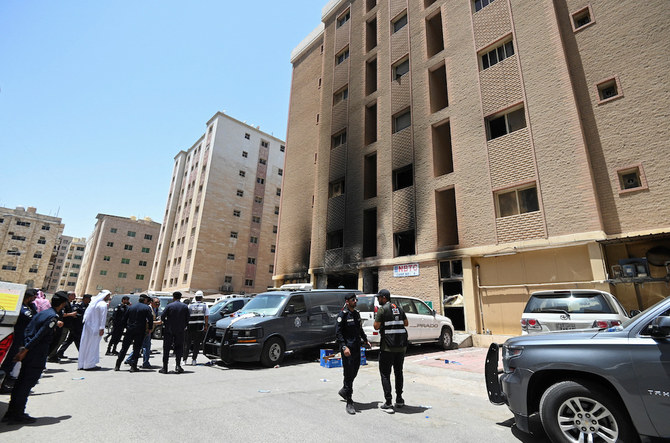
Police authorities inspect the burnt building housing workers in the city of Mangaf in Kuwait’s southern Ahmadi Governorate on June 12, 2024. (Reuters)
Short Url
Updated 12 June 2024
Follow

Death toll rises to 49 in Kuwait building fire: interior ministry

  • The owner of the impacted building was arrested until investigations are complete
  • Kuwait municipality ordered to demolish violating properties without warning the violators.

KUWAIT: At least 49 people were killed in a fire that engulfed a building housing workers in the city of Mangaf in Kuwait’s southern Ahmadi Governorate, Kuwait’s interior ministry said on Wednesday.

In a statement, the Emir of Kuwait Sheikh Meshal Al-Ahmad Al-Jaber Al-Sabah ordered a probe into the cause of the fire and vowed to bring to justice those responsible.

The owner of the impacted building was arrested until investigations are complete, according to Deputy Prime Minister, Minister of Defense and Acting Minister of Interior Sheikh Fahad Youssef Saud Al-Sabah.

“We will address the issue of labor overcrowding and neglect,” said Al-Sabah in a statement posted on Kuwait News Agency.

Following the massive fire, the municipality has also been ordered to demolish violating properties from tomorrow (Thursday) without warning the violators.


According to KUNA, at least 43 people were hospitalized due to the fire. The authorities said they had contained the fire and were investigating the cause.


Tunisia’s famed blue-and-white village threatened after record rains

Updated 31 January 2026
Follow

Tunisia’s famed blue-and-white village threatened after record rains

  • The one-time home of French philosopher Michel Foucault and writer Andre Gide, the village is protected under Tunisian preservation law, pending a UNESCO decision on its bid for World Heritage status

SIDI BOU SAID, Tunisia: Perched on a hill overlooking Carthage, Tunisia’s famed blue-and-white village of Sidi Bou Said now faces the threat of landslides, after record rainfall tore through parts of its slopes.
Last week, Tunisia saw its heaviest downpour in more than 70 years. The storm killed at least five people, with others still missing.
Narrow streets of this village north of Tunis — famed for its pink bougainvillea and studded wooden doors — were cut off by fallen trees, rocks and thick clay. Even more worryingly for residents, parts of the hillside have broken loose.
“The situation is delicate” and “requires urgent intervention,” Mounir Riabi, the regional director of civil defense in Tunis, recently told AFP.
“Some homes are threatened by imminent danger,” he said.
Authorities have banned heavy vehicles from driving into the village and ordered some businesses and institutions to close, such as the Ennejma Ezzahra museum.

- Scared -

Fifty-year-old Maya, who did not give her full name, said she was forced to leave her century-old family villa after the storm.
“Everything happened very fast,” she recalled. “I was with my mother and, suddenly, extremely violent torrents poured down.”
“I saw a mass of mud rushing toward the house, then the electricity cut off. I was really scared.”
Her Moorish-style villa sustained significant damage.
One worker on site, Said Ben Farhat, said waterlogged earth sliding from the hillside destroyed part of a kitchen wall.
“Another rainstorm and it will be a catastrophe,” he said.
Shop owners said the ban on heavy vehicles was another blow to their businesses, as they usually rely on tourist buses to bring in traffic.
When President Kais Saied visited the village on Wednesday, vendors were heard shouting: “We want to work.”
One trader, Mohamed Fedi, told AFP afterwards there were “no more customers.”
“We have closed shop,” he said, adding that the shops provide a livelihood to some 200 families.

- Highly unstable -

Beyond its famous architecture, the village also bears historical and spiritual significance.
The village was named after a 12th-century Sufi saint, Abu Said Al-Baji, who had established a religious center there. His shrine still sits atop the hill.
The one-time home of French philosopher Michel Foucault and writer Andre Gide, the village is protected under Tunisian preservation law, pending a UNESCO decision on its bid for World Heritage status.
Experts say solutions to help preserve Sidi Bou Said could include restricting new development, building more retaining walls and improving drainage to prevent runoff from accumulating.
Chokri Yaich, a geologist speaking to Tunisian radio Mosaique FM, said climate change has made protecting the hill increasingly urgent, warning of more storms like last week’s.
The hill’s clay-rich soil loses up to two thirds of its cohesion when saturated with water, making it highly unstable, Yaich explained.
He also pointed to marine erosion and the growing weight of urbanization, saying that construction had increased by about 40 percent over the past three decades.
For now, authorities have yet to announce a protection plan, leaving home and shop owners anxious, as the weather remains unpredictable.