

Iraq’s top Christian leader reinstated as head of church

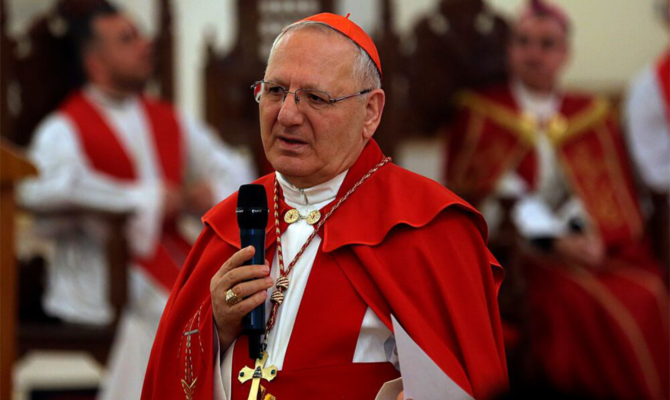
Cardinal Louis Sako addresses the faithful during the Palm Sunday service at Mar Youssif Church in Baghdad. (AP/File)
Short Url
Updated 12 June 2024
Follow

Iraq’s top Christian leader reinstated as head of church

  • Sako, in turn, said the parliamentarian aimed to gain legitimacy as the sole representative of the Christian community

BAGHDAD: Iraq’s prime minister reinstated Cardinal Louis Raphael Sako as the patriarch of the Chaldean Catholic church, paving the way for his return to Baghdad a year after a dispute with the president.
Sako, Iraq’s top Christian leader and the architect of Pope Francis’ historic visit to the country in 2021, is a key interlocutor between the Iraqi government and its Christian minority.

In July last year, Sako left Baghdad and settled in the autonomous Kurdistan region in northern Iraq after President Abdul Latif Rashid canceled a decree recognizing him as head of the Chaldean church.

But the church on Tuesday published a recent decree by Prime Minister Mohamed Shia Al-Sudani naming Sako as the patriarch, adding that he “will be responsible” for the church’s endowment and properties.
“I will return to Baghdad,” Sako told AFP.
“I am very pleased because the rule of law prevailed, which gives more hope to Christians about the respecting of their rights,” added the cardinal, who met Sudani in April during a rare visit to Baghdad.
For several months before the presidential decree last year, Sako had been embroiled in a war of words with a Christian lawmaker, Rayan Al-Kildani.
Kildani is the leader of the Babylon Movement, whose armed wing is part of Hashed Al-Shaabi — a network of largely pro-Iran paramilitaries that were integrated into Iraqi security forces in recent years.
In a country ravaged by repeated conflicts and plagued by endemic corruption, Sako and Kildani both accused each other of illegally seizing Christian-owned properties.
Kildani, who has been under US sanctions since 2019, accused the cardinal of assuming a political role beyond his religious mandate.
Sako, in turn, said the parliamentarian aimed to gain legitimacy as the sole representative of the Christian community.
Iraq’s Christian population has drastically declined since the 2003 US-led invasion that toppled strongman Saddam Hussein, dropping from more than 1.5 million people to around 400,000 today.
Many have fled the violence that has plagued the country over the past 20 years.


Arab and Islamic states reject Israel’s recognition of Somaliland

Updated 28 December 2025
Follow

Arab and Islamic states reject Israel’s recognition of Somaliland

  • Israel formally recognized Somaliland as an “independent and sovereign state” on Friday
  • Saudi Arabia on Friday expressed full support for sovereignty, unity, territorial integrity of Somalia

A group of foreign ministers from Arab and Islamic countries, alongside the Organisation of Islamic Cooperation (OIC), have firmly rejected Israel’s announcement of its recognition of the Somaliland region within Somalia.

In a joint statement issued on Saturday, the ministers condemned Israel’s decision, announced on December 26, warning that the move carries “serious repercussions for peace and security in the Horn of Africa and the Red Sea region” and undermines international peace and security, the Jordan News Agency reported.

The statement described the recognition as an unprecedented and flagrant violation of international law and the charter of the United Nations, which uphold the principles of state sovereignty, unity and territorial integrity, JNA added.

Israel formally recognized Somaliland as an “independent and sovereign state” and signed an agreement to establish diplomatic ties, as the region’s leader hailed its first-ever official recognition.

The ministers reaffirmed their full support for the sovereignty of Somalia, rejecting any measures that would undermine its unity or territorial integrity.

They warned that recognizing the independence of parts of states sets a dangerous precedent and poses a direct threat to international peace and security.

The statement also reiterated categorical opposition to any attempt to link the move with plans to displace the Palestinian people outside their land, stressing that such proposals are rejected “in form and substance.”

Alongside the Jordanian foreign ministry, the joint statement was issued by the foreign ministers of Egypt, Algeria, Comoros, Djibouti, The Gambia, Iran, Iraq, Kuwait, Libya, Maldives, Nigeria, Oman, Pakistan, Palestine, Qatar, Somalia, Sudan, Turkiye and Yemen, as well as the OIC.

Saudi Arabia on Friday expressed full support for the sovereignty, unity, and territorial integrity of Somalia, and expressed its rejection of the declaration of mutual recognition between Israel and Somaliland.