

Iraq’s top Christian leader reinstated as head of church

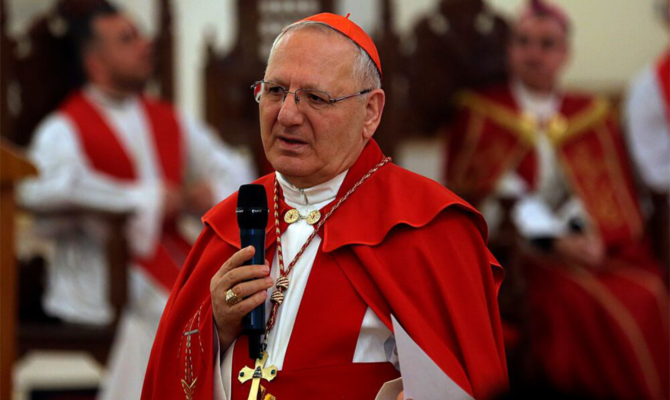
Cardinal Louis Sako addresses the faithful during the Palm Sunday service at Mar Youssif Church in Baghdad. (AP/File)
Short Url
Updated 12 June 2024
Follow

Iraq’s top Christian leader reinstated as head of church

  • Sako, in turn, said the parliamentarian aimed to gain legitimacy as the sole representative of the Christian community

BAGHDAD: Iraq’s prime minister reinstated Cardinal Louis Raphael Sako as the patriarch of the Chaldean Catholic church, paving the way for his return to Baghdad a year after a dispute with the president.
Sako, Iraq’s top Christian leader and the architect of Pope Francis’ historic visit to the country in 2021, is a key interlocutor between the Iraqi government and its Christian minority.

In July last year, Sako left Baghdad and settled in the autonomous Kurdistan region in northern Iraq after President Abdul Latif Rashid canceled a decree recognizing him as head of the Chaldean church.

But the church on Tuesday published a recent decree by Prime Minister Mohamed Shia Al-Sudani naming Sako as the patriarch, adding that he “will be responsible” for the church’s endowment and properties.
“I will return to Baghdad,” Sako told AFP.
“I am very pleased because the rule of law prevailed, which gives more hope to Christians about the respecting of their rights,” added the cardinal, who met Sudani in April during a rare visit to Baghdad.
For several months before the presidential decree last year, Sako had been embroiled in a war of words with a Christian lawmaker, Rayan Al-Kildani.
Kildani is the leader of the Babylon Movement, whose armed wing is part of Hashed Al-Shaabi — a network of largely pro-Iran paramilitaries that were integrated into Iraqi security forces in recent years.
In a country ravaged by repeated conflicts and plagued by endemic corruption, Sako and Kildani both accused each other of illegally seizing Christian-owned properties.
Kildani, who has been under US sanctions since 2019, accused the cardinal of assuming a political role beyond his religious mandate.
Sako, in turn, said the parliamentarian aimed to gain legitimacy as the sole representative of the Christian community.
Iraq’s Christian population has drastically declined since the 2003 US-led invasion that toppled strongman Saddam Hussein, dropping from more than 1.5 million people to around 400,000 today.
Many have fled the violence that has plagued the country over the past 20 years.


Hundreds mourn in Syria’s Homs after deadly mosque bombing

Updated 27 December 2025
Follow

Hundreds mourn in Syria’s Homs after deadly mosque bombing

  • Officials have said the preliminary investigations indicate explosive devices were planted inside the mosque but have not yet publicly identified a suspect

HOMS: Hundreds of mourners gathered Saturday despite rain and cold outside of a mosque in the Syrian city of Homs where a bombing the day before killed eight people and wounded 18.
The crowd gathered next to the Imam Ali ibn Abi Talib Mosque in the Wadi Al-Dhahab neighborhood, where the population is predominantly from the Alawite minority, before driving in convoys to bury the victims.
Officials have said the preliminary investigations indicate explosive devices were planted inside the mosque but have not yet publicly identified a suspect.
A little-known group calling itself Saraya Ansar Al-Sunna claimed responsibility for the attack in a statement posted on its Telegram channel, in which it indicated that the attack intended to target members of the Alawite sect, an offshoot of Shia Islam whom hard-line Islamists consider to be apostates.
The same group had previously claimed a suicide attack in June in which a gunman opened fire and then detonated an explosive vest inside a Greek Orthodox church in Dweil’a, on the outskirts of Damascus, killing 25 people as worshippers prayed on a Sunday.
A neighbor of the mosque, who asked to be identified only by the honorific Abu Ahmad (“father of Ahmad“) out of security concerns, said he was at home when he heard the sound of a “very very strong explosion.”
He and other neighbors went to the mosque and saw terrified people running out of it, he said. They entered and began trying to help the wounded, amid blood and scattered body parts on the floor.
While the neighborhood is primarily Alawite, he said the mosque had always been open to members of all sects to pray.
“It’s the house of God,” he said. “The mosque’s door is open to everyone. No one ever asked questions. Whoever wants to enter can enter.”
Mourners were unable to enter the mosque to pray Saturday because the crime scene remained cordoned off, so they prayed outside.
Some then marched through the streets chanting “Ya Ali,” in reference to the Prophet Muhammad’s cousin and son-in-law whom Shiite Muslims consider to be his rightful successor.