Rare elephant twins born in dramatic birth in Thailand

1 / 3
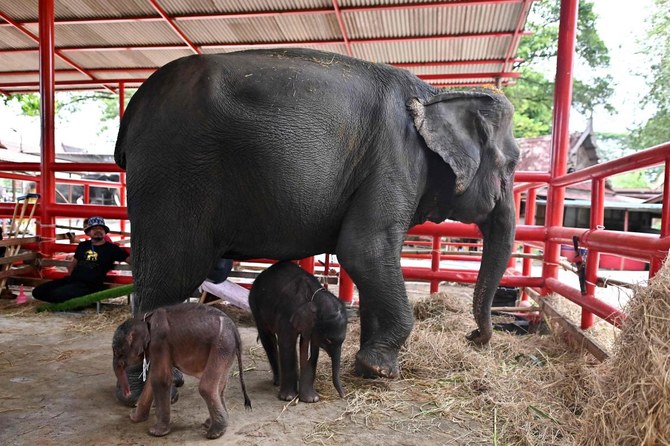
Newborn elephant twins, a female (L) and a male (C), stand next to their mother Jamjuree at the Ayutthaya Elephant Palace and Royal Kraal in Ayutthaya on June 10, 2024. (AFP)
2 / 3
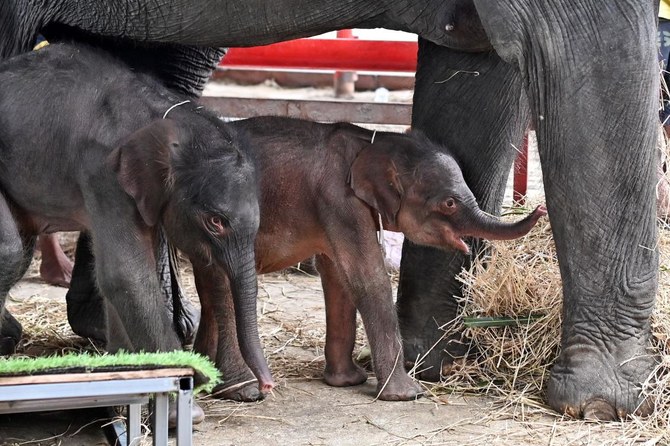
Newborn elephant twins, a female (R) and a male (L), stand next to their mother Jamjuree at the Ayutthaya Elephant Palace and Royal Kraal in Ayutthaya on June 10, 2024. (AFP)
3 / 3
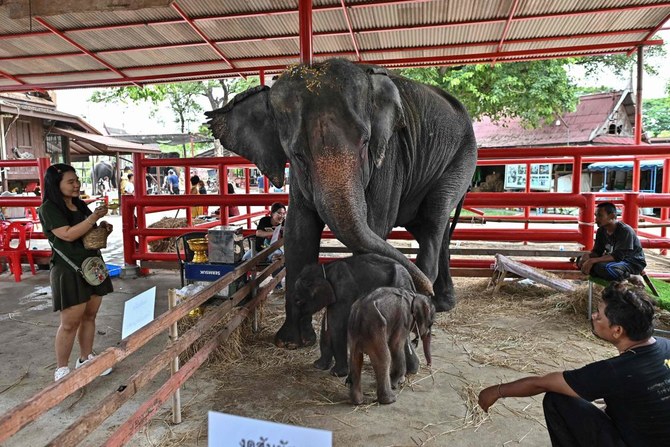
Newborn elephant twins, a female (R) and a male (C), stand in front of their mother Jamjuree at the Ayutthaya Elephant Palace and Royal Kraal in Ayutthaya on June 10, 2024. (AFP)
Short Url
Updated 11 June 2024
Follow

Rare elephant twins born in dramatic birth in Thailand

AYUTTHAYA: An elephant in Thailand has delivered a rare set of twins in a dramatic birth that left a carer injured after he tried to rescue one of the newborns.
The 36-year-old Asian elephant named Jamjuree gave birth to an 80-kilogramme (176-pound) male at the Ayutthaya Elephant Palace and Royal Kraal north of Bangkok on Friday night.
But when a second, 60-kilogramme female calf emerged 18 minutes later, the mother went into a frenzy and attacked her new arrival.
“We heard somebody shout ‘there is another baby being born!’” said veterinarian Lardthongtare Meepan.
An elephant keeper, also known as a mahout, moved in to prevent the mother from attacking her newborn, and took a blow to his ankle in return.
“The mother attacked the baby because she had never had twins before — it’s very rare,” said Michelle Reedy, the director of the Elephant Stay organization, which allows visiting tourists to ride, feed and bathe elephants at the Royal Kraal center.
“The mahouts who are the carers of the elephants jumped in there trying to get the baby away so that she didn’t kill it,” Reedy told AFP.
Jamjuree has now accepted her calves, who are so small that a special platform has been built to help them reach up to suckle.
They are also being given supplemental pumped milk by syringe, said Lardthongtare.
Twin elephants are rare, forming around only one percent of births, according to research organization Save the Elephants, and male-female twin births are even more unusual.
Mothers often do not have enough milk for both calves and the pair might not have survived in the wild, said Reedy.
“Whether the rest of the herd may have intervened — they may have, but the baby may have been trampled in the process,” she said.
Reedy said many of the 80 elephants at the center were rescued from street begging, a practice that became increasingly common after a logging ban in 1989 that left mahouts working in the industry with their elephants seeking alternative income.
The practice, which was outlawed in 2010, involved the animals performing tricks like playing with footballs or carrying baskets of fruit.
Some elephants at Royal Kraal carry tourists to the nearby ruins and temples of Ayutthaya, the historic former capital of Siam.
Many conservation groups oppose elephant riding, arguing it is stressful for the animals and often involves abusive training.
The center argues the rides allow the animals to socialize and exercise, and promote conservation of the species, which is endangered in Southeast Asia and China.
Only about 8,000-11,000 Asian elephants remain in the wild, according to the WWF.
The animals were once widespread, but deforestation, human encroachment and poaching have decimated their numbers.
The twin calves, whose father is a 29-year-old elephant named Siam, will be named seven days after their birth, in accordance with Thai custom.


Cambodia takes back looted historic artifacts handled by British art dealer

Updated 28 February 2026
Follow

Cambodia takes back looted historic artifacts handled by British art dealer

  • The objects were returned under a 2020 agreement between the Ministry of Culture and Fine Arts and the family of the late Douglas Latchford, a British art collector and dealer who allegedly had the items smuggled out of Cambodia

PHNOM PENH, Cambodia: Cambodian officials on Friday received more than six dozen historic artifacts described as part of the country’s cultural heritage that had been looted during decades of war and instability.
At a ceremony attended by Deputy Prime Minister Hun Many, the 74 items were unveiled at the National Museum in Phnom Penh after their repatriation from the United Kingdom.
The objects were returned under a 2020 agreement between the Ministry of Culture and Fine Arts and the family of the late Douglas Latchford, a British art collector and dealer who allegedly had the items smuggled out of Cambodia.
“This substantial restitution represents one of the most important returns of Khmer cultural heritage in recent years, following major repatriations in 2021 and 2023 from the same collection,” the Culture Ministry said in a statement. “It marks a significant step forward in Cambodia’s continued efforts to recover, preserve, and restore its ancestral legacy for future generations.”
The artifacts were described as dating from the pre-Angkorian period through the height of the Angkor Empire, including “monumental sandstone sculptures, refined bronze works, and significant ritual objects.” The Angkor Empire, which extended from the ninth to the 15th century, is best known for the Angkor Wat archaeological site, the nation’s biggest tourist attraction.
Latchford was a prominent antiquities dealer who allegedly orchestrated an operation to sell looted Cambodian sculptures on the international market.
From 1970 to the 1980s, during Cambodia’s civil wars and the communist Khmer Rouge ‘s brutal reign, organized looting networks sent artifacts to Latchford, who then sold them to Western collectors, dealers, and institutions. These pieces were often physically damaged, having been pried off temple walls or other structures by the looters.
Latchford was indicted in a New York federal court in 2019 on charges including wire fraud and conspiracy. He died in 2020, aged 88, before he could be extradited to face charges.
Cambodia, like neighboring Thailand, has benefited from a trend in recent decades involving the repatriation of art and archaeological treasures. These include ancient Asian artworks as well as pieces lost or stolen during turmoil in places such as Syria, Iraq and Nazi-occupied Europe. New York’s Metropolitan Museum of Art is one of the prominent institutions that has been returning illegally smuggled art, including to Cambodia.
“The ancient artifacts created and preserved by our ancestors are now being returned to Cambodia, bringing warmth and joy, following the country’s return to peace,” said Hun Many, who is the younger brother of Prime Minister Hun Manet.