BURGENSTOCK, Switzerland: World leaders will gather in Switzerland this weekend to try to lay out a roadmap for an eventual peace process for Ukraine — albeit without Russia.
The gathering at the luxury Burgenstock resort, on a mountain ridge overlooking Lake Lucerne, comes immediately after the G7 summit in southern Italy, during which the wealthy democracies will also discuss Ukraine in the presence of its president, Volodymyr Zelensky.
The G7, running from Thursday to Saturday, will look at ways to use frozen Russian assets to provide fresh aid to Ukraine, invaded by Russia in February 2022.
Zelensky will then head to Switzerland, to be joined by G7 and other leaders on Saturday and Sunday for what is being billed as the first “Summit on Peace in Ukraine.”
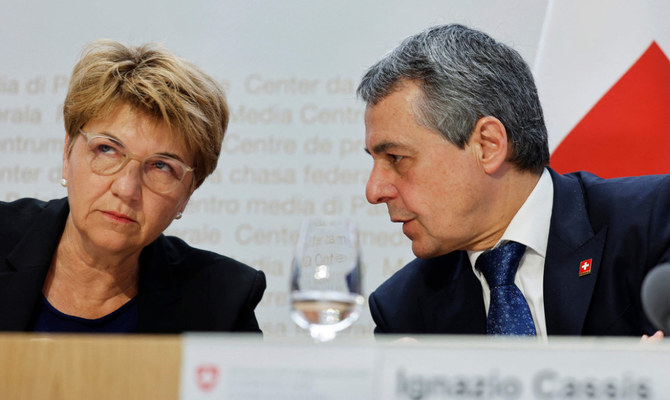
“We would like to have a very broad process with a view to lasting, just peace in Ukraine,” Swiss President Viola Amherd told a press conference in Bern on Monday.
She said the event would lay the groundwork “for a future peace summit that would involve Russia.”
“The conference will focus on topics of global interest — nuclear security, food security and humanitarian aspects,” she added.
Switzerland invited more than 160 delegations, representing countries and international organizations.
Amherd said more than 90 confirmations had been received so far — around half from European nations — with about 50 percent of countries represented by their heads of state or government.
Attendees include French President Emmanuel Macron, US Vice President Kamala Harris, German Chancellor Olaf Scholz and Japanese Prime Minister Fumio Kishida.
Organized at Ukraine’s request, the outcome of the summit remains uncertain, though Switzerland is hoping to secure a joint final declaration.
“We need to do everything we can to bring an end to this violence,” Swiss Foreign Minister Ignazio Cassis told the press conference.
“At the end of this road there is not just world stability and safety but also the end of suffering for millions of victims,” he said.
The program, sculpted by Bern, draws on a 10-point peace plan presented by Zelensky in late 2022. Ukraine hopes to gain broad international support for its conditions to end the war.
Amherd said the summit aimed to find paths toward a comprehensive, just and lasting peace for Ukraine, based on international law and the United Nations charter; a possible framework to achieve this goal; and a roadmap as to how both warring parties could come together in a future peace process.
It will also touch on freedom of navigation in the Black Sea and on prisoners of war.
Up to 4,000 Swiss troops will be on duty, while 6.5 kilometers (four miles) of steel fencing is going up.
Military vehicles buzzed around the Burgenstock mountain on Monday, with troops laying a temporary helipad in the valley behind the hotel complex.
“My division is familiar with the area, with the people, and we are trained to deal with circumstances such as these,” said Major General Daniel Keller, adding that his troops “are ready to take action if required.”
Switzerland said there had already been cyberattacks and extreme misinformation surrounding the conference, without giving details.
The summit comes as Russia on Monday claimed the capture of another village in Ukraine’s eastern Donetsk region.
After almost a year of stalemate, Ukraine has been forced to abandon dozens of front-line settlements this spring, with Russian troops holding a significant advantage in manpower and resources.
The Kremlin has repeatedly indicated it will not participate in any negotiations if Kyiv does not accept Moscow’s annexation of the approximately 20 percent of Ukrainian territory Russia currently occupies.
As Moscow said it was not interested in participating in the summit, Bern did not issue an invitation.
Further summits hosted by other nations are tentatively envisaged.
Cassis said it was more a question of “when Russia will be on board” in the process rather than if.
As for China, he said it would not attend a summit without Russia at the table.
“It’s difficult for China to participate at the moment,” he said, adding that Beijing had hitherto “really helped give us a hand on this journey.”
Cassis welcomed the possibility of parallel peace proceedings involving China and other states not coming to the Burgenstock summit.
“Anything that can be done to walk through that mindset would be beneficial, because the mindset might be different,” he said.


![]()

Swiss summit on Ukraine set to thrash out path to peace
Short Url
https://arab.news/j7taf
Swiss summit on Ukraine set to thrash out path to peace
- Amherd said more than 90 confirmations had been received so far — around half from European nations — with about 50 percent of countries represented by their heads of state or government


Latest updates


Recommended


© 2026 SAUDI RESEARCH & PUBLISHING COMPANY, All Rights Reserved And subject to Terms of Use Agreement.