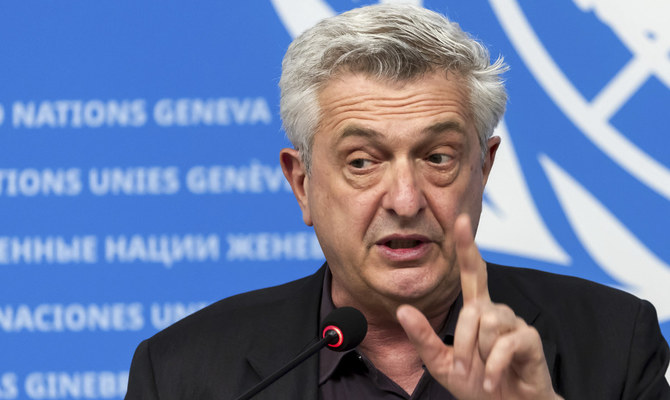
GENEVA: The United Nations’ refugees chief denounced Monday the politicization of migration in European elections, warning that demonizing refugees would only make the issue more difficult to deal with.
Filippo Grandi told AFP that his main concern after the weekend’s European Parliament elections, which handed significant gains to far-right parties across much of the continent, was that “the refugee-migration theme has become so politicized in these elections.”
That, he said, was “partly because some politicians have manipulated it, have portrayed it as a threat, as a risk.”
Many European countries have for years focused on tightening migration policies, and a heftier far-right representation is expected to make itself felt on the EU’s migration and asylum agenda.
Grandi acknowledged that swelling numbers of refugees and migrants could pose significant challenges, “first and foremost for the people that are on the move, but also for the people hosting and receiving them, for the countries, governments receiving them.”
“But to simply say: this is an invasion... (of) ill-intentioned people that come here to steal your jobs, threaten your values, your security, and therefore they have to go away, we have to build barriers... does not solve the problem,” he said.
“It’s not just wrong, because... these people have rights, whoever they are, but also because these positions do not solve the problem — they make it worse,” Grandi said.
“To build barriers actually increases irregularity of movements which are more difficult to manage,” he said.
Instead of demonizing refugees and migrants, he said countries would be far wiser to work together on addressing the root causes pushing people to leave their homes.
Such an approach would be in Europe’s “self-interest,” he said.
He pointed to the largely neglected conflict raging in Sudan that in recent months has spurred a “steep rise in the arrival of Sudanese refugees... into North Africa, Libya, Tunisia and then across to Italy.”
“There’s no point in screaming and anguishing about these flows when... not enough is done to stop the reasons why they’re coming,” he said.
Focusing on addressing root causes and dismal conditions along migration routes that spur people to keep moving may be “less sexy in terms of political attraction, but that’s the right way to go,” he said.
“Unless we do that, this problem will become bigger, and then there will be no slogans to counter it, because we will all be in deep trouble.”
Speaking to journalists, Grandi voiced hope that the anti-migrant rhetoric in Europe would die down now that the EU Parliament voting was over, and politicians would focus on getting “to work.”
UNHCR, the UN Refugee Agency, “will work with whoever will be part of the European institutions,” he said.
But he warned the results could impact attitudes far beyond the continent.
“Everybody looks at Europe in terms of how they deal with these matters,” he told AFP.
Grandi noted that the majority of people on the move globally were not heading for Europe.
“The number of people who have crossed the Mediterranean in the first few months of this year is about 60-70,000, that we know about,” he said.
Chad meanwhile “has received 600,000 Sudanese (refugees) in a year: 10 times more.”
If rich countries backtrack on the principles guaranteeing people the right to cross borders to seek protection from violence and oppression, Grandi said he was “very worried that we will start hearing other countries backtracking too.”


![]()

UN warns of ‘politicized’ migration after EU’s far-right tilt
Short Url
https://arab.news/nbywk
UN warns of ‘politicized’ migration after EU’s far-right tilt
- Many European countries have for years focused on tightening migration policies, and a heftier far-right representation is expected to make itself felt on the EU’s migration and asylum agenda


Latest updates


© 2026 SAUDI RESEARCH & PUBLISHING COMPANY, All Rights Reserved And subject to Terms of Use Agreement.