

France enters election mode after far-right win in European Parliament vote

This screen shot shows France's President Emmanuel Macron announcing on Sunday that he is dissolving the National Assembly, French Parliament lower house, and setting a new general elections on June 30. (AFP)
Short Url
Updated 10 June 2024
Follow

France enters election mode after far-right win in European Parliament vote

  • Emmanuel Macron’s unexpected decision could hand major political power to the far-right after years on the sidelines
  • Legislative vote will take place on June 30, less than a month before the start of the Paris Olympics, with a second round on July

PARIS: France began to gear up for elections on Monday, after President Emmanuel Macron called a shock snap legislative election following a bruising loss in the European Parliament vote to the far-right party of Marine Le Pen.

Macron’s unexpected decision, which amounts to a roll of the dice on his political future, could hand major political power to the far-right after years on the sidelines, and neuter his presidency three years before it ends.

The legislative vote will take place on June 30, less than a month before the start of the Paris Olympics, with a second round on July.

Analysts said Macron’s decision aimed to make the best of his weak position, reclaiming the initiative and forcing Le Pen’s National Rally (RN) into election mode faster than it would have liked.
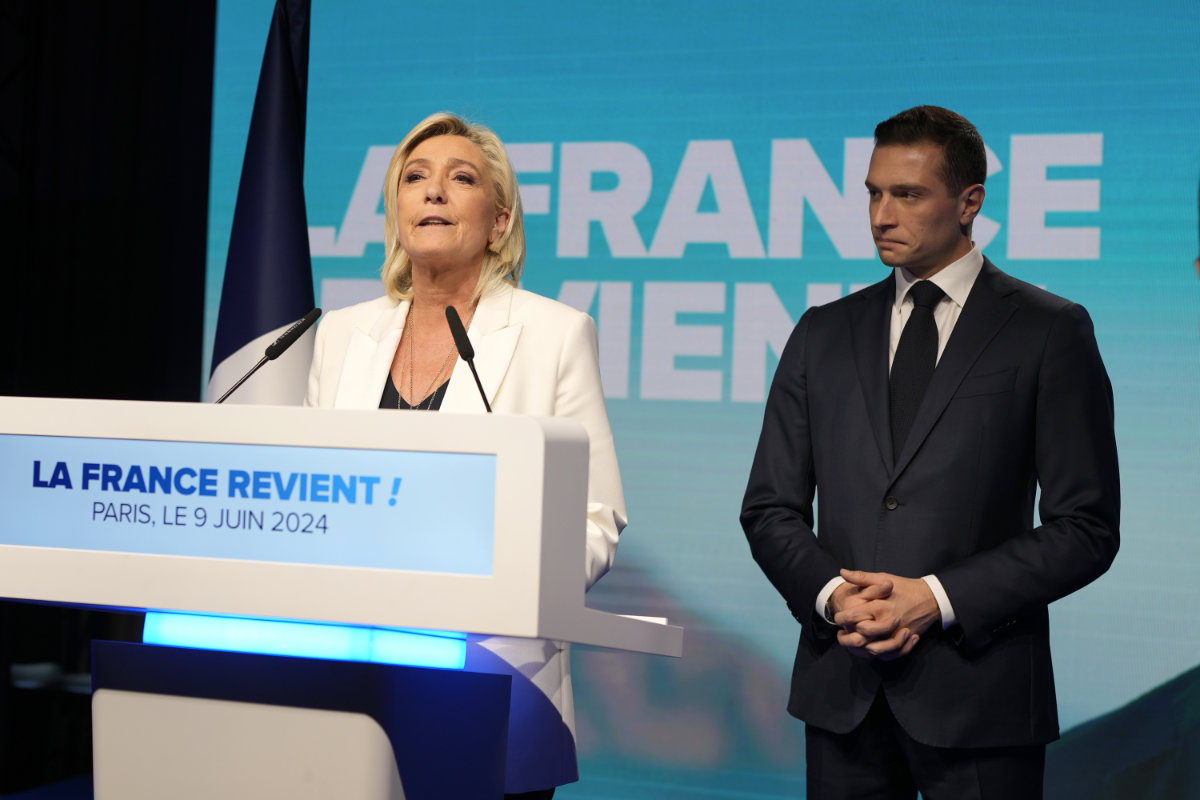


French far-right leader Marine Le Pen speaks as Jordan Bardella, president of the French far-right National Rally, listens at the party election night headquarters after French President Emanuel Macron called a new legislative election after defeat in EU vote. (AP)

“We didn’t think it would be immediately after the European elections, even if we wanted it to be,” the deputy chairman of the RN, Sebastien Chenu, said on RTL Radio, adding: “Elections are rarely a gift and in this context, they aren’t.”

He called for right-wing lawmakers from outside the RN to swell its ranks in its battle to beat Macron, and said the party’s telegenic president, 28-year-old Jordan Bardella, would be its candidate for prime minister.

Led by Bardella, the RN won about 32 percent of the vote on Sunday, more than double the Macron ticket’s 15 percent, according to exit polls. The Socialists came within a whisker of Macron, with 14 percent.

Macron’s Renaissance party currently has 169 lower house lawmakers, out of a total of 577. The RN has 88.

If the RN wins a majority, Macron would still direct defense and foreign policy, but would lose the power to set the domestic agenda, from economic policy to security.

Those powers would likely end up in the hands of Bardella, if he were to be prime minister.

“I’m confident in the ability of the French people to make the fairest choice for themselves and for future generations,” Macron tweeted on Monday. “My only ambition is to be useful to our country that I love so much.”


Bolivia and Israel restore ties severed over the war in Gaza

Updated 6 sec ago
Follow

Bolivia and Israel restore ties severed over the war in Gaza

  • Bolivia’s top diplomat Fernando Aramayo met his Israeli counterpart Gideon Saar in Washington and signed a declaration agreeing to revive bilateral ties

LA PAZ: Bolivia’s new right-wing government said Tuesday that it restored diplomatic relations with Israel, the latest sign of the dramatic geopolitical realignment underway in the South American country that was once among the most vocal critics of Israeli policies toward Palestinians.

Bolivian Foreign Minister Fernando Aramayo met his Israeli counterpart Gideon Saar in Washington and signed a declaration agreeing to revive bilateral ties, which Bolivia’s previous left-wing government severed two years ago over Israel’s devastating campaign against Hamas in Gaza.

Bolivia’s ministry said the two countries would reinstate ambassadors in the near future and dispatch officials on visits.

As part of a new foreign policy strategy under conservative President Rodrigo Paz, the rapprochement “represents a return to trust, intelligent cooperation and the ties that have always existed, but which are now being revitalized with a modern perspective,” the ministry said in a statement after the meeting late Tuesday.

Aramayo, as well as Bolivian Economy Minister José Gabriel Espinoza, launched this week into a whirlwind of meetings with American officials as their government works to warm long-chilly relations with the United States and unravel nearly two decades of hardline, anti-Western policies under the Movement Toward Socialism, or MAS, party that left Bolivia economically isolated and diplomatically allied with China, Russia and Venezuela.

Paz’s government eased visa restrictions on American and Israeli travelers last week.

In announcing his meeting with Aramayo on Monday, Israeli Foreign Minister Saar thanked Bolivia for scrapping Israeli visa controls and said he spoke to Paz after the center-right senator’s Oct. 19 election victory to express “Israel’s desire to open a new chapter” in relations with Bolivia.

Paz entered office last month, ending the dominance of the MAS party founded by Evo Morales, the charismatic former coca-growing union leader who became Bolivia’s first Indigenous president in 2006. Not long after taking power, Morales sent Israel’s ambassador packing and cozied up to Iran over their shared enmity toward the US and Israel.

When protests over Morales’ disputed 2019 reelection prompted him to resign under pressure from the military, a right-wing interim government took over and restored full diplomatic relations with the US and Israel as it sought to undo many of Morales’ popular policies.

But 2020 elections brought the MAS party back to power with the presidency of Luis Arce, who in 2023 once again cut ties with Israel in protest over its military actions in Gaza.

Other left-wing Latin American countries, like Chile and Colombia, soon made similar moves, recalling their ambassadors and joining South Africa’s genocide case against Israel before the United Nations’ highest judicial body.