

US military confirms 2 merchant ships were hit by Houthi missiles in Gulf of Aden

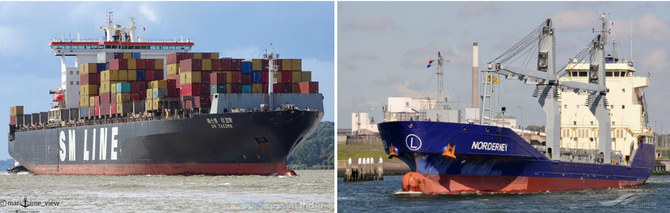
Combination image showing the container ship M/V Tavvishi and cargo ship M/V Norderney, which were reportedly hit by missiles launched by the Houthi militia on Sunday as they sailed through the Gulf of Aden. (Social media photos)
Short Url
Updated 10 June 2024
Follow

US military confirms 2 merchant ships were hit by Houthi missiles in Gulf of Aden

  • CENTCOM says the Swiss-owned container ship M/V Tavvishi and German-owned cargo ship M/V Norderney both sustained damages but managed to sail away

RIYADH: The US military on Monday confirmed that two commercial vessels passing through the Red Sea were hit in attacks by the Iran-backed Houthi militia of Yemen in the last 24 hours.

In a statement posted on X, the US Central Command, or CENTCOM, said two anti-ship ballistic missiles were launched from Houthi-controlled areas of Yemen into the Gulf of Aden.

One missile was successfully destroyed by a coalition ship, but the other missile struck the M/V Tavvishi, a Liberian-flagged, Swiss-owned and operated container ship.

“M/V Tavvishi reported damage but has continued underway,” the statement said.

“Separately, Iranian-backed Houthis launched one ASBM and one anti-ship cruise missile (ASCM) into the Gulf of Aden.  Both missiles struck M/V Norderney, an Antigua and Barbados-flagged, German-owned and operated cargo ship. M/V Norderney reported damage but has continued underway,” the statement continued.

“There were no injuries reported by US, coalition, or merchant vessels,” it said.

CENTCOM also said its forces successfully destroyed one a hostile drone over the Gulf of Aden, as well as two Houthi land attack cruise missiles (LACM) and one missile launcher in Houthi-controlled areas of Yemen. 

Earlier reports quoting marinetraffic.com, which provides information on ships and their positions, said the Norderney was traveling from India to Lebanon and was in the Gulf of Aden on Sunday.

Yemen’s Houthi militia claimed on Sunday they attack two merchant vessels for defying the militia’s embargo on traveling to Israeli ports.

Houthi military spokesman Yahya Sarea said in a television statement that their forces also targeted the UK warship HMS Diamond with ballistic missiles in the Red Sea in response to the US-UK joint strikes on militia positions in Yemen.

The Houthis control the most populous parts of Yemen and have attacked merchant ships since November in solidarity with Palestinians in Gaza. The militants have sunk one ship, seized a different vessel and killed three crew members in a yet another attack.

Their campaign has disrupted global shipping by forcing vessels to avoid the nearby Suez Canal and reroute trade around Africa. The action also has stoked fears that the Israel-Hamas war could spread and destabilize the wider Middle East.

The United States and Britain have carried out strikes against Houthi targets in response to the attacks.

(With Reuters)


First AI-aided transaction in Dubai promises to change way consumers shop

Updated 15 min 3 sec ago
Follow

First AI-aided transaction in Dubai promises to change way consumers shop

  • Artificial intelligence agent purchases movie tickets for a customer after asking a few questions

DUBAI: CEO of Mastercard Michael Miebach announced on Tuesday that the company, in conjunction with UAE retailer Majid Al-Futtaim, had successfully completed the first transaction by an AI agent in Dubai.

An AI agent purchased movie tickets for a customer after asking a few questions during the transaction.

Speaking at the Dubai Future Forum alongside UAE Minister of State for Artificial Intelligence Omar Al-Olama, Miebach said that in the future “AI agents” would guide most transactions.

Al-Olama hailed the transaction, saying it was part of a future that would streamline the way people consumed online and in person.

“I saw that transaction, I found it extremely seamless,” Olama told the crowd at the Museum of the Future. “It’s very, very convenient, and it’s like having the best personal assistant that will do everything for you, select the movie, get your best seats, find the best timing, the closest location to you, and make a payment without many instructions. And that’s why it stood out.”

While retail chatbots that help customers have been around for some time, Mastercard’s new agentic solution differs in that it is able to make the transaction directly, working like a real-life assistant with access to your finances.

Asked by Al-Olama whether this risked agentic AI going on shopping sprees without consent, likening it to giving away card details to your child, Miebach said that the risk could be mitigated through the right mix of controls and regulation.

“If you think about it from a perspective of powering a digital economy in a country like the UAE, a lot of things need to have (happened) in the background to make it safe, to make it secure, to make it intuitive,” Miebach told the forum.

“When AI starts to make decisions on your behalf for shopping, that can be very scary. So, we (have) got to put in the controls, and all of that is what Mastercard’s Agent Pay has done.”

Miebach said that he envisioned a future where agents would start to understand your preferences for groceries, movies and retail items and make purchases seamlessly when asked, which would substantially streamline the experience of customers.

But he believed that before the technology could really take off, companies and governments would have to gain the trust of individuals and communities.

“What happens if something goes wrong in the world of an AI-generated transaction? And so, what do you do as a consumer? You say, I never intended to do this transaction, and you lose trust,” Miebach said.

“So we have to build in the safeguards. We have to build in the controls. And that is what our business does for a living. That’s what regulators look at. I think it’s really important.”