

Polls open in 20 EU countries as voting for the European Parliament enters its final day

1 / 3
Voters prepare to cast their ballots for the European Parliament election at a polling station in Dumbea, France's Pacific territory of New Caledonia on June 9, 2024. The first polling stations for the EU's next parliament opened in the French Pacific territory of New Caledonia, the site of deadly rioting this month. Most of the European Union's 27 member countries, including powerhouses France and Germany, go to the polls on June 9. (Photo by Theo Rouby / AFP)
2 / 3
People take part in a demonstration for voting at the European election and against far right on the square in front of the Old Opera in Frankfurt, Germany, on June 8, 2024. (AP)
3 / 3
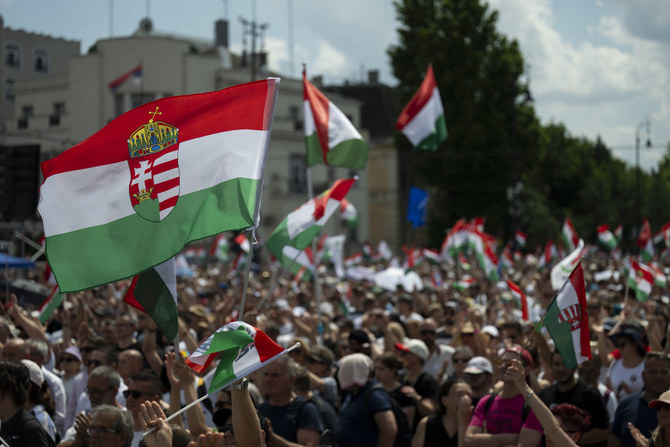
People wave Hungarian national flags during a demonstration, where Peter Magyar, a challenger to Hungarian Prime Minister Viktor Orbán, addresses his supporters on the eve of European Parliament elections on June 8, 2024. (AP)
Short Url
Updated 09 June 2024
Follow

Polls open in 20 EU countries as voting for the European Parliament enters its final day

  • The election began on Thursday in the Netherlands and in other countries on Friday and Saturday, but the bulk of EU votes will be cast on Sunday
  • The election will shape how the EU, a bloc of 450 million citizens, confronts challenges including a hostile Russia, increased industrial rivalry from China and the US, climate change and immigration

BRUSSELS: Polls opened on Sunday in 20 European Union countries, from Sweden and Lithuania in the north to Portugal and Cyprus in the south, as voters choose their representatives for the next five-year term of the European Parliament, amid concern that a likely shift to the political right will undermine the ability of the world’s biggest trading bloc to take decisions as war rages in Ukraine and anti-migrant sentiment mounts.

Citizens will cast ballots to elect 720 members of the European Parliament. Seats in the assembly are allocated based on population, ranging from six in Malta or Luxembourg to 96 in Germany.

Official results of the elections, which are held every five years and began in the Netherlands on Thursday, cannot be published before the last polling stations in the 27 EU nations close — those in Italy at 11 p.m. Unofficial estimates are due to trickle in from 1615 GMT.

An unofficial exit poll on Thursday suggested that Geert Wilders’ anti-migrant hard right party should make important gains in the Netherlands, even though a coalition of pro-European parties has probably pushed it into second place.

Since the last EU election in 2019, populist or far-right parties now lead governments in three nations — Hungary, Slovakia and Italy — and are part of the ruling coalition in others, including Sweden, Finland and, soon, the Netherlands. Polls give the populists an advantage in France, Belgium, Austria and Italy.


German Chancellor Olaf Scholz, right, and lead candidate Katarina Barley wave to supporters during the closing rally campaign for the European Parliament election of the German Social Democrats (SPD) in Duisburg, Germany, on June 8, 2024. (AP)

The elections come at a testing time for voter confidence in a bloc of some 450 million people. Over the last five years, the EU has been shaken by the coronavirus pandemic, an economic slump and an energy crisis fueled by the biggest land conflict in Europe since the Second World War.

The polls also mark the beginning of a period of uncertainty for the Europeans and their international partners. Beyond the wrangling to form political groups and establish alliances inside parliament, governments will compete to secure top EU jobs for their national officials.

Chief among them is the presidency of the powerful executive branch, the European Commission, which proposes laws and watches to ensure they are respected. The commission also controls the EU’s purse strings, manages trade and is Europe’s competition watchdog.

Other plum posts are those of European Council president, who chairs summits of presidents and prime ministers, and EU foreign policy chief, the bloc’s top diplomat.

EU lawmakers have a say on legislation ranging from financial rules to climate or agriculture policy. They also approve the EU budget, which apart from funding the bloc’s political priorities bankrolls things like infrastructure projects, farm subsidies or aid delivered to Ukraine.

But despite their important role, political campaigning often focuses on issues of concern in individual countries rather than on broader European interests. Voters routinely use their ballots to protest the policies of their national governments.


Graphic urging voters to take part in the election. (X: @Europarl_EN)

Surveys suggest that mainstream and pro-European parties will retain their majority in parliament, but that the hard right, including parties led by politicians like Wilders or France’s Marine Le Pen, will eat into their share of seats.

The biggest political group – the center-right European People’s Party (EPP) – has already edged away from the middle ground, campaigning on traditional far-right issues like more security, tougher migration laws, and a focus on business over social welfare concerns.

Much may depend on whether the Brothers of Italy — the governing party of populist far-right Prime Minister Georgia Meloni, which has neo-fascist roots — stays in the more hard-line European Conservatives and Reformists, or becomes part of a new hard right group that could be created in the wake of the elections. Meloni also has the further option to work with the EPP.

The second-biggest group — the center-left Socialists and Democrats — and the Greens refuse to align themselves with the ECR. A more dire scenario for pro-European parties would be if the ECR joins forces with Le Pen’s Identity and Democracy to consolidate hard-right influence.

Questions remain over what group Hungarian Prime Minister Viktor Orbán’s staunchly nationalist and anti-migrant Fidesz party might join. It was previously part of the EPP but was forced out in 2021 due to conflicts over its interests and values.

The EPP has campaigned for Ursula von der Leyen to be granted a second term as commission president but nothing guarantees that she will be returned even if they win. National leaders will decide who is nominated, even though the parliament must approve any nominee.


Trump says Zelensky ‘isn’t ready’ yet to accept US-authored proposal to end Russia-Ukraine war

Updated 08 December 2025
Follow

Trump says Zelensky ‘isn’t ready’ yet to accept US-authored proposal to end Russia-Ukraine war

  • Trump said he was “disappointed” and suggested that the Ukrainian leader is holding up the talks from moving forward
  • He also claimed Russia is “fine with it” even though Putin last week had said that aspects of Trump’s proposal were unworkable

KYIV, Ukraine: President Donald Trump on Sunday claimed Ukrainian President Volodymyr Zelensky “isn’t ready” to sign off on a US-authored peace proposal aimed at ending the Russia-Ukraine war.
Trump was critical of Zelensky after US and Ukrainian negotiators completed three days of talks on Saturday aimed at trying to narrow differences on the US administration’s proposal. But in an exchange with reporters on Sunday night, Trump suggested that the Ukrainian leader is holding up the talks from moving forward.
“I’m a little bit disappointed that President Zelensky hasn’t yet read the proposal, that was as of a few hours ago. His people love it, but he hasn’t,” Trump claimed in an exchange with reporters before taking part in the Kennedy Center Honors. The president added, “Russia is, I believe, fine with it, but I’m not sure that Zelensky’s fine with it. His people love it it. But he isn’t ready.”
To be certain, Russian President Vladimir Putin hasn’t publicly expressed approval for the White House plan. In fact, Putin last week had said that aspects of Trump’s proposal were unworkable, even though the original draft heavily favored Moscow.
Trump has had a hot-and-cold relationship with Zelensky since riding into a second White House term insisting that the war was a waste of US taxpayer money. Trump has also repeatedly urged the Ukrainians to cede land to Russia to bring an end to a now nearly four-year conflict he says has cost far too many lives.
Zelensky said Saturday he had a “substantive phone call” with the American officials engaged in the talks with a Ukrainian delegation in Florida. He said he had been given an update over the phone by US and Ukrainian officials at the talks.
“Ukraine is determined to keep working in good faith with the American side to genuinely achieve peace,” Zelensky wrote on social media.
Trump’s criticism of Zelensky came as Russia on Sunday welcomed the Trump administration’s new national security strategy in comments by the Kremlin spokesman published by Russia’s Tass news agency.

Dmitry Peskov said the updated strategic document, which spells out the administration’s core foreign policy interests, was largely in line with Moscow’s vision.
“There are statements there against confrontation and in favor of dialogue and building good relations,” he said, adding that Russia hopes this would lead to “further constructive cooperation with Washington on the Ukrainian settlement.”
The document released Friday by the White House said the US wants to improve its relationship with Russia after years of Moscow being treated as a global pariah and that ending the war is a core US interest to “reestablish strategic stability with Russia.”
Speaking on Saturday at the Reagan National Defense Forum, Trump’s outgoing Ukraine envoy, Keith Kellogg, said efforts to end the war were in “the last 10 meters.”
He said a deal depended on the two outstanding issues of “terrain, primarily the Donbas,” and the Zaporizhzhia Nuclear Power Plant.
Russia controls most of Donbas, its name for the Donetsk and neighboring Luhansk regions, which, along with two southern regions, it illegally annexed three years ago. The Zaporizhzhia Nuclear Power Plant is in an area that has been under Russian control since early in Moscow’s invasion of Ukraine and is not in service. It needs reliable power to cool its six shutdown reactors and spent fuel, to avoid any catastrophic nuclear incidents.
Kellogg, who is due to leave his post in January, was not present at the talks in Florida.
Separately, officials said the leaders of the United Kingdom, France and Germany would participate in a meeting with Zelensky in London on Monday.
As the three days of talks wrapped up, Russian missile, drone and shelling attacks overnight and Sunday killed at least four people in Ukraine.
A man was killed in a drone attack on Ukraine’s northern Chernihiv region Saturday night, local officials said, while a combined missile and drone attack on infrastructure in the central city of Kremenchuk caused power and water outages. Kremenchuk is home to one of Ukraine’s biggest oil refineries and is an industrial hub.
Kyiv and its Western allies say Russia is trying to cripple the Ukrainian power grid and deny civilians access to heat, light and running water for a fourth consecutive winter, in what Ukrainian officials call “weaponizing” the cold.
Three people were killed and 10 others wounded Sunday in shelling by Russian troops in Ukraine’s Kharkiv region, according to the regional prosecutor’s office.