

India’s PM Modi sworn in for historic third term

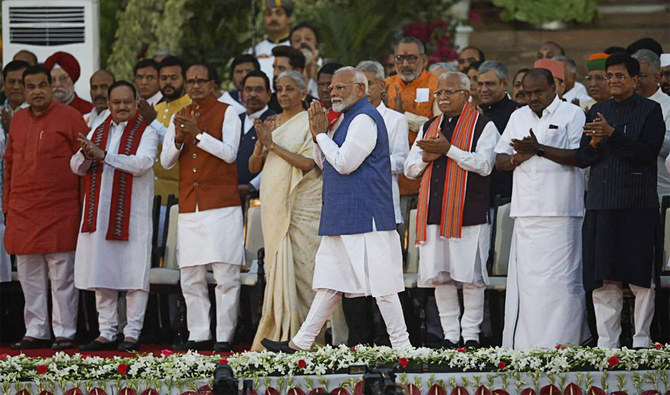
India's Prime Minister Narendra Modi attends the swearing-in ceremony at the presidential palace in New Delhi, India, on June 9, 2024. (REUTERS)
Short Url
Updated 09 June 2024
Follow

India’s PM Modi sworn in for historic third term

  • Modi is first Indian leader to win 3rd straight term since founding PM Jawaharlal Nehru
  • Modi was formally elected leader of India’s winning coalition on Friday 

NEW DELHI: Narendra Modi was sworn in for a historic third term as India’s prime minister on Sunday. 

Modi is the first Indian leader to win a third straight term since founding prime minister Jawaharlal Nehru. Over the past decade, his Hindu-nationalist BJP has governed India as part of the National Democratic Alliance. 

Though the coalition won the election last week, the BJP lost its absolute majority for the first time since 2014, making it dependent on allies to form a government. 

After several days of uncertainty over whether the coalition partners would back the BJP, the alliance leaders unanimously backed Modi on Friday as the leader of the NDA and their prime ministerial candidate. 

His swearing-in ceremony was held at the presidential palace in New Delhi on Sunday evening, in the presence of the presidents of Sri Lanka and the Maldives, the vice president of Seychelles, and the prime ministers of Bangladesh, Mauritius, Nepal, and Bhutan.

In a meeting with prospective members of his new cabinet prior to the ceremony, the Viksit Bharat, or Developed India, appears to remain a priority for Modi, according to reports from local media, as he highlighted his goal of making India a developed nation by 2047 that he often invoked during his reelection campaign. 

“We need to continue with the Viksit Bharat agenda. Development work will go on without any halt,” Modi said.

While the BJP won 240 seats in India’s marathon, six-week election that began on April 19, it fell 32 short of the simple majority required in the 543-member lower house of parliament. 

The NDA coalition bagged 293 seats after the BJP secured the backing of key allies Telugu Desam Party in southern Andhra Pradesh state and the Janata Dal (United) in eastern Bihar state, which won 16 and 12 seats each in their respective states, pushing the alliance comfortably over the halfway mark. 

But Modi’s rare third straight term is the first time in his political career that the 73-year-old must accommodate the pulls and pressures of a coalition government and work with fickle allies. 

The Telugu Desam Party is led by Chandrababu Naidu, who helped build the coalition that tried to unseat Modi in the 2019 election. While the Janata Dal (United) was with the opposition as recently as January. 

Prof. Gopa Kumar, from Kerala-based think tank Center for Public Policy Research, said Modi’s third time as premier is “an extraordinary development,” though he expects some changes in the leadership. 

“I feel that the government will be more careful this time than the past … Strong opposition is good for democracy. Modi will face sharp questions in the parliament and Modi will be cautious in taking up controversial and divisive agenda,” Kumar told Arab News.

Though many are doubting the stability of the new coalition government, Kumar said he was “optimistic” that Modi’s new administration would be able to serve its full term. 

“The mandate given to the NDA government is a restricted mandate which is healthy because most of the parliamentary democracies show that they work better in a coalition system than a single-party absolute majority.”

With the BJP’s reliance on allies, Modi is also expected to be more accommodating in his politics. 

“The mandate showed that Modi as prime minister will have to be more accommodative and open to pursuing a consensual politics, which has completely disappeared from India in the last ten years. So it is a very mature decision of the Indian electorate,” Nilanjan Mukhopadhyay, a Delhi-based political analyst and writer, told Arab News.

“If he wants his government to survive he has to be much more humbler and less authoritarian, less centralizing, more decentralizing and respecting the federal power of the state not centralize everything and overrule the state,” he added. “To run his third government Modi has to be an individual which he was not so far. He will have to work against his instinct.” 


Bangladesh mourns Khaleda Zia, its first woman prime minister

Updated 30 December 2025
Follow

Bangladesh mourns Khaleda Zia, its first woman prime minister

  • Ousted ex-premier Sheikh Hasina, who imprisoned Zia in 2018, offers condolences on her death
  • Zia’s rivalry with Hasina, both multiple-term PMs, shaped Bangladeshi politics for a generation

DHAKA: Bangladesh declared three days of state mourning on Tuesday for Khaleda Zia, its first female prime minister and one of the key figures on the county’s political scene over the past four decades.

Zia entered public life as Bangladesh’s first lady when her husband, Ziaur Rahman, a 1971 Liberation War hero, became president in 1977.

Four years later, when her husband was assassinated, she took over the helm of his Bangladesh Nationalist Party and, following the 1982 military coup led by Hussain Muhammad Ershad, was at the forefront of the pro-democracy movement.

Arrested several times during protests against Ershad’s rule, she first rose to power following the victory of the BNP in the 1991 general election, becoming the second woman prime minister of a predominantly Muslim nation, after Pakistan’s Benazir Bhutto.

Zia also served as a prime minister of a short-lived government of 1996 and came to power again for a full five-year term in 2001.

She passed away at the age of 80 on Tuesday morning at a hospital in Dhaka after a long illness.

She was a “symbol of the democratic movement” and with her death “the nation has lost a great guardian,” Bangladesh’s interim leader Muhammad Yunus said in a condolence statement, as the government announced the mourning period.

“Khaleda Zia was the three-time prime minister of Bangladesh and the country’s first female prime minister. ... Her role against President Ershad, an army chief who assumed the presidency through a coup, also made her a significant figure in the country’s politics,” Prof. Amena Mohsin, a political scientist, told Arab News.

“She was a housewife when she came into politics. At that time, she just lost her husband, but it’s not that she began politics under the shadow of her husband, president Ziaur Rahman. She outgrew her husband and built her own position.”

For a generation, Bangladeshi politics was shaped by Zia’s rivalry with Sheikh Hasina, who has served as prime minister for four terms.

Both carried the legacy of the Liberation War — Zia through her husband, and Hasina through her father, Sheikh Mujibur Rahman, widely known as the “Father of the Nation,” who served as the country’s first president until his assassination in 1975.

During Hasina’s rule, Zia was convicted in corruption cases and imprisoned in 2018. From 2020, she was placed under house arrest and freed only last year, after a mass student-led uprising, known as the July Revolution, ousted Hasina, who fled to India.

In November, Hasina was sentenced to death in absentia for her deadly crackdown on student protesters and remains in self-exile.

Unlike Hasina, Zia never left Bangladesh.

“She never left the country and countrymen, and she said that Bangladesh was her only address. Ultimately, it proved true,” Mohsin said.

“Many people admire Khaleda Zia for her uncompromising stance in politics. It’s true that she was uncompromising.”

On the social media of Hasina’s Awami League party, the ousted leader also offered condolences to Zia’s family, saying that her death has caused an “irreparable loss to the current politics of Bangladesh” and the BNP leadership.

The party’s chairmanship was assumed by Zia’s eldest son, Tarique Rahman, who returned to Dhaka just last week after more than 17 years in exile.

He had been living in London since 2008, when he faced multiple convictions, including an alleged plot to assassinate Hasina. Bangladeshi courts acquitted him only recently, following Hasina’s removal from office, making his return legally possible.

He is currently a leading contender for prime minister in February’s general elections.

“We knew it for many years that Tarique Rahman would assume his current position at some point,” Mohsin said.

“He should uphold the spirit of the July Revolution of 2024, including the right to freedom of expression, a free and fair environment for democratic practices, and more.”