SAN DIEGO: The Border Patrol arrested Gerardo Henao 14 hours after President Joe Biden suspended asylum processing at the US border with Mexico this week. But instead of being summarily deported, he was dropped off by agents the next day at a San Diego bus stop, where he caught a train to the airport for a flight to Newark, New Jersey.
Henao, who said he left his jewelry business in Medellin, Colombia, because of constant extortion attempts, had one thing working in his favor: a scarcity of deportation flights to that country. Lack of resources, diplomatic limitations and logistical hurdles make it difficult for the Biden administration to impose its sweeping measure on a large scale.
The policy, which took effect Wednesday, has an exception for “operational considerations,” official language acknowledging the government lacks the money and authority to deport everyone subject to the measure, especially people from countries in South America, Asia, Africa and Europe who didn’t start showing up at the border until recently.
The Homeland Security Department said in a detailed document outlining the ban that “demographics and nationalities encountered at the border significantly impact” its ability to deport people.
Thousands of migrants have been deported under the ban so far, according to two senior Homeland Security Department officials who briefed reporters Friday on condition that they not be named. There were 17 deportation flights, including one to Uzbekistan. Those deported include people from Colombia, Ecuador, El Salvador, Guatemala, Peru and Mexico.
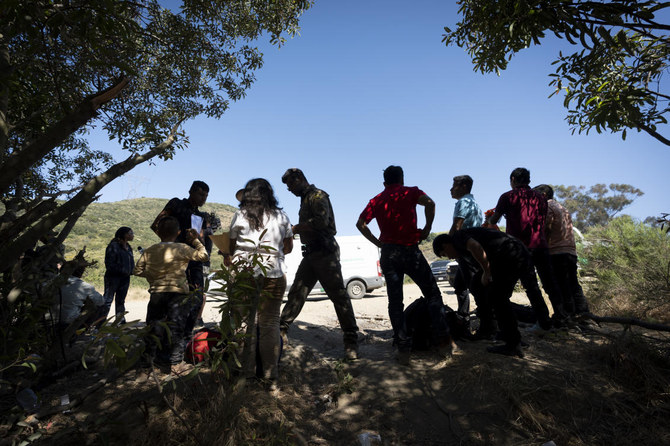
Henao, 59, said a Border Patrol agent told him about the ban after he was picked up Wednesday on a dirt road near a high-voltage power line in the boulder-strewn mountains east of San Diego. The agent processed release papers ordering him to appear in immigration court Oct. 23 in New Jersey. He casually asked Henao why he fled Colombia but didn’t pursue that line of questioning.
“It was nothing,” Henao said at a San Diego transit center, where the Border Patrol dropped off four busloads of migrants in a four-hour span Thursday afternoon. “They took my photo, my fingerprints and that was it.”
Many migrants released that day were from China, India, Colombia and Ecuador. One group included men from Mauritania, Sudan and Ethiopia.
“Hello, if you are arriving right now, you have been released from immigration custody and you can go to the airport,” a volunteer with a bullhorn told the migrants, directing them to a light-rail platform across the parking lot. “You can go for free if you don’t have money for a taxi or an Uber.”
Under the measure, asylum is suspended when arrests for illegal crossings reach 2,500 a day. It ends when they average below 1,500 for a week straight.
Border officials were told to give the highest priority to detaining migrants who can be easily deported, followed by “hard to remove” nationalities requiring at least five days to issue travel documents and then “very hard to remove” nationalities whose governments don’t accept US flights.
The instructions are laid out in a memo to agents that was reported by the New York Post. The Associated Press confirmed its contents with a US official who spoke on condition of anonymity because it has not been publicly released.
Homeland Security has been clear about the hurdles, said Theresa Cardinal Brown, senior adviser for immigration and border policy at the Bipartisan Policy Center, a Washington think tank.
“There’s a limitation to the resources that the government has for detention and removal of people, and in particular to countries that we have a hard time removing people to because the (other) government is not cooperative,” Brown said. “We can’t detain them indefinitely.”
US Immigration and Customs and Enforcement did 679 deportation flights from January through May, nearly 60 percent of them to Guatemala and Honduras, according to Witness at the Border, an advocacy group that analyzes flight data. There were 46 flights to Colombia, 42 to Ecuador and 12 to Peru, a relatively small amount considering that tens of thousands enter illegally from those countries every month.
There were only 10 deportation flights during that period to Africa, which has emerged as a major source of migration to the United States. There was just one to China, despite the arrests of nearly 13,000 Chinese migrants.
Mexico is the easiest country for removals because it’s only a matter of driving to the nearest border crossing, but Mexicans accounted for less than 3 of 10 border arrests in the government’s last fiscal year, down from 9 of 10 in 2010. Mexico also takes up to 30,000 people a month from Cuba, Haiti, Nicaragua and Venezuela, countries that have limited capacity or willingness to take people back.
Some countries refuse to accept flights to avoid getting overwhelmed themselves, Corey Price, then-director of ICE enforcement and removal operations, said in an interview last year.
“We don’t drive the bus on this,” said Price, who retired last month. “We don’t decide unilaterally, ‘OK, we’re sending your citizen back to you.’ No, that country still has to agree to take them back.”


![]()

Some nationalities escape Biden’s sweeping asylum ban because deportation flights are scarce
Short Url
https://arab.news/rgnr3
Some nationalities escape Biden’s sweeping asylum ban because deportation flights are scarce
- Joe Biden suspended asylum processing at the US border with Mexico this week.
- The policy, which took effect Wednesday, has an exception for ‘operational considerations’


Latest updates


© 2026 SAUDI RESEARCH & PUBLISHING COMPANY, All Rights Reserved And subject to Terms of Use Agreement.