

Over 97,000 Pakistani pilgrims arrive in Saudi Arabia for this year’s Hajj 

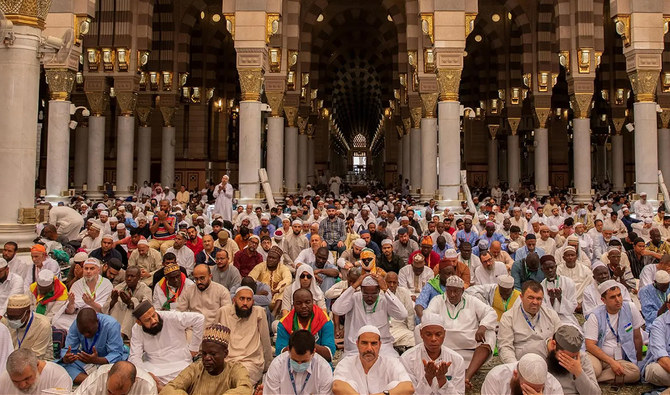
In this handout photograph, taken and released by the Saudi Press Agency, people attend Friday prayers at Prophet’s Mosque in Madinah on June 7, 2024, ahead of annual Hajj pilgrimage. (SPA)
Short Url
Updated 10 June 2024
Follow

Over 97,000 Pakistani pilgrims arrive in Saudi Arabia for this year’s Hajj 

  • Pakistan to conclude month-long pre-Hajj flight operation today 
  • About 65,000 Pakistani pilgrims have arrived under government scheme

ISLAMABAD: More than 97,000 Pakistani pilgrims under the government and private Hajj schemes have arrived in Saudi Arabia to take part in the annual Islamic pilgrimage, state-run media reported this week, with Pakistan expected to conclude its month-long pre-flight Hajj operation today, Sunday. 

Hajj is one of the five pillars of Islam, requiring every adult Muslim to undertake the pilgrimage to the holy Islamic sites in Makkah at least once in their lifetime if they are financially and physically able.

Pakistan has a Hajj quota of 179,210 pilgrims this year, of which around 70,000 people will perform the pilgrimage under the government scheme, while the rest will use private tour operators. This year’s pilgrimage is expected to run from June 14-19. 

Pakistan kicked off a month-long pre-Hajj flight operation on May 9 to transport pilgrims to the holy cities of Makkah and Madinah for the pilgrimage. 

“More than 97,000 pilgrims have arrived in Saudi Arabia under both Government and Private Hajj schemes,” state broadcaster Radio Pakistan reported on Saturday. 

About 65,000 Pakistani pilgrims have arrived via 243 flights under the government scheme while more than 36,402 have arrived under the private scheme, the state broadcaster said. 

“The last flight from Pakistan will operate on Sunday which will end the month-long operation,” Radio Pakistan said, adding that the overall Hajj operation was proceeding as per schedule. 

Muhammad Umer Butt, the spokesperson for Pakistan’s religion ministry, said the government has deployed 375 doctors and paramedical staff, and 511 assistants in Makkah to serve pilgrims free of cost. 

A 400-member dedicated Pakistan Hajj Medical Mission is also working around the clock to serve Pakistani pilgrims in Saudi Arabia and Pakistan has established two hospitals and 11 dispensaries in the Saudi cities of Makkah, Madinah and Jeddah to provide health care to Hajj pilgrims.

A government official said last week that out of Pakistan’s total quota of 179,210 pilgrims, around 160,000 pilgrims from the country are expected to perform the pilgrimage. 


Pakistan’s space agency says country will witness first supermoon of 2026 on Saturday

Updated 3 sec ago
Follow

Pakistan’s space agency says country will witness first supermoon of 2026 on Saturday

  • The supermoon will coincide with the Quadrantid meteor shower, which peaks in early January
  • The space agency says no further supermoon will occur until a new cycle begins in Nov. 2026

ISLAMABAD: Pakistan will witness the first supermoon of 2026 on Saturday evening, a rare celestial event that will coincide with the Quadrantid meteor shower, which is active in early January, the country’s space agency said Friday.

The Jan. 3 supermoon will be the last in a cycle that began in October 2025, while also marking the first supermoon of the new year. Supermoons occur when a full moon coincides with the Moon’s closest approach to Earth, making it appear larger and brighter than usual.

“The January 3 supermoon, traditionally known as the Wolf Moon, marks the final supermoon of the ongoing cycle began in October 2025,” Pakistan’s national space agency, SUPARCO, said in a statement, adding that it also “simultaneously represents the first supermoon of 2026.”

The agency said the supermoon would rise in Pakistan at 5:51 p.m. local time on Jan. 3 and remain visible through the nights of Jan. 3 and Jan. 4, with illumination reaching 99.8 percent.

According to SUPARCO, the Moon will be at a distance of about 362,312 kilometers (225,130 miles) from Earth during the event, making it appear six to seven percent larger and up to 10 percent brighter than a typical full moon.
The astronomical significance of the event will be enhanced by its timing.

“The supermoon of Jan 3 offers an early highlight among the year’s celestial events such as coinciding with the peak activity of the Quadrantid meteor shower during the same time period,” the statement said.

SUPARCO noted that supermoons usually occur in clusters of three to four consecutive events and said the current cycle would conclude with Friday’s phenomenon.

“The next supermoon cycle starts in November 2026,” the agency said, adding that there would be no further supermoon after this until the end of 2026.