BRUSSELS, Belgium: Italy became the first heavyweight nation to cast votes for the EU’s next parliament on Saturday, in a test of far-right leader Giorgia Meloni’s strength at home — and future influence in the bloc.
Most of the European Union’s 27 member countries, including powerhouses France and Germany, go to the polls on Sunday, the final day, with projected overall results due late that evening.
The first polling stations have already opened in the French Pacific territory of New Caledonia, the site of deadly rioting this month.
The two-day ballot in Italy — the EU’s third-largest economy with 76 of 720 seats in the new parliament — could have big consequences.
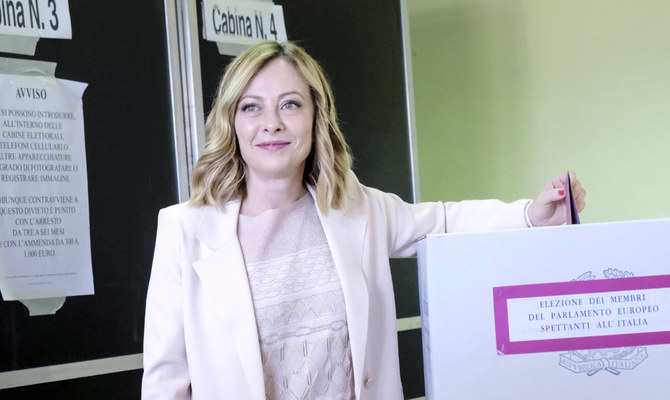
Meloni cast her vote in her Rome constituency, under sweltering late spring temperatures, telling reporters that the EU contest “will shape the next five years.”
Polls suggest Meloni’s Brothers of Italy party could win with 27 percent of the vote — more than quadrupling its score from 2019 — amid a broader surge of far-right groups across the bloc.
Walter Esposito, a 78-year-old Roman, cast his vote for her party in protest at EU policies on the environment, complaining: “Europe has always tried to crush Italy and the Italian people.”
At the other end of the political spectrum, Carlotta Cinardi, an 18-year-old student, said she found no party that “100 percent represents my ideas” — but voted green as the “most progressive toward young people.”
A victory could set up Meloni as a powerbroker in determining whether EU Commission chief Ursula von der Leyen gets the backing she needs, from both member states and parliament, for a second term.
Meloni has been actively courted both by the center-right von der Leyen — and by French far-right leader Marine Le Pen, who wants to create a right-wing EU supergroup.
But one European diplomat warned against overestimating her influence.
“Meloni will have an influence on Italian interests, at the commission, in parliament,” said the diplomat, who asked not to be named. “She will play the game. But does that make her a kingmaker? No.”
For the time being, Meloni is keeping her cards close to her chest — though she makes clear she wants to relegate the EU’s left-wing parties to the opposition.
Public concern over the flow of irregular migrants across the Mediterranean was one of the key issues that propelled Meloni to power in 2022.
EU-wide, immigration is the hot-button issue driving support to far-right parties. They are forecast to grab a quarter of parliament seats — though the centrist mainstream is still seen coming out on top.
Tens of thousands of demonstrators rallied in cities across Germany Saturday, urging a vote against the far-right, with the anti-immigration AfD party polling at about 15 percent.
Beyond the predicted surge, analysts say the bigger question is whether parliament’s main grouping, von der Leyen’s European People’s Party (EPP), will ally with the far-right.
Von der Leyen has indicated willingness to have the EPP work with far-right lawmakers, as long as they are pro-EU and not what she calls “puppets” of Russian President Vladimir Putin.
On those grounds Von der Leyen explicitly ruled out allying with Le Pen’s National Rally (RN), which is topping French polls, or with Germany’s AfD.
Both those parties — unlike Meloni’s — are leery of EU military and financial support to Ukraine against Russia’s invading forces, with the AfD outright hostile to weapons deliveries.
In Hungary — where tens of thousands rallied Saturday in support of opposition leader Peter Magyar — Viktor Orban’s ruling populist Fidesz party is likewise opposed to further helping Kyiv.
Italy was voting on the same day as Slovakia, a NATO and EU member since 2004, shaken by an assassination attempt last month on premier Robert Fico.
Voters have rallied to Fico’s Russia-friendly camp in the wake of the shooting — which he blamed on “aggressive and hateful politics” by the opposition.
Authorities said the assassination attempt, by a 71-year-old poet, was politically motivated.
Jozef Zahorsky, a 44-year-old teacher, said he cast his ballot for Fico’s ruling left-wing nationalist Smer-SD because it stood for “the interests of Slovakia, not Brussels.”
Fico’s party opposes EU arms deliveries to help Ukraine repel Russia’s invasion, and rails against alleged “warmongers” in Brussels.
In a Facebook post, Fico posted a photograph of himself casting a ballot from his hospital bed. He urged voters to “elect European Parliament lawmakers who support peace efforts, not the pursuit of war.”


![]()

Italy votes in EU election with Meloni poised as powerbroker
Short Url
https://arab.news/cebsy
Italy votes in EU election with Meloni poised as powerbroker
- The two-day ballot in Italy — the EU’s third-largest economy with 76 of 720 seats in the new parliament — could have big consequences


Latest updates


Recommended


© 2026 SAUDI RESEARCH & PUBLISHING COMPANY, All Rights Reserved And subject to Terms of Use Agreement.