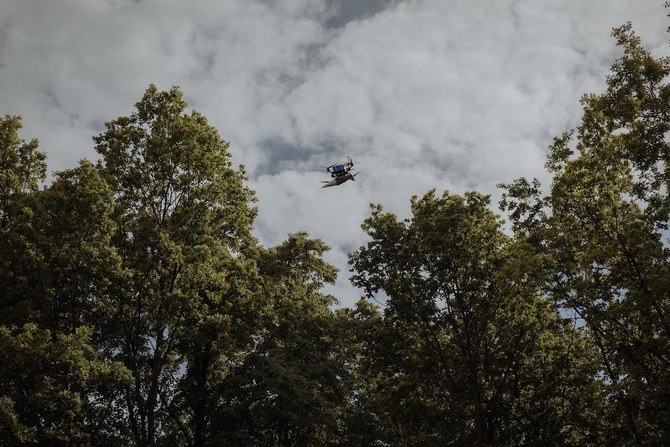
MOSCOW: Ukraine targeted the south Russian region of North Ossetia with drones for the first time ever on Saturday, causing minor damage, local authorities said.
The drones were aimed at a military airfield near the town of Mozdok, more than 700 kilometers from the frontline, according to North Ossetia governor Sergei Menyailo.
“The attack was foiled by the Russian Defense Ministry’s air defense forces. Minor damage and fires were recorded. No one was injured,” he said.
Three drones were shot down in the attack, he added.
Social media videos purportedly filmed in the region showed drones flying overhead, while pictures showed what appeared to be drone fragments scattered on the ground.
“All services have been put on high alert. For the safety of citizens, we have decided to cancel all mass events in Mozdoksky district,” Menyailo added.
Ukraine often targets military and energy facilities on Russian territory in drone attacks, sometimes hundreds of kilometers from the frontline.
Ukraine did not immediately comment, however the Ukrainska Pravda newspaper quoted Kyiv’s military intelligence as saying they were behind the attack.

Ukraine fires drones at south Russian region
https://arab.news/mzepd
Ukraine fires drones at south Russian region
- Ukraine often targets military and energy facilities on Russian territory in drone attacks, sometimes hundreds of kilometers from the frontline
Europeans push back at US over claim they face ‘civilizational erasure’
- “Contrary to what some may say, woke, decadent Europe is not facing civilizational erasure,” Kallas told the conference
MUNICH: A top European Union official on Sunday rejected the notion that Europe faces “civilizational erasure,” pushing back at criticism of the continent by the Trump administration.
EU foreign policy chief Kaja Kallas addressed the Munich Security Conference a day after US Secretary of State Marco Rubio offered a somewhat reassuring message to European allies. He struck a less aggressive tone than Vice President JD Vance did in lecturing them at the same gathering last year but maintained a firm tone on Washington’s intent to reshape the trans-Atlantic alliance and push its policy priorities.
Kallas alluded to criticism in the US national security strategy released in December, which asserted that economic stagnation in Europe “is eclipsed by the real and more stark prospect of civilizational erasure.” It suggested that Europe is being enfeebled by its immigration policies, declining birth rates, “censorship of free speech and suppression of political opposition” and a “loss of national identities and self-confidence.”
“Contrary to what some may say, woke, decadent Europe is not facing civilizational erasure,” Kallas told the conference. “In fact, people still want to join our club and not just fellow Europeans,” she added, saying she was told when visiting Canada last year that many people there have an interest in joining the EU.
Kallas rejected what she called “European-bashing.”
“We are, you know, pushing humanity forward, trying to defend human rights and all this, which is actually bringing also prosperity for people. So that’s why it’s very hard for me to believe these accusations.”
In his conference speech, Rubio said that an end to the trans-Atlantic era “is neither our goal nor our wish,” adding that “our home may be in the Western hemisphere, but we will always be a child of Europe.”
He made clear that the Trump administration is sticking to its guns on issues such as migration, trade and climate. And European officials who addressed the gathering made clear that they in turn will stand by their values, including their approach to free speech, climate change and free trade.
British Prime Minister Keir Starmer said Saturday that Europe must defend “the vibrant, free and diverse societies that we represent, showing that people who look different to each other can live peacefully together, that this isn’t against the tenor of our times.”
“Rather, it is what makes us strong,” he said.
Kallas said Rubio’s speech sent an important message that America and Europe are and will remain intertwined.
“It is also clear that we don’t see eye to eye on all the issues and this will remain the case as well, but I think we can work from there,” she said.