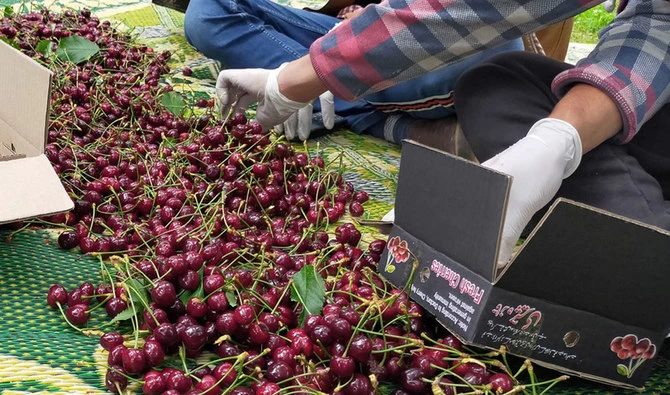
- Region’s fruit farmers say it is easier to transport cherries to China than to Pakistan’s major urban centers
- GB’s agriculture department says the region produces approximately 5,000 tons of cherries every season
KHAPLU: Fruit farmers in Pakistan’s northern Gilgit Baltistan (GB) region expressed optimism on Friday their access to the Chinese market will strengthen the local economy after the country’s trade authorities announced the successful dispatch of the first-ever consignment of Pakistani cherries across the border this week.
GB is frequently described as Pakistan’s gateway to China since it is home to the Khunjerab Pass, which is the highest paved international border crossing in the world and the highest point on the Karakoram Highway. This pass and highway are crucial components of the route that connects Pakistan to China, facilitating trade and travel between the two countries.
GB’s mild to cold climate also makes it an ideal location for fruit orchards, particularly cherries, which are considered some of the best in the region. The area also supports the cultivation of other fruits like apricots and apples, contributing to its reputation for high-quality produce.
Despite its proximity with China, the farmers in GB never exported fruit to the neighboring market before the Trade Development Authority of Pakistan (TDAP) announced the dispatch of the first consignment of cherries on June 5.
“We are very happy that our cherries have entered the Chinese market,” Abbas Skinderi, a cherry farmer from Nagar district, spoke to Arab News over the phone. “If half of GB’s production goes to China, the farmers will be the top beneficiaries.”
Skinderi said there were limited markets available to farmers in GB, adding the recent development would reduce poverty in the area.
“As China opens its door for our cherries, we will plant more of these trees,” he continued.
Irfan Ali Shah, another farmer, agreed, saying the export to the Chinese market would change the lives of local farmers.
“Hundreds of people in GB are associated with cherry farming,” he noted. “This is the first time our cherries have been exported to China. This will change our destiny since the Chinese market is very close to the region.”
Shah said the development was also significant due to the limited shelf life of cherries.
“Due to transportation problems and dilapidated roads, it’s difficult to safely send our cherries to Pakistan’s main cities,” he informed. “China, in contrast, is much closer to GB than cities like Lahore or Karachi, ensuring that our production will not be wasted and our incomes will increase.”
GB’s major cherry-producing areas include Hunza, Nagar, Gilgit, Ghizer, Skardu and Ghanche districts.
Speaking to Arab News, Nazir Ali, a TDAP assistant director, said the first consignment of cherries was packed in a refrigerated container used internationally for transporting perishable goods.
“Over 100 cherry orchards, alongside a cold storage and packing house at Rahimabad in Gilgit, are now registered with the General Administration of Chinese Customs,” he said. “This registration ensures that the cherries meet the stringent quality and safety standards required by the Chinese market, thereby guaranteeing the best prices for Pakistani farmers.”
Javed Akhtar, a deputy director at GB’s agriculture department, said the first consignment had 15 to 20 tons of cherries.
“China’s protocol for exporters of cherries is very tough,” he continued. “Luckily, under the guidance of the plant protection and agriculture departments, our traders fulfilled all protocols and managed to successfully send the first consignment to China. The climate of GB is very favorable for cherry production and 14 different varieties of cherries are found in the region.”
According to the agriculture department, the region produces about 5,000 tons of cherries per season. Access to the Chinese market is expected to significantly boost this production level as more and more farmers adopt advanced agricultural practices and begin to grow the fruit.