

Pakistan’s power regulator raises electricity rates citing fuel cost adjustments

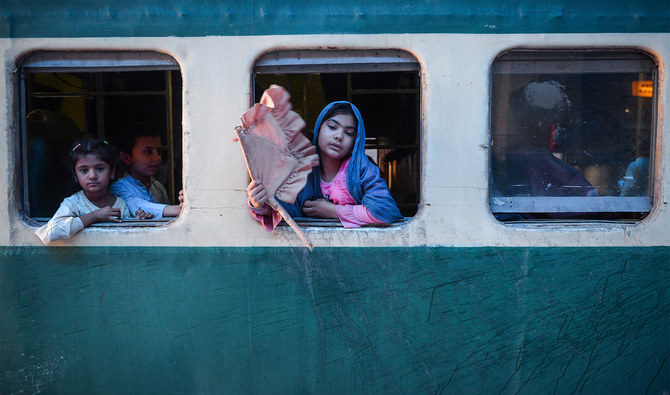
A girl uses a traditional hand fan while sitting in a train at the railway station on a hot summer day in Lahore on May 30, 2024, amid the ongoing heatwave. (AFP/File)
Short Url
Updated 07 June 2024
Follow

Pakistan’s power regulator raises electricity rates citing fuel cost adjustments

  • Rs3.33 per unit hike is expected to allow ex-WAPDA electricity distribution companies to raise $101.4 million
  • Electricity consumers in Karachi will pay an additional Rs2.68 per unit for power consumption in April 2024

KARACHI: Pakistan’s National Electric Power Regulatory Authority (NEPRA) has increased tariff for ex-WAPDA distribution companies (XWDISCOs) and Karachi Electric for the month of June after making fuel cost adjustment, according to a notification issued on Thursday.

The ex-WAPDA distribution companies in Pakistan are entities that were part of the Water and Power Development Authority (WAPDA) before the power sector was restructured over a decade ago, leading to the unbundling of WAPDA’s power distribution functions.

The reforms resulted in the creation of several independent distribution companies (DISCOs), each responsible for providing electricity to specific geographical regions of Pakistan. While these companies operate independently, they are still regulated by NEPRA that notified a Rs3.33 per unit hike for them which would reflect in June 2024 bills.

The move is expected to help them to raise about Rs29 billion ($101.4 million) of additional revenue this month.

“The authority… has reviewed and assessed a National Average Uniform increase of Rs3.332 1/kWh in the applicable tariff for XWDISCOs on account of variations in the fuel charges for the month of April 2024,” said the NEPRA notification.

“The above adjustment of Rs3.3321/kWh shall be applicable to all the consumer categories except Electric Vehicle Charging Stations (EVCS) and lifeline consumers,” it added.

Apart from these companies, the power consumers in Karachi will pay an additional Rs2.68 per unit in June, raising the tariff to Rs10.1 per unit. The tariff will further increase to Rs3.11 per unit in July which would ease to Rs0.998 per unit in September 2024 under monthly fuel cost adjustment charges, according to the notification.

Pakistan produces expensive electricity due to a combination of factors including high reliance on imported fossil fuels, inefficient energy mix, substantial transmission and distribution losses and chronic issues like circular debt and regulatory inefficiencies.

The outdated infrastructure and inefficient power plants further exacerbate costs, while underutilization of domestic resources such as hydropower and coal add to the problem.

Additionally, fluctuations in foreign exchange rates and complex tariff structures contribute to higher electricity prices.

High power cost is one of the key factors that leads to spiraling inflation.\

According to the Pakistan Bureau of Statistics, the electricity charges had increased by 58.8 percent until May this year.

Death toll in Pakistan wedding suicide blast rises to six

Updated 24 January 2026
Follow

Death toll in Pakistan wedding suicide blast rises to six

  • Attack targeted members of local peace committee in Khyber Pakhtunkhwa’s Dera Ismail Khan
  • Peace committees are community-based groups that report militant activity to security forces

PESHAWAR: The death toll from a suicide bombing at a wedding ceremony in northwestern Pakistan rose to six, police said on Saturday, after funeral prayers were held for those killed in the attack a day earlier.

The bomber detonated explosives during a wedding gathering in the Dera Ismail Khan district of Khyber Pakhtunkhwa province, injuring more than a dozen, some of them critically.

“The death toll has surged to six,” said Nawab Khan, Superintendent of Police for Saddar Dera Ismail Khan. “Police have completed the formalities and registered the case against unidentified attackers.”

“It was a suicide attack and the Counter Terrorism Department will further investigate the case,” he continued, adding that security had been stepped up across the district to prevent further incidents.

No militant group has claimed responsibility for the blast so far.

Khan cautioned against speculation, citing ongoing militancy in the area, and said the investigation was being treated with “utmost seriousness.”

The explosion targeted the home of a member of a local peace committee, which is part of community-based groups that cooperate with security forces and whose members have frequently been targeted by militants in the past.

Some media reports also cited a death toll of seven, quoting police authorities.

Emergency officials said several of the wounded were taken to hospital soon after the blast.

Militant attacks have intensified in parts of Khyber Pakhtunkhwa since the Taliban returned to power in neighboring Afghanistan in 2021, with Islamabad accusing Afghan authorities of “facilitating” cross-border assaults, a charge Kabul denies.