

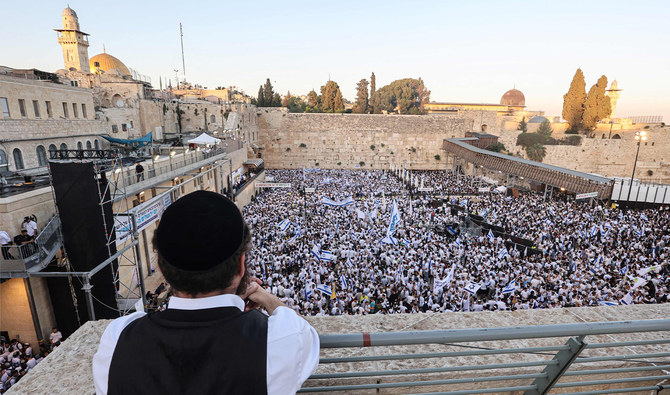

ISLAMABAD: Pakistan on Friday condemned the storming of Al-Aqsa Mosque by hundreds of Israeli “extremists” amid police protection, calling the incident a violation of decades-long international norms regarding respect for religious sites.
Hundreds of Israeli settlers stormed the courtyards of Al-Aqsa Mosque in East Jerusalem on Wednesday, waving flags and many chanting anti-Arab slogans.
The main streets in the neighborhood were empty of Palestinians who feared attacks from the Israeli “extremists” moving toward the mosque.
The so-called Jerusalem Day flag march was to commemorate the Israeli army’s capture of the city’s eastern sector in the 1967 Arab-Israeli war, home to Al-Aqsa Mosque compound, Islam’s third holiest site, which Jews call the Temple Mount.
The incident occurred after Israeli National Security Minister Itamar Ben Gvir threatened to storm the mosque in a recent interview.
“Pakistan strongly condemns the storming of the Al-Aqsa Mosque compound by hundreds of Israeli extremists under the protection of Israeli police forces,” foreign office spokesperson Mumtaz Zahra Baloch said during a weekly media briefing.
“The reprehensible act violates decades-long international agreements and international norms on respect for religious sites,” she added.
Baloch made it clear it was the responsibility of the “occupation authorities” to respect religious sites under international law, urging Israeli forces to ensure Al-Quds’ security. She also called for an “urgent and unconditional” ceasefire in Gaza to put an end to the killings of civilians apart from holding Israel accountable for its crimes.
Israel launched an air and ground offensive in Gaza last October following a surprise attack by Hamas in which around 1,200 Israelis were killed and more than 250 people were taken hostages. The Palestinian group said its attack was in response to the deteriorating condition of Palestinian people under Israeli occupation.
Prime Minister Benjamin Netanyahu’s administration’s response was widely viewed as disproportionate by the international community in which so far more than 36,500 people, mostly women and children, have been killed.
Israel is facing the charges of committing Palestinian genocide in the International Criminal Court that ordered an end to its ongoing offensive in Rafah.
“Pakistan also strongly condemns the horrific bombing of Israeli forces on the UNRWA-run Al-Sardi School in Nuseirat refugee camp in Gaza that led to multiple deaths of mostly women and children,” Baloch said while mentioning the United Nations agency for Palestinian refugees and calling the attack as another crime in the series of attacks against civilians.
Baloch said the “deliberate targeting of civilians” and public facilities was a grave violation of international law.
She further informed that Deputy Prime Minister Ishaq Dar would undertake a daylong visit to Istanbul to attend the D-8 Council of Foreign Ministers’ meeting that will discuss the prevailing Gaza situation.
She said the meeting was called by the foreign minister of Türkiye, Hakan Fidan.
“The D-8 Foreign Ministers will deliberate upon the shared responsibility of the international community to bring an urgent and unconditional ceasefire and an end to the inhumane and unjustified war on the people of Gaza,” Baloch added.


