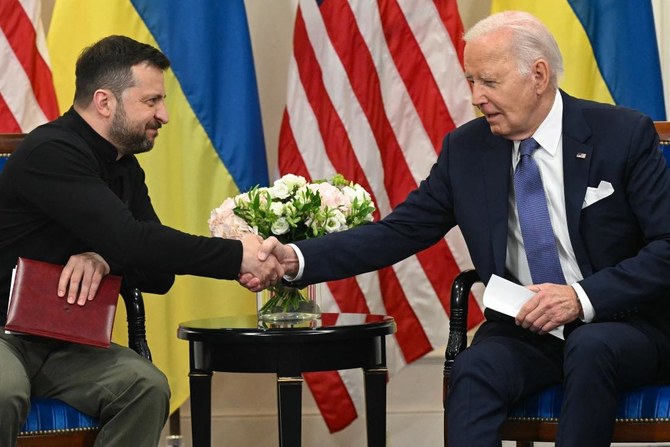
PARIS: US President Joe Biden on Friday for the first time publicly apologized to Ukraine for a monthslong holdup in American military assistance that let Russia make gains on the battlefield, as Ukrainian President Volodymyr Zelensky appealed for bipartisan US support “like it was during World War II.”
Speaking in Paris, where they both attended ceremonies marking the 80th anniversary of the D-Day landings, Biden apologized to the Ukrainian people for the weeks of not knowing if more assistance would come while conservative Republicans in Congress held up a $61 billion military aid package for Ukraine for six months.
Still, the Democratic president insisted that the American people were standing by Ukraine for the long haul. “We’re still in. Completely. Thoroughly,” he said.
Zelensky pressed for all Americans to support his country’s defense against Russia’s invasion, and he thanked lawmakers for eventually coming together to approve the weapons package, which has allowed Ukraine to stem Russian advances in recent weeks.
“It’s very important that in this unity, United States of America, all American people stay with Ukraine like it was during World War II,” Zelensky said. “How the United States helped to save human lives, to save Europe. And we count on your continuing support in standing with us shoulder to shoulder.”
The United States is by far Kyiv’s biggest supplier of wartime support, and Ukraine is trying to fend off an intense Russian offensive in eastern areas of the country. The push is focused on the Ukrainian border regions of Kharkiv and Donetsk, but Ukrainian officials say it could spread as Russia’s bigger army seeks to make its advantage tell.
The offensive is seeking to exploit Kyiv’s shortages of ammunition and troops along the roughly 1,000-kilometer (620-mile) front line.
That shortfall in weaponry came after US military aid was held up in Congress for six months before Biden in April signed the $61 billion package into law.
The slow pace of delivery of pledged Western weaponry has long frustrated Zelensky, as has Biden’s hesitation over supplying more hardware for fear of provoking Russian President Vladimir Putin. That has caused tension in their relationship.
The US will send about $225 million in military aid to Ukraine, US officials said Thursday. The latest package includes munitions for the High Mobility Artillery Rocket System, or HIMARS, as well as mortar systems and an array of artillery rounds, officials said.
Easing their stance amid Russia’s most recent onslaught and with Ukraine’s army reeling, some NATO allies including the US said last week they would allow Ukraine to use weapons they deliver to Kyiv to carry out limited attacks inside Russia.
That step brought a furious response from the Kremlin, which warned that Europe’s biggest conflict since World War II could spin out of control.
Biden and Zelensky attended the anniversary events of D-Day in Normandy, northern France, on Thursday, along with European leaders who have supported Kyiv’s efforts in the war. Biden pledged “we will not walk away” from Ukraine, drawing a direct line from the fight to liberate Europe from Nazi domination to today’s war against Russian aggression.
Ukraine depicts its fight against the Kremlin’s forces as a clash between Western democratic freedom and Russian tyranny. Russia says it is defending itself against a menacing eastward expansion of the NATO military alliance.
In a 20-minute speech Friday at the National Assembly, the lower house of the French parliament, Zelensky drew a parallel with the sacrifices made during World War II and his country’s current fight.
“This battle is a crossroads,” Zelensky said. “A moment where we can now write history the way we need it. Or we can become victims of history as it suits … our enemy.”
Zelensky, who spoke in Ukrainian, was frequently interrupted by lawmakers’ applause and cheers. He prompted a standing ovation when he said in French: “Dear France, I thank you for standing by our side as we defend life.”
French President Emmanuel Macron, meanwhile, announced late Thursday that France will provide Ukraine with its Mirage combat aircraft.
Macron has been a vocal supporter of Ukraine. He said in February that putting Western troops on the ground in Ukraine is not “ruled out.”
Zelensky began a day of meetings in Paris with an official welcome ceremony at the golden-domed Invalides monument, site of Napoleon’s tomb.
During the day, Zelensky was due to visit the Nexter arms manufacturer in Versailles, which makes the Caesar self-propelled howitzers that are among the weapons provided by France to Kyiv’s forces.
He was also to meet with Macron at the Élysée Palace.
Zelensky’s foreign trips aim to keep Ukraine’s plight in the public eye, secure more military help for its fight against Russia’s invasion and lock in long-term Western support through bilateral alliances.
France and Ukraine in February signed a 10-year bilateral security agreement. Zelensky has since signed similar bilateral agreements with many European countries.


![]()

Biden apologizes to Ukraine’s Zelensky for monthslong holdup to weapons that let Russia make gains
Short Url
https://arab.news/pc4xf
Biden apologizes to Ukraine’s Zelensky for monthslong holdup to weapons that let Russia make gains
- Zelensky pressed for all Americans to support his country’s defense against Russia’s invasion
- The United States is by far Kyiv’s biggest supplier of wartime support
Latest updates


© 2026 SAUDI RESEARCH & PUBLISHING COMPANY, All Rights Reserved And subject to Terms of Use Agreement.