

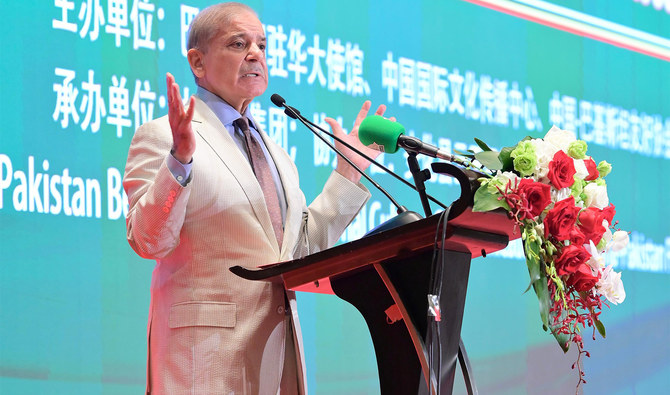

ISLAMABAD: Prime Minister Shehbaz Sharif met high-ranking Chinese aid and trade financing officials on Thursday in Beijing during which both sides explored ways to enhance Pakistan and China’s cooperation in the trade, energy and technology sectors, a statement from his office said.
The Pakistani premier arrived on a five-day trip to China this week and is currently in Beijing, where he arrived after interacting with representatives of Chinese tech companies in Shenzhen on Wednesday. Sharif’s diplomatic engagements are widely viewed as part of his administration’s efforts to enhance and upgrade the China-Pakistan Economic Corridor (CPEC), a flagship of Beijing’s Belt and Road Initiative (BRI), through which Beijing has pledged over $60 billion in Pakistan.
The prime minister’s engagements on Thursday included addressing the Pak-China Friendship and Business reception held in his honor in Beijing and meeting Chinese aid and trade financing officials. He also met the chairman of the PowerChina, a state-owned Chinese construction group to discuss an alternative energy system for Pakistan.
“There is great potential for investment in alternative energy in Pakistan,” Sharif told the Chinese official during a meeting between the two sides, according to the Prime Minister’s Office (PMO).
The Pakistani prime minister also visited the Zhongguancun Science Park in the outskirts of Beijing, which is also known as China’s Silicon Valley. Sharif was briefed on China’s tech start-ups culture and the innovative environment and cutting-edge research taking place in the Science Park, the PMO said.
“The discussions focused on potential collaboration and partnerships in tech start-ups, R&D centers, and digital infrastructure,” the statement said. “The Prime Minister appreciated the scientific and technological advancement in China and highlighted the immense potential for cooperation between Pakistan and China which can boost technological progress and innovation in Pakistan.”
SHARIF ON EMULATING CHINA
Earlier today, the Pakistani prime minister said Islamabad aimed to emulate the Chinese model, focusing on economic cooperation and avoiding conflicts while he spoke at the Pak-China Friendship and Business reception held in his honor in Beijing.
“We will maintain a sharp focus on our industrial and agricultural progress and prosperity and avoid irritations and conflicts, and follow the vision of Chinese President Xi Jinping, who has shown the path not only to the Chinese people but to the world that to make progress is possible by avoiding conflicts and promoting cooperation, avoiding wars and promoting hard work,” Sharif said. “This is what the BRI and CPEC is all about.”
Earlier, the prime minister met with Luo Zhaohui, the chairman of China International Development Cooperation Agency (CIDCA), responsible for Beijing’s strategic planning and foreign aid. He discussed the possibility of further enhancing the strong mutual relations between the two countries in terms of development and security, according to a statement circulated by his office in Islamabad.
The two officials described CPEC as a symbol of friendship between the two countries and discussed its positive outcomes.
“They also expressed confidence that this cooperation will continue in phase II of CPEC to improve the lives and economies of the people of both countries,” the statement said.
Sharif praised Luo, a former Chinese envoy to Pakistan, for strengthening the bilateral relations between both countries.
He said that Pakistan was keen on Chinese investment in the Main Line 1 railway upgrade project.
Additionally, he called for greater cooperation with China in key economic sectors like agriculture, information technology, communications, mining and blue economy.
The CIDCA chairman also noted that his agency was interested in investing in special economic zones and the health sector in Pakistan while emphasizing bilateral cooperation for mutual benefit.
Sharif also met Dr. Wu Fulin, Chairman of China Export-Import Bank (EXIM), and highlighted the reform agenda of his government.
He said these reform measures had already started producing results as food inflation had been successfully tapered along with current account deficit and quantum of public debt.
“As part of efforts to boost Pakistan’s exports to international markets, he also discussed the possible role of the EXIM Bank in financing Pakistan-China joint venture projects and trade financing,” the PM Office said.
The prime minister is also expected to meet the heads of China Power, China Road and Bridge Corporation and China Construction and Communication Corporation later in the day.


