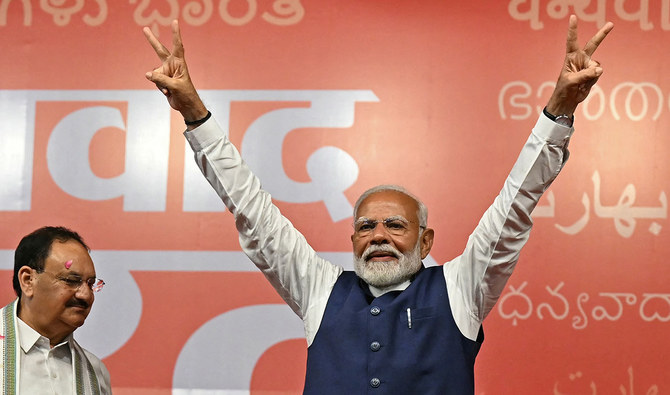

HYDERABAD, India: Indian Prime Minister Narendra Modi is expected to be sworn-in for a record-equalling third term on June 8, after key allies pledged their continued support a day after a humbling election verdict that saw his party lose its majority in parliament.
Modi, a populist who has dominated Indian politics since coming to power in 2014, will for the first time need the support of regional allies whose loyalties have wavered over the years, which could complicate the government’s reform agenda.
On Wednesday, two allies in his National Democratic Alliance coalition, the Telugu Desam Party, a key regional player in the southern state of Andhra Pradesh, and the Janata Dal (United) which rules the northern state of Bihar, pledged their support.
“We are with the NDA, I will be attending the meeting in Delhi today,” Chandrababu Naidu, the leader of the TDP, told reporters, referring to a meeting of the BJP-led alliance scheduled to take place later in the day.
Modi tendered his resignation on Wednesday to President Droupadi Murmu after the federal cabinet met and recommended the dissolution of parliament, the first of many constitutional formalities before Modi can form a new government.
Modi and his new cabinet were scheduled to be sworn-in on Saturday, local media reported.
The NDA won 293 seats in the 543-member lower house of parliament, more than the 272 needed to form a government.
Modi’s BJP won 240 seats on its own, a weakened verdict which could slow India’s fiscal tightening, ratings agency Moody’s said.
Both regional allies, the TDP and JD-(U), are considered pragmatists on economic policy, but Modi’s new government is likely to need to find money to fund more spending on welfare projects in their states.
The weakened majority for Modi’s alliance could pose challenges for the more ambitious elements of the government’s reform agenda, ratings agency Fitch said.
However, it added: “Despite the slimmer majority, we do expect broad policy continuity to persist, with the government retaining its focus on its capex push, ease of doing business measures, and gradual fiscal consolidation.”
The closer-than-expected election should increase the prospect of productive reforms, the country’s chief economic adviser the country’s chief economic adviser said on Wednesday.
RURAL SETBACKS
With the party losing most ground in rural areas, investors say land and labor reforms, that had been expected to unlock value and growth, will probably fall by the wayside.
Newspapers said Modi’s aura had dimmed, with the Indian Express’s banner headline reading: “India gives NDA a third term, Modi a message.”
In the latter stages of the campaign Modi had sought to renew his appeal to India’s Hindu-majority, accusing the opposition of favoring minority Muslims.
But without a majority of its own, some policies of his Hindu-nationalist BJP, such as a uniform civil code for all religions that was opposed by some Muslims, will likely be put on the back burner, with Modi’s regional allies seen as more accommodating toward minorities.
The BJP lost heavily in the two states that send the most lawmakers to parliament, its northern stronghold of Uttar Pradesh, which has 80 seats, and the western state of Maharashtra, which sends 48 members to the decision-making lower house.
In Uttar Pradesh, the party lost nearly half its seats, down to 33 from its 2019 tally of 62, while in Maharashtra, India’s richest state that includes financial powerhouse Mumbai, it slumped to a dismal nine seats from its previous tally of 23.
Modi’s own victory in his seat of Varanasi, located in Uttar Pradesh and considered one of the holiest cities for Hindus, was subdued, with his margin of victory down from nearly 500,000 votes at the last general election in 2019 to a little more than 150,000.
But this reduced victory may not necessarily mean reform paralysis, the chairman of a government finance panel, Arvind Panagariya, said in an editorial in the Economic Times newspaper.
“Despite the reduced majority in parliament, the necessary reforms are entirely feasible. Delivering sustained growth at a accelerated pace can only strengthen the government’s hand in the coming years,” he said.
The opposition INDIA alliance led by Rahul Gandhi’s centrist Congress party won 230 seats, more than forecast. Congress alone won 99, almost double the 52 it won in 2019 — a surprise jump that is expected to boost Gandhi’s standing.
The INDIA alliance was also expected to meet on Wednesday in New Delhi, and discuss a future course of action.